
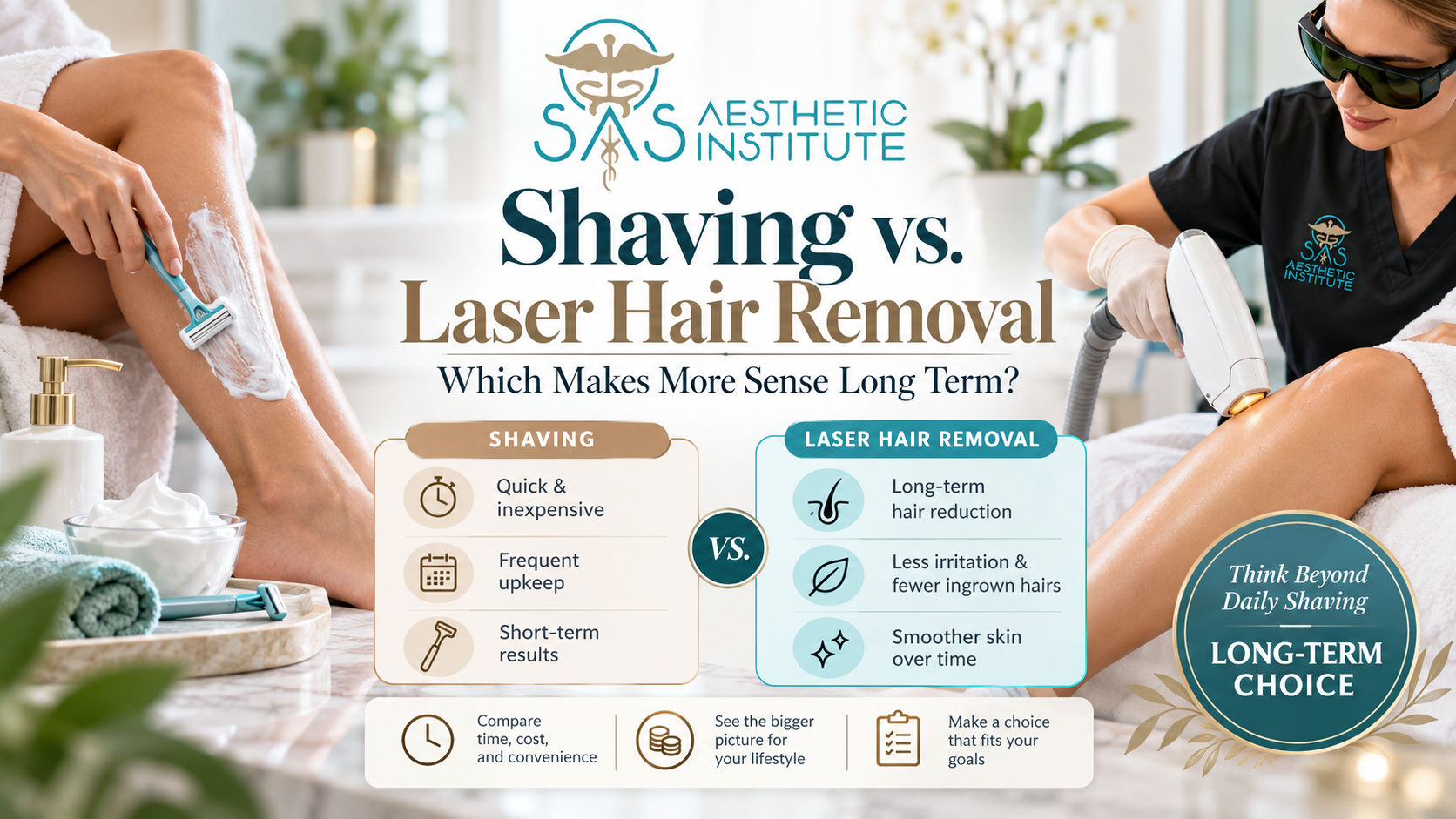
Shaving can seem simple.
Pick up a razor, spend a few minutes removing unwanted hair, and continue with your day.
But when shaving becomes something you repeat every few days—or even every day—the time, irritation, stubble and constant maintenance can become frustrating.
That is usually when people start comparing shaving with laser hair removal.
The two methods have very different goals.
Shaving removes hair that has already grown above the surface of the skin.
Laser hair removal is designed to reduce future hair growth by targeting pigment within the hair follicle.
That means this is not simply a comparison between two different ways of removing the same hair.
It is a comparison between:
repeated temporary removal
and
a treatment series designed for longer-term hair reduction.
At SAS Aesthetic Institute in Mokena, Dr. Michael Romberg, MD, takes a physician-guided approach to laser hair removal. The treatment area, skin characteristics, hair color, hair thickness and individual goals are considered before a treatment plan is recommended.
What Is the Biggest Difference Between Shaving and Laser Hair Removal?
The biggest difference is where each method works.
Shaving cuts the visible portion of the hair near the skin’s surface.
It does not change the follicle that produces the hair.
That follicle remains capable of producing another hair.
This is why shaved hair eventually becomes visible again.
Laser hair removal takes a different approach.
The laser delivers controlled energy that is absorbed by pigment within the hair. That energy is directed toward structures in the follicle involved in future hair production.
The goal is long-term reduction of unwanted hair, not simply cutting down the hair that is visible today.
| Shaving | Laser Hair Removal |
|---|---|
| Removes visible hair temporarily | Targets the follicle for long-term hair reduction |
| Must be repeated regularly | Performed as a treatment series |
| Works immediately on surface hair | Reduction develops progressively |
| Does not depend heavily on hair pigment | Hair pigment affects treatment response |
| Can cause cuts or razor irritation | May cause temporary treatment-area redness |
| Requires ongoing home maintenance | Can reduce long-term grooming needs |
| Hair regrows because the follicle remains intact | Treated follicles may produce less hair over time |
Neither method is automatically right for everyone.
The better choice depends on your priorities.
Does Shaving Make Hair Grow Back Thicker?
No.
Shaving does not change the actual thickness of the hair follicle.
What changes is the shape of the hair after it is cut.
An untreated hair naturally becomes narrower toward the end.
A razor cuts across the hair shaft, leaving a blunt edge.
When that hair begins growing back, the blunt end can:
- Feel rougher
- Look darker
- Feel thicker to the touch
- Create noticeable stubble
That can make it seem as though shaving caused thicker hair.
It did not change the underlying follicle.
Why Does Hair Come Back So Quickly After Shaving?
Because shaving never removes or disables the follicle.
It only cuts the part of the hair that extends above the skin.
The follicle remains beneath the surface and continues producing hair.
How quickly stubble becomes noticeable depends on several factors, including:
- Treatment area
- Individual growth rate
- Hair thickness
- Hair color
- Hormonal influences
- How close the shave was
Hair on one area of the body may seem to return much faster than hair on another.
Someone may shave their legs every several days but notice facial or underarm stubble much sooner.
How Long Does Shaving Last?
There is no universal timeline.
Some people notice regrowth within a day.
Others may go several days before hair becomes bothersome again.
The important distinction is that shaving does not reduce the follicle’s ability to produce new hair.
As long as you want the area to remain smooth, shaving usually remains part of the routine.
Is Laser Hair Removal Permanent?
Laser hair removal is better described as long-term hair reduction rather than promising that every treated hair will permanently disappear forever.
Hair growth can change over time.
Factors that may influence future growth include:
- Hormonal changes
- Age
- Treatment area
- Hair characteristics
- Individual response
- Medical conditions
- Medications
Some patients may eventually benefit from occasional maintenance treatments.
The goal is to significantly reduce the amount and density of unwanted hair so that routine hair removal becomes less frequent and less burdensome.
Why Does Laser Hair Removal Require Multiple Treatments?
Hair does not all grow at exactly the same time.
Individual follicles move through different stages of a growth cycle.
Laser treatment is most useful when the hair and follicle are in an appropriate stage for the energy to reach its intended target.
During one treatment, not every follicle in the area will be at that stage.
That is why laser hair removal is performed as a series of treatments rather than relying on a single appointment.
Over the course of treatment, different groups of hairs become available to target.
If you want a deeper explanation of treatment series and timing, read How Many Laser Hair Removal Sessions Do You Actually Need?.
Which Is More Convenient: Shaving or Laser Hair Removal?
For a one-time situation, shaving is usually more convenient.
If you suddenly decide you want smooth legs tonight, a razor provides an immediate result.
The long-term calculation is different.
Consider someone who shaves several times every week.
That routine may include:
- Getting the razor
- Applying shaving cream
- Shaving
- Rinsing
- Treating small cuts
- Moisturizing irritated skin
- Repeating everything a few days later
Now multiply that over:
- One month
- One year
- Five years
- Ten years
For patients who already know they dislike maintaining unwanted hair, laser hair removal may reduce the amount of time devoted to repetitive grooming.
Which Takes More Time Long Term?
Shaving takes small amounts of time repeatedly.
Laser hair removal takes larger blocks of time during a treatment series but may substantially reduce future maintenance.
That means the answer depends on the period you are measuring.
Over One Week
Shaving may seem easier.
Over Several Months
Repeated shaving can start adding up.
Over Several Years
The difference in routine maintenance can become much more noticeable.
This is one reason people often pursue laser hair removal not simply because they dislike hair, but because they dislike managing the same hair over and over again.
Is Laser Hair Removal More Expensive Than Shaving?
Laser hair removal requires a larger upfront investment.
Shaving spreads the cost across years.
When comparing the two, it helps to think beyond the price of one razor.
Long-term shaving expenses may include:
- Disposable razors
- Replacement cartridges
- Shaving cream
- Aftershave products
- Exfoliating products
- Products for razor irritation
- Products used for ingrown hairs
The exact financial comparison depends on:
- How often you shave
- Which products you buy
- How many areas you shave
- How many laser sessions you need
- Whether maintenance treatments are eventually needed
For some people, the main reason for choosing laser is not financial at all.
It is convenience.
Which Is Better for Razor Bumps?
For someone who repeatedly develops razor bumps, simply shaving more carefully may not fully solve the problem.
Razor bumps can develop when cut hairs curve or grow back into the skin.
This can lead to:
- Small inflamed bumps
- Redness
- Tenderness
- Dark marks
- Repeated irritation
Areas with coarse or curly hair can be particularly prone to this problem.
Because shaving keeps producing freshly cut hairs, some patients become stuck in a cycle:
shave → irritation → regrowth → ingrown hair → shave again
Laser hair removal may be worth considering when unwanted hair and recurring shaving-related irritation are both concerns.
Can Laser Hair Removal Help With Ingrown Hairs?
Reducing the amount of hair growing in an area can also reduce the number of hairs available to become ingrown.
That makes laser hair removal particularly appealing for patients who repeatedly deal with ingrown hairs on areas such as:
- Bikini line
- Neck
- Chin
- Underarms
- Legs
- Chest
However, not every bump after shaving is necessarily an ingrown hair.
Persistent inflammation should be evaluated rather than automatically assuming shaving is the only cause.
Which Is Better for Sensitive Skin?
That depends on what is irritating the skin.
For some patients, shaving itself is the problem.
Repeated razor contact may create:
- Burning
- Redness
- Small cuts
- Dryness
- Razor bumps
- Stinging
Other patients tolerate shaving very well.
Laser treatment also temporarily affects the skin, and mild redness or sensitivity can occur after treatment.
The difference is that shaving irritation may happen repeatedly for as long as shaving continues, while laser treatment is performed according to a planned treatment schedule.
Skin characteristics should be considered when determining whether laser treatment is appropriate.
What Areas Can Be Treated With Laser Hair Removal?
Diode laser hair removal can be used for many areas of unwanted facial and body hair.
Common areas include:
- Upper lip
- Chin
- Jawline
- Neck
- Underarms
- Arms
- Legs
- Bikini line
- Brazilian area
- Chest
- Abdomen
- Shoulders
- Back
Not every area requires the same treatment plan.
The density and character of the hair can differ significantly between the upper lip, legs and back.
Learn more about the actual treatment offered at SAS on our Laser Hair Removal in Mokena page.
Does Laser Hair Removal Work the Same on Every Hair?
No.
Hair characteristics matter.
Laser hair removal relies on pigment within the hair to absorb laser energy.
That means darker pigmented hair generally provides a clearer target than hair containing very little pigment.
Hair thickness can also affect response.
This is why consultation matters.
A patient should not automatically assume that every visible hair will respond identically.
What About Blonde, Gray or Very Light Hair?
Hair with very little pigment provides less of the target used by laser hair removal.
This can make very light, white or gray hairs less responsive.
The effectiveness of treatment therefore depends partly on the contrast and characteristics of the hair being treated.
This is different from shaving.
A razor can cut almost any visible hair regardless of pigment because it works mechanically rather than relying on light absorption.
Does Skin Tone Matter With Laser Hair Removal?
Yes.
Melanin is present not only in hair but also in skin.
That means skin tone must be considered when choosing treatment parameters.
Modern diode laser systems can be used across a broad range of skin types when the equipment and settings are appropriate.
At SAS Aesthetic Institute, treatment is individualized rather than applying identical settings to everyone.
For a deeper explanation of the technology, visit our Diode Laser Hair Removal Technology page.
Is Shaving Required Before Laser Hair Removal?
Patients are commonly asked to shave the treatment area according to the instructions provided before their appointment.
That may seem confusing:
Why would you shave before a treatment designed to reduce shaving?
The reason is that the laser needs the follicle available beneath the skin while unnecessary surface hair is minimized.
This allows treatment to target pigment associated with the hair follicle rather than simply heating a long hair extending above the skin.
Preparation instructions should be followed based on the treatment plan SAS provides.
Why Is Shaving Allowed but Waxing Usually Avoided Before Laser?
The methods affect the follicle differently.
Shaving
Shaving cuts hair near the skin’s surface.
The follicle and hair structure beneath the skin remain available.
Waxing
Waxing removes the hair from the follicle.
That can remove the pigment-containing structure the laser needs to target effectively.
The same concern applies to methods such as tweezing that remove hair from the follicle.
This is why shaving is often used between laser sessions while waxing or tweezing is avoided.
Can You Keep Shaving Between Laser Sessions?
Generally, yes, when needed and when the skin is not irritated.
As treatment progresses, many patients notice they do not need to shave as often.
The amount of regrowth may decrease progressively rather than disappearing immediately after the first treatment.
This is another difference between shaving and laser treatment:
Shaving gives an immediate surface result but does not change future growth.
Laser treatment produces progressive reduction across a treatment series.
Does Laser Hair Removal Hurt More Than Shaving?
The sensations are completely different.
Shaving itself may not hurt when everything goes smoothly, although cuts, irritation and razor burn certainly can.
Laser hair removal may create brief sensations of:
- Heat
- Tingling
- Snapping
- Warmth
The sensation varies depending on:
- Treatment area
- Hair density
- Skin characteristics
- Individual sensitivity
- Treatment settings
Treatment comfort can therefore differ considerably from patient to patient.
Which Is Better for Facial Hair?
That depends largely on the cause and characteristics of the hair.
Facial hair can be influenced by:
- Genetics
- Hormones
- Age
- Medications
- Individual hair patterns
Some facial hair may respond well to laser treatment when there is adequate pigment in the hair.
However, hormonally influenced facial hair may behave differently from leg or underarm hair.
A consultation is particularly valuable when unwanted facial hair has:
- Appeared suddenly
- Increased substantially
- Become coarser
- Changed alongside other symptoms
Removing visible hair and understanding why hair growth changed are two different questions.
Can Hormonal Hair Growth Return After Laser Treatment?
It can.
Laser treatment targets existing follicles that contain appropriate hair targets.
It does not stop future hormonal changes inside the body.
If hormonal activity later stimulates new or previously inactive follicles, new hair may become visible.
That does not mean every treated follicle has returned to its original state.
It means human hair growth can change over time.
This is one reason some patients may eventually need maintenance treatment.
Which Is Better for Underarms?
Underarms are a common area where the long-term difference becomes easy to understand.
Someone who shaves regularly may deal with:
- Visible stubble
- Razor irritation
- Ingrown hairs
- Frequent maintenance
- Dark appearance from hair beneath the surface
Laser hair removal may reduce hair density progressively, decreasing how much ongoing shaving is needed.
Whether it makes sense depends on the hair characteristics and the patient’s goals.
Which Is Better for the Bikini Area?
The bikini area is another common location where repetitive shaving can become frustrating.
Frequent concerns include:
- Razor bumps
- Ingrown hairs
- Redness
- Stubble
- Irritation from clothing
- Repeated grooming before vacations or events
Laser hair removal may provide a longer-term alternative for appropriate candidates who no longer want shaving or waxing to be a constant part of their routine.
What About Legs?
Legs are a large treatment area.
That means shaving can take more time than shaving a small area such as the underarms.
A patient who shaves both legs every several days may spend a substantial amount of time on the process over many years.
Laser hair removal requires scheduled treatment sessions but may significantly decrease future hair-maintenance needs.
What About the Back and Chest?
Back hair creates a practical problem that facial or leg hair may not:
It can be difficult to reach.
Some people depend on another person, electric grooming equipment or professional waxing to maintain the area.
Laser hair removal can be useful for patients seeking long-term reduction across larger body areas such as:
- Back
- Shoulders
- Chest
- Abdomen
Hair density and treatment time should be considered during consultation.
Is Laser Hair Removal Only for Women?
No.
Unwanted hair affects men and women.
Men commonly pursue laser hair reduction for areas such as:
- Back
- Shoulders
- Chest
- Abdomen
- Neck
- Beard-line areas
The goal may be complete reduction in one area and simply reducing excessive density in another.
Laser treatment does not have to mean removing every hair.
Treatment goals can be individualized.
What If You Actually Like Shaving?
Then there may be no reason to change.
Laser hair removal is not something everyone needs.
Shaving may remain the better choice if:
- You shave infrequently
- Your skin tolerates shaving well
- The hair does not bother you very much
- You want complete flexibility
- You do not want a treatment series
- The hair characteristics are not ideal for laser treatment
A good aesthetic treatment decision should solve an actual problem.
If shaving is not a problem for you, there may be nothing to solve.
Who May Benefit Most From Considering Laser Hair Removal?
Laser hair removal may make more sense for someone who thinks:
- “I am tired of shaving constantly.”
- “I always have stubble.”
- “Shaving irritates my skin.”
- “I keep getting razor bumps.”
- “I keep getting ingrown hairs.”
- “I spend too much time managing body hair.”
- “Waxing appointments are becoming repetitive.”
- “I want longer-term reduction rather than temporary removal.”
That is different from simply asking whether laser treatment exists.
The real question is whether repetitive hair removal has become enough of a burden that a longer-term strategy makes sense.
Shaving vs. Laser Hair Removal: Which Is Better for Cost?
There is no universal winner because the comparison depends on how you currently manage hair.
Someone who uses inexpensive razors once a week has a very different long-term cost from someone who:
- Buys premium razor cartridges
- Shaves multiple large areas
- Uses specialized shaving products
- Treats recurrent irritation
- Switches between shaving and waxing
Laser treatment requires an upfront treatment plan.
Shaving spreads expenses across time.
The better comparison is therefore not:
“Which is cheaper today?”
but:
“What am I willing to spend in time, money and maintenance over the next several years?”
Shaving vs. Laser Hair Removal: Which Is Better for Results?
The results are different because the goals are different.
Shaving Gives You:
- Immediate removal of visible surface hair
- Complete control over when you shave
- No treatment series
- Regrowth because the follicle remains active
Laser Hair Removal Is Designed to Give You:
- Progressive reduction of unwanted hair
- Less repeated shaving
- Reduced hair density over time
- A longer-term approach
- Potential maintenance depending on future growth
Laser should not be judged after one session using the same expectations as shaving.
One creates an immediate temporary result.
The other is a progressive treatment.
Why a Consultation Matters Before Choosing Laser Hair Removal
Not every patient is an identical candidate.
Before treatment, several factors should be considered:
- Hair color
- Hair thickness
- Skin tone
- Treatment area
- Hair density
- Medical history
- Medications
- Hormonal factors
- Previous hair-removal methods
- Treatment expectations
This is particularly important because laser hair removal depends on the interaction between laser energy, hair pigment and skin.
At SAS Aesthetic Institute, diode laser hair removal is approached as a personalized treatment rather than a one-setting-fits-everyone service.
Frequently Asked Questions About Shaving vs. Laser Hair Removal
Is laser hair removal better than shaving?
It depends on your goals. Shaving provides quick temporary removal. Laser hair removal is designed for progressive, long-term hair reduction.
Does laser hair removal mean I will never shave again?
Not necessarily. Results vary, and some patients may have residual or future hair growth that they occasionally shave or treat with maintenance sessions.
Does shaving before laser make the hair thicker?
No. Shaving changes the blunt shape of the hair above the skin but does not make the follicle thicker.
Why can I shave before laser but not wax?
Shaving leaves the follicle available beneath the skin. Waxing removes the hair from the follicle, which removes the target the laser needs.
Can laser hair removal reduce razor bumps?
Reducing hair growth can reduce the amount of repeated shaving and may decrease the opportunity for hairs to become ingrown.
Does laser hair removal work on all hair colors?
No. Hair pigment matters because the laser relies on pigment within the hair to absorb energy. Very light, white or gray hair may respond poorly.
Can laser hair removal work on darker skin tones?
Diode laser systems can be used across a range of skin types when the technology and treatment settings are appropriate. Skin tone should be evaluated before treatment.
Which is better for ingrown hairs?
Patients who repeatedly develop ingrown hairs from shaving may benefit from reducing the amount of hair growing in the area.
Is laser hair removal worth it for a small area?
It can be. Small areas such as the chin, upper lip or underarms may require frequent maintenance despite their size.
Is laser hair removal worth it for large areas?
For patients who regularly shave large areas such as the legs, chest or back, reducing repeated maintenance may be particularly valuable.
Will hair come back after laser treatment?
Some hair may remain or return over time. Hormonal changes and other factors can influence future growth. Laser is best understood as long-term hair reduction.
How many laser hair removal sessions do I need?
The number varies according to the area, hair characteristics, growth cycle and individual response. A treatment plan should be customized rather than assuming the same number for everyone.
Can men get laser hair removal?
Yes. Common treatment areas for men include the back, chest, shoulders, abdomen and neck.
Can I continue shaving between treatments?
Shaving is commonly used between treatments when needed, provided the skin is not irritated and your treatment instructions allow it.
Does laser hair removal take longer than shaving?
One shaving session is faster than completing a laser treatment series. The difference is that shaving must continue indefinitely while laser treatment is designed to reduce future hair growth.
The Long-Term Question Is Really About Maintenance
Shaving and laser hair removal can both remove the appearance of unwanted hair.
But they do not solve the same problem.
Shaving answers:
“How do I remove the hair I can see today?”
Laser hair removal asks:
“How can I reduce the amount of hair I have to manage in the future?”
For someone who shaves occasionally and does not mind doing it, shaving may remain completely reasonable.
For someone who is tired of constant stubble, razor irritation, ingrown hairs or repetitive grooming, a longer-term approach may make more sense.
At SAS Aesthetic Institute, Dr. Michael Romberg, MD, provides physician-guided treatment planning based on the patient’s skin, hair characteristics and goals.
Learn more about Laser Hair Removal in Mokena or explore the Diode Laser Hair Removal Technology used at SAS Aesthetic Institute.
SAS Aesthetic Institute
19657 South La Grange Road, Mokena, IL 60448
(708) 476-8205

Michael S. Romberg, MD
Dr. Michael S. Romberg is a Board Certified General Surgeon with more than 32 years of experience. His medical expertise includes general and oncologic surgery, wound care, burn care, lymphedema care, and Hyperbaric Oxygen Therapy. He is also an experienced national and international speaker for healthcare professionals and patients.