You shave because you want smoother skin.
Then a day or two later, small red bumps appear.
Some itch.
Some hurt.
Some look like pimples.
Others develop a dark center where a hair appears trapped beneath the skin.
Then the hair grows back, you shave again, and the same cycle starts over.
For some people, razor bumps are an occasional inconvenience.
For others, they become a recurring problem on the neck, chin, bikini line, underarms, legs or other frequently shaved areas.
The reason is not necessarily that you are shaving incorrectly.
Often, the problem involves how the cut hair grows back through—or into—the skin.
At SAS Aesthetic Institute in Mokena, Dr. Michael Romberg, MD, evaluates unwanted hair, repeated shaving irritation, ingrown hairs and skin characteristics when determining whether a longer-term hair reduction strategy may make sense.
What Are Razor Bumps?
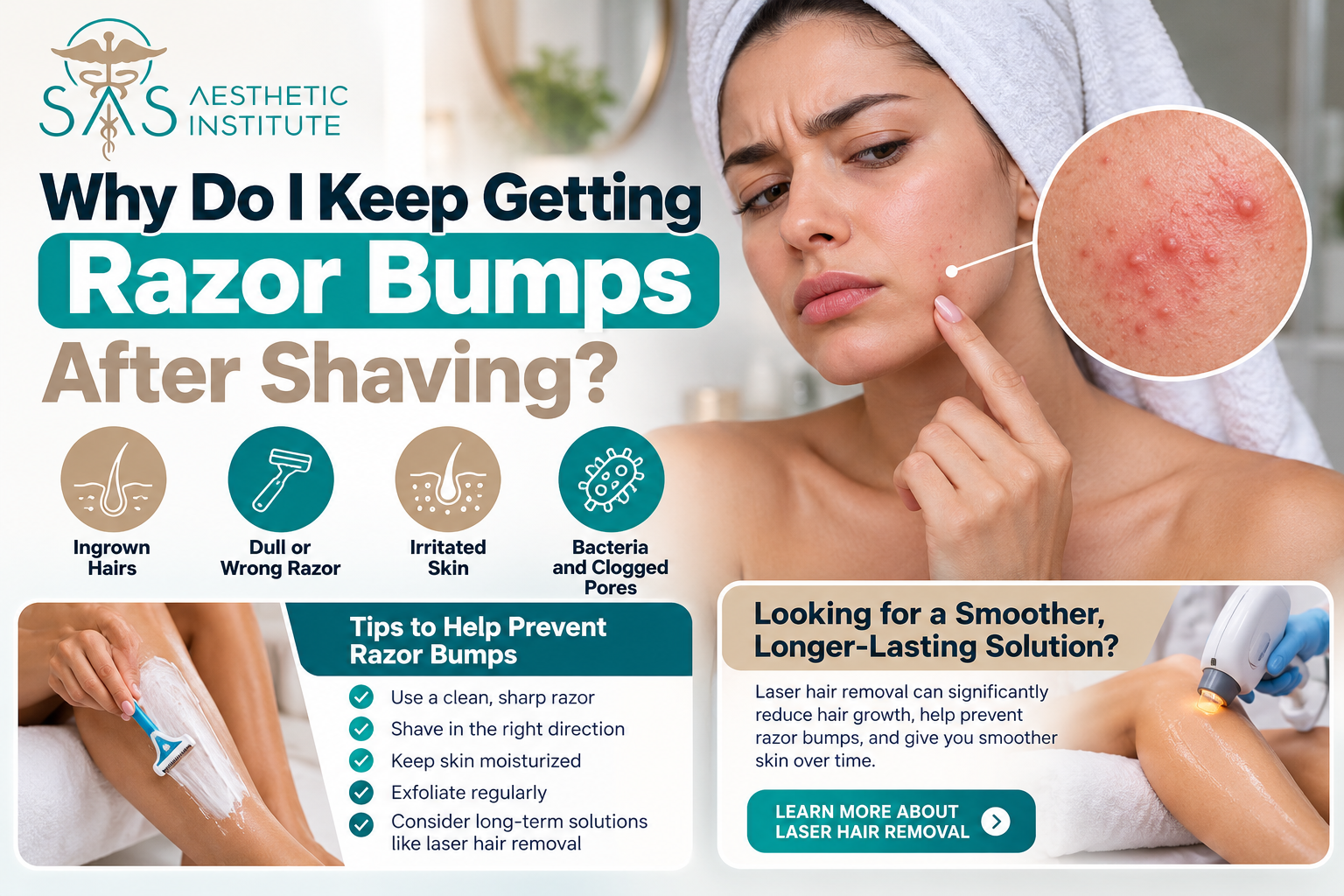
Razor bumps are inflamed bumps that can develop when shaved hairs curve back toward the skin or become trapped as they grow.
Instead of growing cleanly outward, a cut hair may:
- Curve back into the skin
- Grow sideways beneath the surface
- Become trapped by surrounding skin
- Irritate the follicle as it grows
The body can react to the trapped hair with inflammation.
That may create a bump that looks red, swollen or similar to a pimple.
Some bumps contain a visible hair.
Others do not.
Are Razor Bumps the Same as Razor Burn?
No.
The two problems can happen together, but they are different.
Razor Burn
Razor burn is primarily surface irritation caused by shaving.
It may cause:
- Redness
- Burning
- Stinging
- Tenderness
- Dryness
- General irritation
It often develops shortly after shaving.
Razor Bumps
Razor bumps are more closely associated with hairs growing back into or beneath the skin.
They may develop later as the cut hair begins to regrow.
A person can have razor burn immediately after shaving and then develop razor bumps several days later.
Are Razor Bumps the Same as Ingrown Hairs?
They are closely related.
An ingrown hair is a hair that grows into or becomes trapped beneath the skin rather than emerging normally.
That ingrown hair can trigger inflammation and create what people often call a razor bump.
Not every shaving bump is necessarily an ingrown hair, though.
Inflammation can also be caused by:
- Friction
- Skin irritation
- Follicular inflammation
- Small shaving injuries
This is why persistent bumps should not automatically be treated as acne.
Why Does Shaving Cause Razor Bumps?
Shaving cuts the hair near the surface of the skin.
The follicle beneath the surface remains active.
As that hair begins growing again, the cut end has to make its way back through the skin.
Problems can occur when the hair:
- Curves toward the skin
- Has difficulty emerging from the follicle opening
- Gets trapped beneath dead skin
- Is cut extremely close to the surface
- Grows sideways instead of outward
The result can be repeated inflammation around the follicle.
Why Do I Get Razor Bumps Every Time I Shave?
If razor bumps return every time you shave, there may be several factors working together.
These can include:
- Curly or coarse hair
- Very close shaving
- Shaving against the direction of growth
- Repeated passes over the same skin
- A dull razor
- Friction
- Skin irritation
- Tight clothing after shaving
- Frequently shaving the same area
The hair itself may also naturally be more likely to curve back toward the skin.
In that situation, improving shaving technique may help—but it may not completely eliminate the problem.
Why Does Curly Hair Cause More Ingrown Hairs?
Curly hair does not always grow straight outward from the follicle.
After shaving, the shortened hair can curve.
If the curved tip turns toward the surrounding skin, it may re-enter the skin instead of continuing outward.
This can cause:
- Redness
- Swelling
- Tenderness
- Itching
- Dark marks
- Small inflamed bumps
This is why some patients can shave carefully and still repeatedly develop razor bumps.
The problem may involve the natural growth pattern of the hair.
Can Coarse Hair Cause More Razor Bumps?
It can.
Thicker hairs may create more noticeable irritation when they become trapped or curve back into the skin.
Coarse stubble can also feel much more prominent during regrowth.
This is particularly common in areas such as:
- Beard and neck
- Bikini line
- Underarms
- Chest
Patients may then shave more frequently because the regrowth feels rough, creating an ongoing cycle of shaving and inflammation.
Why Are Razor Bumps Common on the Neck?
The neck can be especially difficult to shave.
Hair in this area may grow in several directions.
One section may grow downward.
Another may grow sideways.
Another may angle upward.
That makes it easy to accidentally shave against the natural direction of growth.
The neck is also exposed to:
- Shirt collars
- Sweat
- Friction
- Repeated shaving
For some men, the result is chronic irritation along the beard line and neck.
Why Are Razor Bumps Common on the Bikini Line?
The bikini area combines several factors that can encourage ingrown hairs.
These include:
- Coarser hair
- Curved hair growth
- Close shaving
- Friction from underwear
- Tight clothing
- Heat
- Sweat
After shaving, the newly cut hair begins regrowing in an area that is frequently covered and exposed to friction.
This can make recurring bumps especially frustrating.
Can Razor Bumps Happen on the Underarms?
Yes.
Underarm hair can be coarse, and the area is exposed to:
- Repeated shaving
- Sweat
- Deodorant
- Skin-on-skin friction
- Tight clothing
If shaving produces repeated irritation, patients may notice:
- Red bumps
- Ingrown hairs
- Tenderness
- Dark marks
- Persistent uneven-looking skin
Can You Get Razor Bumps on Your Legs?
Yes.
Legs can develop razor bumps, particularly when the hair is shaved very closely or the skin becomes irritated.
The risk may increase when:
- A dull razor is used
- The skin is dry
- Several passes are made
- Shaving occurs against hair growth
- Tight clothing is worn immediately afterward
Some patients also notice more ingrown hairs around the thighs or other areas where clothing creates friction.
Does Shaving Against the Grain Cause Razor Bumps?
It can increase the likelihood.
Shaving against the natural direction of hair growth can create a closer shave.
That sounds desirable.
But the closer cut may leave the hair tip below or very near the skin surface.
As it begins growing again, the hair may have more difficulty emerging normally.
For patients who are already prone to ingrown hairs, the extra-close shave may lead to more bumps.
Does Shaving Too Close Cause Ingrown Hairs?
It can.
A very close shave leaves little hair extending above the skin.
If the hair naturally curves during regrowth, it can become trapped more easily.
This creates a frustrating trade-off:
The closer the shave, the smoother the immediate result.
But in someone prone to razor bumps, that extremely close result may contribute to more problems during regrowth.
Can a Dull Razor Cause Razor Bumps?
A dull blade can contribute to irritation.
Instead of cutting cleanly, a worn razor may:
- Pull at hairs
- Require more passes
- Create additional friction
- Irritate the skin
Repeatedly going over the same area increases the amount of mechanical irritation.
Changing the blade regularly may help reduce this component of the problem.
Is a Multi-Blade Razor Better for Razor Bumps?
Not necessarily.
Multi-blade razors can provide a very close shave.
For someone who does not develop ingrown hairs, that may be completely acceptable.
For someone who repeatedly develops razor bumps, an extremely close shave may sometimes contribute to the problem.
The best shaving method depends on how the individual’s hair and skin respond.
Does Dry Shaving Cause More Irritation?
It can.
Shaving dry skin creates more friction between the razor and the skin surface.
Using an appropriate shaving product can help the razor move more smoothly.
Warm water before shaving may also help soften the hair.
The goal is to reduce unnecessary friction while cutting the hair.
Should You Exfoliate to Prevent Razor Bumps?
Gentle exfoliation can sometimes help reduce buildup around follicle openings.
But aggressive exfoliation can create a different problem.
If the skin is already inflamed, excessive:
- Scrubbing
- Acids
- Brushes
- Exfoliating gloves
- Peels
can make the area more irritated.
More exfoliation is not automatically better.
A razor-bump routine should reduce inflammation rather than repeatedly injuring the skin.
Should You Pop Razor Bumps?
No.
Razor bumps can look like pimples, which makes them tempting to squeeze.
But squeezing may create additional inflammation and damage.
That can lead to:
- Longer healing time
- Increased redness
- Dark marks
- Skin injury
- Scarring
If a hair is visibly trapped beneath the skin, repeatedly digging into the area with fingers or sharp tools can make the problem significantly worse.
Why Do Razor Bumps Leave Dark Spots?
Inflamed razor bumps can trigger post-inflammatory pigmentation.
After the bump heals, a flat brown, gray or darker area may remain.
Repeated shaving can create a cycle:
shaving → ingrown hair → inflammation → dark mark → new shaving → another bump
Over time, the patient may have relatively few active bumps but many leftover dark marks.
This is why recurrent ingrown hairs can become both a hair-removal problem and a skin-tone concern.
Can Razor Bumps Cause Scars?
Repeated inflammation and picking can lead to lasting skin changes.
The risk becomes greater when bumps are:
- Deep
- Frequently manipulated
- Repeatedly inflamed
- Infected
- Occurring in the same areas
This is another reason chronic razor bumps deserve more attention than simply shaving over them again.
Why Do My Razor Bumps Look Like Acne?
Both conditions can produce red inflamed bumps.
But they form for different reasons.
Acne
Acne involves clogged follicles, oil production and inflammation.
Razor Bumps
Razor bumps are associated with hair regrowing into or irritating the surrounding skin.
Location and timing can provide clues.
If bumps repeatedly develop several days after shaving in exactly the shaved area, hair regrowth may be part of the problem.
Can I Have Acne and Razor Bumps at the Same Time?
Yes.
This can make facial or body bumps difficult to understand.
For example, someone may have:
- Facial acne
- Ingrown beard hairs
- Razor irritation
- Post-inflammatory dark marks
all at the same time.
Treating every bump as acne may not solve the shaving-related component.
Likewise, assuming every bump is an ingrown hair can miss true acne.
Why Do Razor Bumps Keep Coming Back Even When I Change Razors?
Changing razors may help if a dull blade was contributing to irritation.
But the razor itself may not be the entire problem.
If the natural hair pattern encourages hairs to curve back toward the skin, bumps may continue.
The same is true when the person must keep shaving frequently.
Each new shave starts another regrowth cycle.
This is where the question shifts from:
“Which razor should I buy?”
to:
“Would reducing the amount of hair growing in this area reduce the problem?”
Can You Stop Razor Bumps Without Stopping Shaving?
Sometimes the frequency and severity can be reduced.
Helpful changes may include:
- Using a clean, sharp razor
- Avoiding excessive pressure
- Shaving with the direction of hair growth
- Limiting repeated passes
- Using appropriate shaving lubrication
- Avoiding aggressive scrubbing afterward
- Avoiding immediate friction from tight clothing
- Allowing irritated skin time to recover
However, patients whose bumps are strongly related to the natural curl and regrowth pattern of the hair may still experience recurrence.
Is Waxing Better Than Shaving for Razor Bumps?
Waxing removes hair from the follicle rather than cutting it at the surface.
That eliminates immediate razor friction.
But waxing can still be associated with:
- Ingrown hairs
- Follicular irritation
- Redness
- Repeated maintenance
So switching from shaving to waxing does not guarantee that recurring ingrown hairs will disappear.
Both are temporary hair-removal methods.
Can Laser Hair Removal Help Reduce Razor Bumps?
For appropriate candidates, reducing the amount of hair growing in an area may reduce the number of hairs available to become ingrown.
This is one reason patients with chronic shaving irritation may consider laser hair removal.
Instead of repeatedly cutting the hair and waiting for it to regrow, diode laser technology targets pigment within the hair follicle as part of a treatment series designed for long-term hair reduction.
As hair density decreases, patients may experience less need for frequent shaving.
That may be particularly useful for areas prone to repetitive razor bumps.
How Does Laser Hair Removal Help With Ingrown Hairs?
Laser hair removal approaches the problem differently from topical products or shaving changes.
A topical routine tries to manage the skin around the hair.
A shaving adjustment changes how the hair is cut.
Laser hair removal aims to reduce future hair growth from treated follicles.
If fewer coarse hairs are repeatedly growing through the area, there may be fewer opportunities for those hairs to become trapped beneath the skin.
The goal is not simply to calm today’s razor bump.
It is to reduce the amount of recurring hair growth that contributes to the cycle.
Which Razor-Bump Areas Can Be Treated With Laser Hair Removal?
Common areas where unwanted hair and ingrown hairs may overlap include:
- Neck
- Beard-line areas
- Chin
- Jawline
- Underarms
- Bikini line
- Brazilian area
- Legs
- Chest
- Abdomen
- Back
Whether laser is appropriate depends on the hair and skin characteristics rather than the location alone.
Learn more about Laser Hair Removal in Mokena.
Can Men Get Laser Hair Removal for Neck Razor Bumps?
Yes, selected beard and neck areas can be considered for laser hair reduction.
Not every man wants to remove an entire beard.
Some may simply want to reduce hair in areas where shaving repeatedly creates irritation.
Potential treatment goals may include:
- Cleaning up the lower neck
- Reducing unwanted hair below the beard line
- Decreasing density in irritation-prone areas
- Reducing frequent shaving
The treatment pattern can be individualized.
Can Laser Hair Removal Help Bikini-Line Razor Bumps?
The bikini line is a common area where patients become tired of repeated shaving and ingrown hairs.
Laser hair removal may be considered when the goal is to reduce recurring hair growth and the need for frequent shaving.
This can be particularly appealing when the patient repeatedly develops:
- Ingrown hairs
- Redness
- Tender bumps
- Dark marks
- Irritation from shaving
Treatment goals should be discussed before beginning so the exact area to be treated is clear.
Can Laser Hair Removal Help Underarm Razor Bumps?
It may.
Reducing underarm hair can decrease how often the area needs to be shaved.
This can be useful for patients who repeatedly experience irritation every time the hair regrows.
Underarm treatment can also be appealing because the area is relatively small but often shaved frequently.
Does Laser Hair Removal Work on Every Hair Type?
No.
Diode laser hair removal depends on pigment within the hair.
Hair with more pigment generally provides a stronger target.
Very light, white or gray hair may not respond well because there is less pigment available to absorb the laser energy.
Hair thickness, skin tone and treatment area also matter.
This is why consultation comes before assuming laser treatment will solve every ingrown-hair problem.
Does Skin Tone Matter?
Yes.
Skin contains melanin too.
Treatment settings should therefore be selected with the patient’s skin characteristics in mind.
At SAS Aesthetic Institute, diode laser treatment is individualized according to the skin, hair and treatment area.
You can learn more about the Diode Laser Hair Removal Technology used at SAS Aesthetic Institute.
Why Does Laser Hair Removal Take Several Sessions?
Hair follicles do not all move through their growth cycles at the same time.
Laser treatment is most effective when the hair is in an appropriate growth phase.
That means one session cannot target every hair equally.
Treatment is performed as a series so different groups of hairs can be treated as they enter appropriate growth stages.
For more information, read How Many Laser Hair Removal Sessions Do You Actually Need?.
Can You Shave While Having Laser Hair Removal?
Shaving is commonly used between laser treatments when needed and when the skin is not irritated.
This can sound strange because shaving is the exact habit many patients are trying to reduce.
The difference is that laser treatment is gradually reducing hair growth while shaving provides temporary surface removal between sessions.
As treatment progresses, some patients may find they need to shave less frequently.
Why Should You Avoid Waxing Between Laser Sessions?
Waxing removes the hair from the follicle.
Laser hair removal needs pigment associated with the hair and follicle available to serve as a target.
Shaving cuts the visible hair while leaving the underlying target available.
That is why shaving is generally compatible with a laser treatment series while waxing or tweezing is typically avoided.
Can Laser Hair Removal Remove Existing Dark Marks From Razor Bumps?
The main purpose of laser hair removal is reducing unwanted hair growth.
Dark marks left by previous inflammation are a separate skin concern.
However, reducing ongoing hair growth may help interrupt the pattern that keeps creating new razor bumps and new marks.
The overall treatment plan should distinguish:
- Active ingrown hairs
- Current inflammation
- Unwanted hair
- Post-inflammatory pigmentation
- Scarring
One treatment should not be expected to solve every concern automatically.
Is Laser Hair Removal Worth Considering If I Only Get a Few Razor Bumps?
That depends on how much they bother you and how frequently you want to remove hair.
Someone with two occasional razor bumps per year may have little reason to pursue laser treatment.
Someone who repeatedly develops painful bumps every time they shave may view the situation very differently.
The real question is:
How much time and irritation are you spending managing the same hair over and over again?
Our comparison of Shaving vs. Laser Hair Removal explains the long-term difference between these approaches.
What If My Razor Bumps Suddenly Become Severe?
Not every inflamed bump after shaving is simply an ingrown hair.
An evaluation may be helpful when bumps:
- Become very painful
- Drain
- Spread
- Persist for long periods
- Create significant scarring
- Occur even when you have not shaved
- Do not look like your usual ingrown hairs
The goal is to make sure the correct problem is being treated.
Frequently Asked Questions About Razor Bumps
Why do I get bumps every time I shave?
Cut hairs may curve back into the skin or become trapped as they regrow. Close shaving, coarse or curly hair, friction and repeated shaving can increase the likelihood.
Are razor bumps ingrown hairs?
Many razor bumps involve ingrown hairs, although shaving irritation and other types of follicular inflammation can also cause bumps.
Why do razor bumps itch?
Inflammation around the follicle can cause itching and irritation as the hair regrows.
Why do razor bumps hurt?
A trapped or inflamed hair can create localized swelling and tenderness.
Should I pop razor bumps?
No. Squeezing or digging into bumps can increase inflammation, pigmentation and scarring.
Does shaving against the grain cause more bumps?
It can in people who are prone to ingrown hairs because the hair may be cut extremely close to the skin.
Do dull razors cause razor bumps?
A dull blade may increase pulling, friction and repeated passes, which can worsen irritation.
Can razor bumps leave dark spots?
Yes. Inflammation can leave post-inflammatory pigmentation after the bump heals.
Can laser hair removal help razor bumps?
Reducing hair growth may decrease the number of hairs available to become ingrown and can reduce the need for repetitive shaving.
Can laser help neck razor bumps?
Selected neck and beard-line areas may be treated when the hair and skin characteristics are appropriate.
Can laser help bikini-line razor bumps?
Laser hair removal may be considered for patients who repeatedly experience bikini-line ingrown hairs and shaving irritation.
Will I still need to shave after laser treatment?
Some hair may remain, and occasional shaving or maintenance treatment may still be needed. Laser hair removal is best understood as long-term hair reduction.
Is waxing better for ingrown hairs?
Not necessarily. Waxing avoids razor friction but can still result in ingrown hairs as the hair regrows.
How do I know whether a bump is acne or an ingrown hair?
Timing, location and whether a trapped hair is present can provide clues. Persistent or unusual bumps may need evaluation.
If Shaving Keeps Creating the Same Problem, Consider the Hair Growth Itself
A razor bump is not always simply a shaving-technique problem.
Sometimes the recurring cycle exists because the hair itself keeps growing back in a way that irritates the skin.
You shave.
The hair regrows.
It becomes trapped.
The skin becomes inflamed.
A dark mark remains.
Then you shave again.
For patients caught in that cycle, changing razors may only go so far.
Reducing the amount of hair growing in the area may provide a different long-term strategy.
At SAS Aesthetic Institute, Dr. Michael Romberg, MD, provides physician-guided treatment planning for patients interested in reducing unwanted facial and body hair.
SAS Aesthetic Institute
19657 South La Grange Road, Mokena, IL 60448
(708) 476-8205

Michael S. Romberg, MD
Dr. Michael S. Romberg is a Board Certified General Surgeon with more than 32 years of experience. His medical expertise includes general and oncologic surgery, wound care, burn care, lymphedema care, and Hyperbaric Oxygen Therapy. He is also an experienced national and international speaker for healthcare professionals and patients.