Losing weight can be a major accomplishment. You may feel healthier, move more comfortably, fit into clothes differently, and finally see progress you worked hard to achieve.
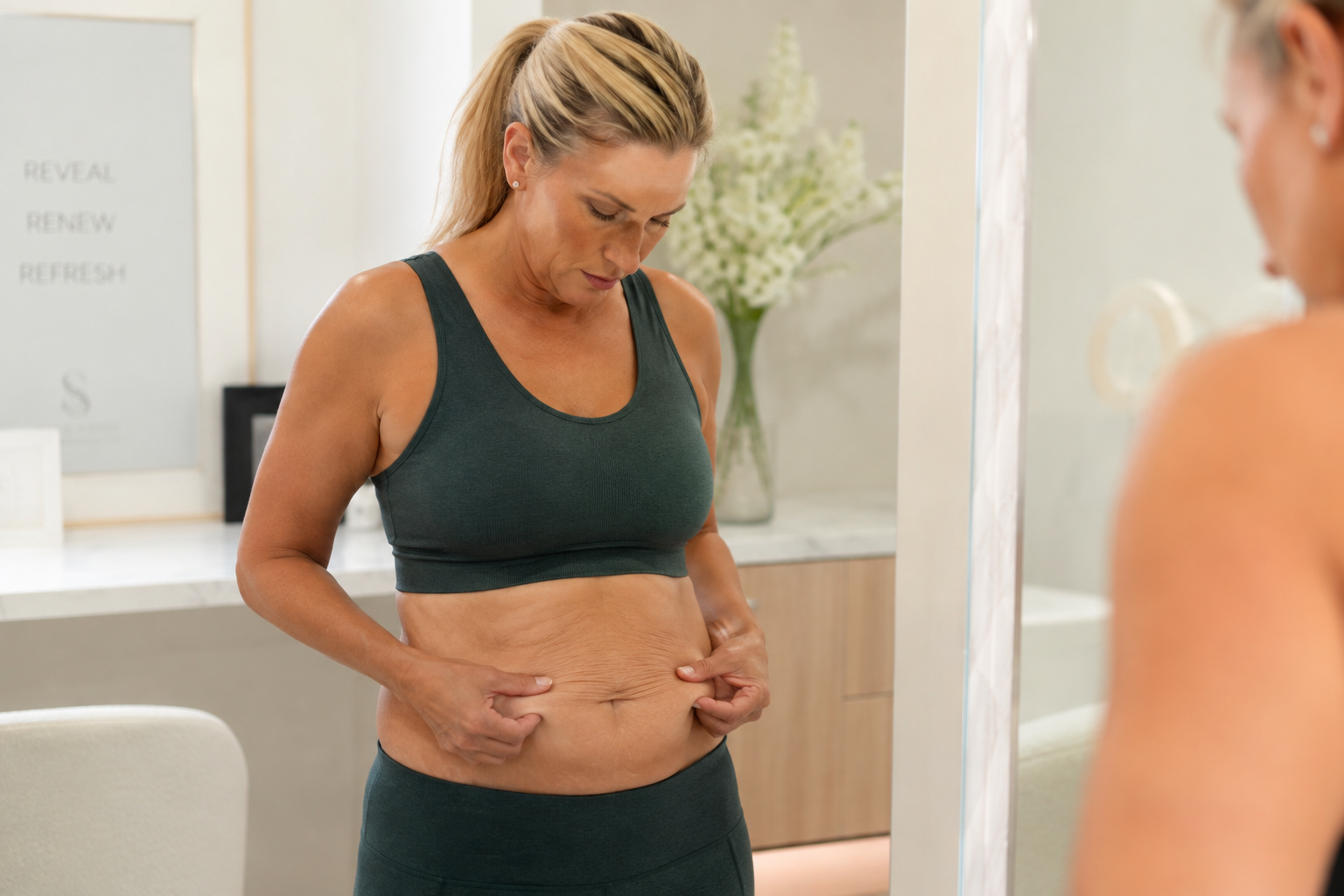
Then you notice something you did not necessarily expect: loose skin.
It may appear around your stomach when you sit down. Your upper arms may feel less firm. Your thighs may have more creasing. Your neck or jawline may look different. Some people notice changes in their face after significant or rapid weight loss.
This can happen after lifestyle-based weight loss, bariatric surgery, pregnancy, or weight loss associated with medications such as semaglutide or tirzepatide.
And it leads to one of the most common questions we hear:
Can loose skin after weight loss actually be tightened without surgery?
The answer is sometimes — but it depends heavily on how much loose skin you have, where it is located, your age, skin quality, genetics, weight stability, and the kind of result you expect.
For mild to moderate skin laxity, non-surgical skin-tightening treatments may improve firmness and skin quality without an incision or lengthy surgical recovery.
For a large amount of hanging excess skin, however, non-surgical treatment cannot reproduce what surgical skin removal can accomplish.
Understanding that difference is the first step toward choosing the right approach.
Quick Answer
Mild loose skin may gradually improve on its own and can sometimes be improved further through healthy weight maintenance, resistance training, good skin care, and professionally performed non-surgical skin-tightening treatments.
Significant excess skin that hangs or folds usually cannot be completely removed without surgery.
The goal should not be finding a miracle treatment. It should be determining how much of your concern is caused by skin laxity, remaining fat, loss of facial or body volume, muscle loss, or a combination of these factors.
Why Does Skin Become Loose After Weight Loss?
Skin is not simply a covering over the body. It is living tissue containing structural proteins, including collagen and elastin, that help provide strength and elasticity.
When body size increases, the skin stretches to accommodate the change.
After weight loss, the volume beneath the skin decreases. The question is whether the stretched skin can contract enough to fit the body’s smaller shape.
Sometimes it can.
Sometimes it cannot completely.
This is why two people can lose a similar amount of weight and have very different experiences afterward.
Several factors can influence how much skin remains loose.
Amount of Weight Lost
Generally, the greater the change in body size, the more the skin has had to stretch.
Someone who loses a relatively small amount of weight may notice little skin laxity. Someone who loses a substantial amount may notice loose skin around several parts of the body.
How Long the Skin Was Stretched
Skin that has been stretched for many years may have more difficulty returning to its previous shape than skin exposed to a shorter period of stretching.
Age
Collagen and elastin production change as we age.
Younger skin often has greater elasticity, although age is only one factor. Genetics, sun exposure, smoking history, overall health, and the magnitude of weight change can all influence the outcome.
Genetics
Some people naturally have thicker, more resilient skin. Others may be genetically more prone to stretch marks, laxity, or reduced elasticity.
Sun Exposure
Years of ultraviolet exposure can damage collagen and other structures responsible for maintaining skin quality.
That is another reason daily sun protection matters even if your primary concern is body skin rather than facial aging.
Smoking
Smoking is associated with premature skin aging and can negatively affect collagen.
If improving your skin is a goal, stopping tobacco use benefits far more than appearance.
Will Loose Skin Tighten on Its Own After Weight Loss?
Some skin may gradually contract after weight loss, especially when the amount of laxity is relatively small.
But there is no universal timeline or guarantee.
Skin does not behave like a rubber band that instantly snaps back after weight disappears.
If you have just reached your goal weight, your appearance may continue to change as your weight stabilizes and your body composition changes.
This is one reason it is usually better to assess your skin after your weight has become relatively stable rather than constantly changing.
But significant folds of excess skin are different.
If skin hangs substantially from the abdomen, arms, thighs, chest, or other areas after major weight loss, exercise, creams, and non-surgical treatments generally cannot make all of that tissue disappear.
That distinction is extremely important.
A responsible aesthetic consultation should tell you what can realistically improve — and what cannot.
Does Losing Weight Quickly Cause More Loose Skin?
Rapid weight loss can make changes in appearance more noticeable because the volume beneath your skin is changing quickly.
Weight loss also does not exclusively involve body fat. Depending on your diet, exercise habits, health, and weight-loss method, some lean tissue can be lost as well.
This can make certain areas look less full or less supported.
That does not mean people should avoid medically appropriate weight loss because of cosmetic concerns. Health should come first.
It does mean that preserving muscle, eating appropriately, following medical guidance when using prescription weight-loss medication, and allowing your body time to adjust are important parts of the process.
What About Loose Skin After GLP-1 Weight Loss?
With the increased use of GLP-1 medications, more people are asking about changes in the face and body after weight loss.
Terms such as “Ozempic face” and “Ozempic butt” have become popular online, but they can be misleading.
These are not formal medical diagnoses.
The changes are more accurately associated with significant or rapid weight loss — regardless of whether that weight loss came from medication, bariatric surgery, diet, or another method.
When volume is lost rapidly from areas such as the cheeks, neck, buttocks, abdomen, or arms, the overlying skin may look looser.
Some people may also experience reduced muscle volume during significant weight loss, which can further change body contours.
If you are using a GLP-1 or another prescription medication, medication decisions should always be discussed with the healthcare professional prescribing it. An aesthetic treatment should never replace appropriate medical management of your weight or overall health.
What Is “Ozempic Face”?
“Ozempic face” is an informal term used to describe facial changes that can become noticeable after significant weight loss.
These changes can include:
- A more hollow appearance in the cheeks
- More visible facial lines
- Loose skin around the jaw or neck
- Reduced facial fullness
- Jowling
- A generally more angular or less full appearance
Importantly, this is not necessarily caused by one specific drug.
Facial fat contributes to the structure and fullness of the face. When a meaningful amount of that volume is lost, the skin may not fully contract around the smaller underlying structure.
That is why treatment needs to begin with identifying the actual problem.
Skin laxity and volume loss are not the same thing.
A skin-tightening treatment is intended to address laxity. It cannot replace significant lost facial volume.
At SAS Aesthetic Institute, our philosophy is to evaluate what is actually causing the concern before recommending a non-invasive treatment.
Can Exercise Tighten Loose Skin?
Exercise is extremely important after weight loss, but it is important to understand what it can and cannot do.
Strength training can build the muscle underneath your skin.
That may improve the overall shape and firmness of an area, particularly the arms, legs, shoulders, abdomen, and glutes.
Exercise can also help preserve lean body mass while supporting long-term weight maintenance.
What exercise cannot do is physically remove large amounts of excess skin.
If a fold consists primarily of stretched skin rather than fat or lack of muscle tone, no number of abdominal exercises can simply make the skin disappear.
Still, resistance training is one of the best things you can do for your overall body composition.
Think of it as improving the foundation underneath the skin rather than directly removing the skin itself.
Do Skin-Tightening Creams Work?
This is where marketing frequently gets ahead of science.
A moisturizer can temporarily make skin look smoother or slightly plumper because properly hydrated skin reflects light differently and fine lines may be less noticeable.
Some topical ingredients can also contribute to overall skin quality.
But a cream cannot lift a substantial fold of loose abdominal skin or dramatically tighten sagging upper arms.
If a product promises results comparable to surgery simply by applying a lotion, be skeptical.
Skin care can be part of a good overall plan.
It should not be confused with structural skin tightening.
What Actually Helps Loose Skin After Weight Loss?
There is no single solution for every person.
A useful way to think about loose skin is to separate your options into four categories.
| Approach | What It May Help | What It Cannot Do |
|---|---|---|
| Stable weight | Gives the body time to adjust and prevents repeated stretching | Remove significant excess skin |
| Resistance training | Improves muscle tone and underlying body shape | Eliminate hanging skin |
| Skin care and sun protection | Supports overall skin quality | Create a surgical-level lift |
| Non-surgical skin tightening | May improve mild to moderate laxity in appropriate candidates | Remove large folds of excess skin |
| Surgical body contouring | Can remove significant excess skin | Avoid surgery, scars, and recovery |
The right option depends on the severity of your concern.
Non-Surgical Skin Tightening After Weight Loss
Non-surgical skin-tightening treatments are designed for people who want improvement without undergoing surgery.
Different technologies approach the skin differently. Depending on the device, treatments may use various forms of energy or stimulation to encourage changes within the deeper layers of the skin.
The goal is generally gradual improvement in firmness and skin quality rather than physically cutting away skin.
That difference sets realistic expectations.
Non-surgical treatment is usually best suited for someone with mild to moderate laxity, not someone with a substantial amount of hanging excess skin.
At SAS Aesthetic Institute in Mokena, our approach focuses on non-invasive technologies and physician-guided treatment planning rather than surgery or injectable treatments.
Patients interested in this category can learn more through our Skin Tightening in Mokena treatment information.
Loose Stomach Skin After Weight Loss
The abdomen is one of the most common areas where people notice loose skin.
The abdominal skin may have been stretched by:
- Weight gain
- Pregnancy
- Multiple pregnancies
- Years of weight fluctuation
- Significant weight loss
The first question is whether the fullness you see is actually loose skin.
Sometimes it is.
Other times, there may also be remaining subcutaneous fat, abdominal muscle weakness, or separation of the abdominal muscles.
And sometimes several of those issues occur together.
This is why simply choosing a “fat removal” treatment without evaluating the skin can produce disappointing results.
If the primary problem is laxity, reducing additional volume without addressing skin quality could potentially make that laxity more noticeable.
People who have both stubborn fat and skin laxity may benefit from discussing Body Contouring in Mokena rather than focusing on only one concern.
Loose Arms After Weight Loss
Upper-arm skin can become especially noticeable after weight loss.
People often describe it as:
“Bat wings.”
“Crepey arms.”
“Loose underarm skin.”
Or simply skin that moves more than it did before.
Strength training can improve the triceps and other muscles underneath the area, which may improve the contour.
But when the skin itself has lost elasticity, muscle development does not directly eliminate that laxity.
Mild cases may be suitable for non-surgical skin-tightening approaches.
Significant hanging upper-arm skin may require a surgical consultation if complete removal is the goal.
Loose Thigh Skin After Weight Loss
The inner thighs are another common trouble area because the skin there can be relatively thin and may have experienced substantial stretching.
After weight loss, people may notice:
- Wrinkling
- Crepey texture
- Skin folds
- Reduced firmness
- Cellulite becoming more noticeable
It is also important to distinguish cellulite from loose skin.
They are not the same condition.
Cellulite involves the relationship between fat, connective tissue, and the skin’s surface. Skin laxity refers to reduced firmness or excess skin.
A person can have one, the other, or both.
SAS offers separate options for Cellulite Treatment and Body Contouring, allowing those concerns to be evaluated individually rather than assuming every irregularity is simply excess fat.
Loose Neck and Jawline Skin After Weight Loss
The face and neck often receive less attention when people think about post-weight-loss body changes.
But they can be some of the most noticeable areas.
After facial fat decreases, people may notice:
- A softer jawline
- Jowls
- Loose neck skin
- More noticeable wrinkles
- Reduced cheek fullness
Again, treatment should depend on the cause.
If reduced facial volume is the dominant issue, skin tightening alone may not fully address it.
If mild laxity is the primary concern, a non-invasive treatment intended to improve firmness may be more relevant.
SAS Aesthetic Institute offers Skin Rejuvenation Treatments for patients interested in non-surgical facial and skin-quality options.
Body Contouring vs. Skin Tightening: What Is the Difference?
These terms are often used interchangeably online, but they describe different goals.
Body contouring generally refers to changing the shape or proportions of an area of the body.
Skin tightening focuses specifically on improving laxity or firmness.
Fat reduction focuses on decreasing localized fat volume.
One person may need only one of these.
Another may have all three concerns.
For example, imagine someone who has lost weight but still has a small pocket of abdominal fat plus mildly lax skin.
Treating only the fat may leave the skin looking less supported.
Treating only the skin may not address the contour created by remaining fat.
That is why individualized assessment matters.
At SAS Aesthetic Institute, our CellSound Body and other non-invasive body-contouring technologies are used as part of personalized plans based on the patient’s specific goals rather than assuming one treatment is appropriate for everyone.
When Does Non-Surgical Skin Tightening Make the Most Sense?
You may be a better candidate for non-surgical treatment when:
- Your weight is relatively stable
- You have mild or moderate laxity rather than large hanging folds
- You want gradual, natural-looking improvement
- You want to avoid an incision
- You understand that the result will not duplicate surgery
- You are willing to follow an individualized treatment plan
- Your medical history does not create a reason to avoid the treatment being considered
A professional consultation is important because not every treatment is appropriate for every patient.
When Might Surgery Be More Appropriate?
There is a point where the most medically honest answer is that non-surgical treatment is unlikely to accomplish what someone wants.
After major weight loss, significant excess skin can develop around the abdomen, arms, thighs, breasts, back, buttocks, face, and neck.
If that skin hangs in large folds, the most dramatic method of removing it is surgery.
Procedures such as an abdominoplasty, arm lift, thigh lift, body lift, breast lift, or other post-weight-loss body-contouring surgeries physically remove excess tissue.
These procedures come with very different considerations, including anesthesia, incisions, scars, medical risks, cost, and recovery.
SAS Aesthetic Institute focuses on non-surgical treatments, so someone whose goals require actual surgical removal should be given realistic expectations rather than being promised that an aesthetic device can replace surgery.
That kind of honesty matters.
What Is CellSound Body?
SAS Aesthetic Institute offers CellSound Body as part of its non-invasive body-contouring and skin-quality treatment options.
The technology uses non-focused ultrasound combined with ElectroSonic Resonance technology.
Treatment plans are individualized because someone concerned about abdominal laxity may need a different approach from someone focused on cellulite, body contour, or another area.
The most important point is not the name of the technology.
It is whether the technology is appropriate for your anatomy and your goal.
Before committing to any aesthetic treatment, ask:
What exactly are we treating?
Is the problem fat, loose skin, muscle tone, cellulite, volume loss, or several things together?
What degree of improvement is realistic?
How many treatments are expected?
What happens if I am not an appropriate candidate?
Those questions are more valuable than simply choosing the treatment with the most dramatic advertisement.
What About Skin After Pregnancy?
Pregnancy deserves its own discussion because postpartum abdominal changes are not always caused by weight alone.
Pregnancy stretches abdominal skin and connective tissue.
It can also contribute to stretch marks, changes in fat distribution, and separation of the abdominal muscles known as diastasis recti.
That means a postpartum belly may involve several different anatomical changes.
If the concern is primarily loose skin, a skin-quality treatment may be appropriate.
If there is stubborn localized fat, body contouring may be considered.
If there is abdominal muscle separation, that is a different concern.
SAS Aesthetic Institute offers a Non-Surgical Mommy Makeover in Mokena designed around several common postpartum aesthetic concerns rather than assuming every patient needs the same treatment.
How Long Should You Wait After Losing Weight?
There is no one waiting period that applies to everyone.
But if your weight is still changing significantly, your body is still changing too.
Reaching and maintaining a relatively stable weight generally gives you a clearer picture of what skin laxity remains.
It also helps distinguish temporary changes during active weight loss from concerns that are likely to persist.
People considering surgical body contouring are commonly advised to establish weight stability before proceeding.
For non-surgical aesthetic treatment, timing should likewise be personalized to your health, goals, and treatment area.
Can Collagen Supplements Tighten Loose Skin?
Collagen is one of the structural proteins associated with skin strength, so it is understandable that collagen supplements have become extremely popular.
But drinking or swallowing collagen is not equivalent to directly rebuilding a stretched piece of skin.
Nutrition is important for general health and normal tissue function, and adequate protein intake is especially important during weight loss.
However, supplements should not be marketed as a substitute for medical or surgical treatment of significant skin laxity.
Be cautious of before-and-after advertising suggesting otherwise.
Can Drinking More Water Tighten Skin?
Hydration supports normal skin function and can affect how dry or plump the skin appears.
But drinking extra water does not physically remove loose skin.
Think of hydration as part of maintaining healthy skin, not a lifting procedure.
The same applies to sleep, nutrition, exercise, and sun protection.
These habits matter.
They simply accomplish something different from a skin-tightening treatment.
What Results Should You Realistically Expect Without Surgery?
This may be the most important section of this entire guide.
The best non-surgical result is not necessarily a dramatic transformation.
Often, the goal is:
Firmer-looking skin.
Smoother texture.
A more refined contour.
Less visible mild laxity.
Gradual improvement without surgical recovery.
If your expectation is for a non-surgical machine to completely erase a large hanging abdominal apron after massive weight loss, you are likely to be disappointed.
If your concern is a smaller amount of laxity and you want measurable improvement without an incision, the conversation is very different.
Good aesthetic care starts with matching the treatment to the problem.
Questions to Ask Before Choosing a Loose-Skin Treatment
Before purchasing a package or committing to a treatment, ask the provider:
- What do you think is causing the appearance I dislike?
- How much of the concern is skin versus fat?
- Am I actually a good candidate for non-surgical tightening?
- What kind of improvement would be realistic for someone like me?
- How many sessions might be needed?
- Does the treatment involve downtime?
- What are the risks or reasons someone should not receive it?
- Who oversees the treatment?
- What happens if my amount of loose skin is too significant for this treatment?
- Can I see actual treatment results?
You can also review SAS Aesthetic Institute Treatment Results to better understand the types of changes associated with the technologies offered at our Mokena practice.
Why Physician-Guided Treatment Planning Matters
The aesthetic industry contains an enormous number of devices, trends, before-and-after photos, social media claims, and treatments promising transformation.
More technology does not automatically mean better care.
The important question is whether the treatment makes sense for the individual patient.
SAS Aesthetic Institute is a physician-led practice in Mokena, Illinois, offering non-invasive aesthetic technology for the face and body.
Our approach is centered on evaluating the concern first and then determining whether a non-surgical option is appropriate.
You can also explore Our Technology to learn more about the systems used at SAS Aesthetic Institute.
Loose Skin After Weight Loss: Frequently Asked Questions
Can loose skin actually go away after weight loss?
A small amount of skin laxity may improve over time, particularly depending on age, genetics, skin quality, and the amount of weight lost. Significant excess skin is much less likely to disappear completely on its own.
What is the best way to tighten loose stomach skin after weight loss?
There is no universal best treatment. Mild laxity may be improved with non-surgical skin-tightening approaches, while significant hanging skin generally requires surgical removal for a dramatic change. The abdomen should also be evaluated for remaining fat and muscle-related concerns.
Can you tighten loose skin without surgery?
Yes, non-surgical treatments can produce improvement in appropriately selected patients, particularly when laxity is mild to moderate. Results are typically less dramatic than surgery.
Does exercise remove loose skin?
No. Strength training can build muscle beneath the skin and improve body shape, but it cannot physically remove excess skin.
Does loose skin mean I still have fat to lose?
Not necessarily. Loose skin and body fat are different tissues. Some people have both, while others reach a healthy or stable weight and still have excess skin.
Can losing more weight make loose skin worse?
If the volume beneath already lax skin decreases further, the looseness may become more noticeable. Whether additional weight loss is appropriate should be based on health considerations, not solely appearance.
Does Ozempic cause loose skin?
Loose skin is more accurately associated with significant or rapid weight loss rather than being a unique effect of one specific medication. People can experience similar changes after other forms of major weight loss.
What is Ozempic face?
“Ozempic face” is a popular, non-medical term describing facial volume loss, wrinkles, hollowing, or skin laxity that may become noticeable after rapid or substantial weight loss.
Can non-surgical treatments remove hanging skin?
They can improve firmness in selected patients but do not physically cut away large folds of excess skin. Surgical removal is generally the most effective option when substantial excess tissue is present.
When should I consider skin tightening after weight loss?
It is generally useful to consider treatment after your weight has become relatively stable. A consultation can determine whether the concern is primarily loose skin, remaining fat, muscle tone, cellulite, or a combination.
You Lost the Weight. The Next Step Should Be Personal.
Loose skin after weight loss is not a failure.
It is often simply evidence that your body changed faster or more dramatically than your skin could completely accommodate.
You also do not need to jump immediately to the most aggressive treatment.
Start by understanding what you are actually seeing.
For some people, maintaining their weight, building muscle, and giving the body time is enough.
For others, non-surgical skin tightening may provide the additional improvement they want.
And for people with substantial excess skin, a surgical consultation may ultimately offer the result they are looking for.
At SAS Aesthetic Institute in Mokena, our focus is on non-invasive, physician-guided aesthetic treatments for people who want to improve skin quality and body contours without surgery or injections.
If loose skin, stubborn areas of fat, cellulite, or changes after weight loss are bothering you, a consultation can help determine which concerns can realistically be treated non-surgically.
Educational Notice: This article is for general educational purposes and is not a substitute for individual medical advice, diagnosis, or treatment. Treatment suitability, risks, expected results, and timing vary by individual. If you use prescription weight-loss medication, questions about starting, stopping, or changing your medication should be addressed with the healthcare professional who prescribed it.

Michael S. Romberg, MD
Dr. Michael S. Romberg is a Board Certified General Surgeon with more than 32 years of experience. His medical expertise includes general and oncologic surgery, wound care, burn care, lymphedema care, and Hyperbaric Oxygen Therapy. He is also an experienced national and international speaker for healthcare professionals and patients.