Acne is often treated as a teenage problem.
For many adults, that assumption makes the condition even more frustrating.
You may have expected breakouts to disappear after high school or college. Instead, you may still be dealing with pimples in your 30s or 40s. In other cases, someone who had relatively clear skin as a teenager suddenly begins developing acne as an adult.
Both situations can happen.
Adult acne may be a continuation of acne that began during adolescence, acne that disappeared and later returned, or acne that appears for the first time after the teenage years.
The important question is not simply, “Why am I too old for acne?”
You are not.
A better question is:
What factors are contributing to my breakouts now, and has anything changed that could explain the pattern?
Adult acne can involve hormones, oil production, clogged follicles, inflammation, genetics, skin and hair products, medications, stress and other factors. In some cases, a sudden change in the skin can also be a reason to look more closely at a person’s overall health history.
At SAS Aesthetic Institute in Mokena, our approach is physician-led because adult breakouts should not automatically be treated with whatever worked during the teenage years. Understanding the pattern often comes before choosing the treatment.
Can You Really Get Acne as an Adult?
Yes. Acne can persist well beyond adolescence, return after years of clear skin, or begin for the first time in adulthood.
There are several common patterns.
Persistent Adult Acne
Some people develop acne during adolescence and simply never experience a complete, long-term resolution.
The severity may change over time. Someone who once had widespread teenage acne may experience only occasional adult breakouts, while another person continues to develop significant inflammatory lesions.
Recurrent Adult Acne
In this pattern, teenage acne improves or disappears and then returns years later.
The recurrence may coincide with hormonal changes, a new medication, different skin-care products, stress or another change.
Adult-Onset Acne
Some adults develop acne even though significant breakouts were not a problem during adolescence.
This is called adult-onset acne.
The fact that acne begins later in life does not automatically mean something serious is wrong. It does, however, make the history surrounding the breakout particularly important.
Why Does Adult Acne Happen?
Acne develops inside the pilosebaceous unit—the structure containing a hair follicle and its associated sebaceous gland.
Several processes can contribute:
- Excess production of sebum, or skin oil
- Abnormal accumulation of cells within the follicle
- Follicular plugging
- Inflammation
- Activity involving Cutibacterium acnes
- Hormonal influences on the oil glands
Adult acne can involve the same basic mechanisms as teenage acne.
What may differ are the factors influencing those mechanisms.
For adults, those factors may include hormonal fluctuations, stress, genetics, medications, cosmetics, hair products or other changes occurring later in life.
If you want a broader explanation of how acne develops, start with our Complete Guide to Acne.
Is Adult Acne Always Hormonal?
No. Adult acne is not automatically hormonal acne.
The term “hormonal acne” is used frequently online, especially to describe breakouts around the chin or jawline.
Hormones absolutely can play an important role in adult acne. Androgens can stimulate sebaceous glands and influence oil production.
But the location of a breakout alone cannot prove that hormones are the cause.
Adult acne may involve several contributing factors simultaneously.
For example, a patient could have hormonally influenced acne while also using a pore-clogging cosmetic. Another may experience worsening around the menstrual cycle but also have a strong family history of acne.
Rather than assigning every adult breakout to hormones, it is more useful to look for a pattern.
What Does Hormonal Adult Acne Look Like?
There is no single appearance that definitively proves acne is hormonal.
However, some patients notice predictable patterns associated with hormonal changes.
These may include breakouts that:
- Flare around the menstrual cycle
- Begin or change during pregnancy
- Change after starting or stopping hormonal contraception
- Appear or worsen during perimenopause
- Occur alongside other signs of hormonal change
The jawline, chin and lower face are often discussed in connection with adult female acne, but lesion location should be considered alongside the patient’s history rather than used as a diagnosis by itself.
A monthly photograph or simple calendar can sometimes help patients recognize whether breakouts are truly cyclical.
Can Acne Begin During Perimenopause or Menopause?
Yes.
Hormone levels do not remain constant throughout adult life.
During perimenopause and menopause, the balance between different hormones changes. These changes can influence oil production and the behavior of the skin.
Some women who have not thought about acne in years become surprised when breakouts return during this stage of life.
At the same time, adult skin may become drier or more sensitive.
This combination creates an important treatment consideration:
Trying to aggressively “dry out” adult acne can sometimes create significant irritation without appropriately treating the acne itself.
Adult acne care therefore needs to consider both the breakouts and the condition of the surrounding skin.
Can Stress Cause Adult Acne?
Stress is frequently blamed for acne, but the relationship requires some clarification.
Stress does not create acne from nothing, but it can worsen existing acne in susceptible individuals.
The body’s stress response affects hormones and inflammatory pathways. During periods of ongoing stress, some people notice more frequent or more inflammatory breakouts.
There may also be indirect effects.
When someone is stressed, they may:
- Sleep less
- Touch or pick at their skin more frequently
- Change their diet
- Skip their normal skin-care routine
- Exercise differently
- Use different products
- Experience other hormonal changes
This is why a stressful period can appear to coincide with worsening skin even though there may be more than one factor involved.
Can Your Skin-Care Products Cause Adult Acne?
Yes.
Products that work well for one person can contribute to clogged pores in another.
This can include:
- Moisturizers
- Sunscreens
- Makeup
- Foundation
- Primers
- Facial oils
- Thick occlusive products
- Certain hair products
When choosing products for acne-prone skin, terms such as non-comedogenic, oil-free, or won’t clog pores can be useful starting points.
However, those labels do not guarantee that every product will work perfectly for every individual.
The timing of a breakout can provide clues.
If acne suddenly appears after introducing a new foundation, heavy moisturizer or hair product, it is reasonable to consider whether that product could be contributing.
Can Hair Products Cause Facial Acne?
Yes, especially around the hairline and forehead.
Hair oils, pomades, leave-in conditioners, styling products and other products can come into contact with nearby skin.
For some people, those products contribute to clogged follicles.
This may produce many small bumps around:
- The upper forehead
- Hairline
- Temples
- Back of the neck
The patient may continue adding acne treatments while never identifying the product that is repeatedly coming into contact with the skin.
This is a good example of why treating adult acne begins with asking questions.
Sometimes the solution is not adding another product.
It is removing the one contributing to the problem.
Can Makeup Cause Acne?
Makeup does not automatically cause acne.
Many people with acne can wear cosmetics without difficulty.
The important considerations are the formulation, how the skin reacts to the product and how makeup is removed.
Patients with acne-prone skin may benefit from products labeled non-comedogenic or oil-free.
It is also important to remove makeup before sleeping and regularly clean objects that repeatedly contact the face, including makeup brushes and applicators.
Aggressive scrubbing, however, is not necessary.
Acne is not caused by having a “dirty” face.
Excessive cleansing can irritate the skin and potentially worsen inflammation.
Can a Medication Cause Adult Acne?
Certain medications can cause acne-like eruptions or worsen acne in some people.
If breakouts begin soon after starting a new medication, that timing is worth discussing with the prescribing physician.
Do not stop a prescribed medication simply because you suspect it is affecting your skin.
Instead, tell your physician:
- When the acne began
- When the medication was started
- Whether the dose recently changed
- What the breakout looks like
- Where it is occurring
The physician can determine whether the medication could reasonably be involved and whether any change is appropriate.
Can Adult Acne Be a Sign of an Underlying Medical Condition?
Sometimes, although most adult breakouts should not immediately be interpreted as evidence of disease.
Certain hormonal or medical conditions can be associated with acne.
What matters is the entire clinical picture.
A sudden change in acne may deserve further evaluation when it occurs with other symptoms such as:
- New menstrual irregularity
- Excess facial or body hair
- Significant scalp hair changes
- Other signs of hormonal alteration
- A sudden severe change in previously stable skin
The goal is not to make patients anxious about every breakout.
It is to recognize that skin can occasionally provide useful information about changes occurring elsewhere in the body.
When the history suggests that additional evaluation is appropriate, acne treatment should not substitute for investigating the underlying issue.
Why Am I Suddenly Breaking Out at 30, 40 or 50?
When acne appears unexpectedly, reviewing what changed before the breakout began can be surprisingly useful.
Think backward several weeks or months.
Did you:
- Start or stop hormonal contraception?
- Enter pregnancy, postpartum, perimenopause or menopause?
- Begin a new medication?
- Change foundation or concealer?
- Start using a heavier moisturizer?
- Change sunscreen?
- Add facial oil?
- Begin a new hair product?
- Start wearing equipment that repeatedly rubs the area?
- Experience unusually prolonged stress?
- Start picking at small imperfections that previously would have healed?
There may not always be one obvious answer.
But building a timeline gives a physician far more useful information than simply saying, “My skin suddenly got bad.”
Why Does Adult Acne Often Appear Around the Chin and Jawline?
The lower face is a common area of concern in adults, particularly women.
Hormonal influences can contribute to acne in this distribution.
However, the popular social-media rule that “chin acne equals hormones” is too simplistic.
Breakouts in that area can also be affected by:
- Cosmetics
- Skin-care products
- Touching the face
- Friction
- Occlusive products
- Hair removal
- Other acne mechanisms
Location provides a clue.
It does not provide the entire diagnosis.
Adult Acne vs. Teenage Acne: Is There a Difference?
The underlying disease process is still acne, but the surrounding circumstances may differ.
| Adult Acne | Teenage Acne |
|---|---|
| May be persistent, recurrent or adult-onset | Commonly begins around puberty |
| Hormonal fluctuations throughout adult life may influence breakouts | Puberty-related androgen increases play a major role |
| Skin may simultaneously be dry, sensitive or showing signs of aging | Skin is often oilier overall |
| Product and medication history can be particularly important | Pubertal changes frequently dominate the history |
| Pregnancy and hormonal medication considerations may affect treatment | Different age-related treatment considerations apply |
| Patients may have both active acne and older acne scars | Scars may just be beginning to develop |
One important mistake is assuming the same aggressive routine someone used at age 16 will automatically be appropriate at age 38.
Skin changes over time.
Treatment should change with it.
Are Blackheads and Whiteheads Adult Acne Too?
Yes.
Adult acne does not have to consist of large red pimples.
Acne can include:
- Open comedones, or blackheads
- Closed comedones, or whiteheads
- Papules
- Pustules
- Nodules
- Cysts
Identifying the lesion type matters because different treatments target different acne processes.
A treatment intended primarily for inflammatory pimples may not be the best way to address predominantly clogged pores.
Similarly, someone with deep, painful nodules needs a different level of evaluation than someone with several occasional blackheads.
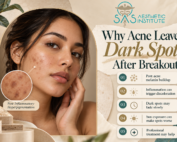
Why Does Adult Acne Leave Dark or Red Marks?
Inflammatory acne can leave visible changes even after the active pimple has resolved.
These may include:
Post-inflammatory erythema:
Persistent red or pink discoloration.
Post-inflammatory hyperpigmentation:
Brown, gray or darker discoloration that develops after inflammation, particularly in skin tones prone to pigment changes.
True acne scars:
Permanent structural changes such as depressions or raised areas.
These three problems should not be lumped together as “acne scars.”
A flat dark mark is not necessarily a scar.
This distinction matters because each concern can require a different approach.
Does Picking Adult Acne Make It Worse?
It can.
Squeezing, picking or repeatedly manipulating acne can increase inflammation and damage surrounding tissue.
That may increase the likelihood of:
- Prolonged redness
- Hyperpigmentation
- Infection
- Delayed healing
- Scarring
It is especially tempting to manipulate a lesion when an important meeting, event or photograph is approaching.
Unfortunately, aggressive squeezing can turn a relatively small pimple into a much more noticeable inflammatory area.
Should You Scrub Adult Acne?
No.
Acne is not caused by inadequate scrubbing.
Blackheads are also not simply dirt trapped inside pores.
Frequent scrubbing, abrasive brushes and harsh exfoliation can damage the skin barrier and worsen irritation.
A gentle routine is usually more appropriate.
That generally includes:
- A gentle cleanser
- Appropriate acne treatment based on lesion type
- Moisturizer when needed
- Daily sunscreen
More products do not automatically produce better skin.
In adults, especially, an overly complicated routine can make it difficult to determine which product is helping and which one is causing irritation.
Which Ingredients Are Commonly Used for Adult Acne?
The correct treatment depends on the patient’s acne and medical history, but several ingredients are commonly used in acne care.
Salicylic Acid
Salicylic acid can help unclog pores and is commonly used for blackheads and whiteheads.
Benzoyl Peroxide
Benzoyl peroxide can be useful for inflammatory acne and has activity relevant to acne-associated bacteria.
Higher concentrations are not automatically better. Increasing strength can also increase irritation.
Topical Retinoids
Retinoids such as adapalene help normalize follicular cell turnover and can be useful for clogged pores and inflammatory acne.
Retinoid use requires additional consideration during pregnancy or when trying to become pregnant.
Azelaic Acid
Azelaic acid can be useful in acne management and may also help with some post-inflammatory pigmentation.
However, buying every active ingredient and applying them all at once is not a thoughtful acne plan.
Layering multiple irritating products can result in burning, peeling and redness that make the skin look worse.
How Long Should Adult Acne Treatment Take to Work?
Acne treatment requires patience.
Visible improvement is generally measured in weeks rather than days.
Many treatments need consistent use before a meaningful change becomes obvious. The exact timeline depends on the type of acne, the treatment being used, how consistently it is used and how the individual skin responds.
Changing products every few days because a new pimple appears makes it difficult to determine whether the treatment is actually helping.
A lesion visible today may also have begun developing before the current treatment was started.
Consistency matters, but so does reassessment. If the skin continues worsening, becomes very irritated or is not improving after a reasonable period of consistent care, the treatment plan may need to be adjusted.
When Should an Adult Stop Trying Over-the-Counter Products?
Mild acne may improve with appropriate nonprescription care.
But an adult should consider a professional evaluation when acne is:
- Deep or painful
- Creating nodules or cysts
- Leaving scars
- Producing significant dark marks
- Persistently inflamed
- Worsening despite consistent treatment
- Suddenly very different from previous acne
- Affecting confidence or quality of life
- Difficult to distinguish from another skin condition
Patients do not need to wait until acne becomes severe before asking for help.
Earlier treatment can also reduce the opportunity for repeated inflammation to leave lasting marks.
Could It Be Something Other Than Acne?
Yes.
Not every red bump on an adult face is acne.
Conditions that can sometimes resemble acne include:
- Rosacea
- Folliculitis
- Perioral dermatitis
- Certain medication-related eruptions
- Other inflammatory skin conditions
This is particularly important when someone’s “acne treatment” repeatedly makes the skin worse.
If the diagnosis is wrong, adding stronger acne products may increase irritation without addressing the condition.
Our upcoming guide to Acne vs. Rosacea will examine one of the most common areas of confusion in greater detail.
Can Laser Treatment Help Adult Acne?
It may be an option for appropriately selected patients.
Certain laser and light-based technologies can be incorporated into acne treatment plans depending on the type of acne, inflammation, redness and other concerns present.
At SAS Aesthetic Institute, ADVATx is one technology available for selected patients.
The important point is that the device should be selected based on what needs to be treated.
Someone with active inflammatory lesions may have different needs from someone whose acne has resolved but who has persistent redness.
Someone with true acne scars has yet another treatment objective.
You can read our full explanation in Can Laser Treatment Help Active Acne? and learn more about the ADVATx technology used at SAS Aesthetic Institute.
What If Adult Acne Keeps Coming Back?
Recurring acne is common because acne is influenced by biological factors that can continue changing.
Improvement followed by a later breakout does not necessarily mean every previous treatment failed.
Instead, ask whether the pattern changed.
For example:
Is it cyclical?
Hormonal timing may deserve consideration.
Did it begin after a new product?
Review the product routine.
Did it follow a medication change?
Discuss the timing with the prescribing physician.
Is the acne in areas of repeated friction?
Mechanical factors may be contributing.
Are lesions becoming deeper or leaving scars?
It may be time to escalate care.
For a deeper discussion of recurrence, read Why Does Acne Keep Coming Back?.
Frequently Asked Questions About Adult Acne
Is it normal to have acne in your 30s?
Yes. Acne can persist into the 30s and beyond, and some people develop acne for the first time as adults.
Why did I suddenly get acne when I never had it as a teenager?
Adult-onset acne can be associated with hormonal fluctuations, products, medications, stress, genetics and other factors. A sudden change is worth evaluating in the context of what else changed around the same time.
Does jawline acne mean my hormones are unbalanced?
Not necessarily. Hormones can influence lower-face acne, but location alone cannot diagnose a hormonal imbalance.
Why does my acne get worse before my period?
Hormonal fluctuations associated with the menstrual cycle can influence sebaceous glands and acne activity in susceptible individuals.
Can menopause cause acne?
Hormonal changes during perimenopause and menopause can contribute to adult breakouts in some women.
Can stress cause acne?
Stress can worsen existing acne in some people. It should be viewed as a potential aggravating factor rather than the sole cause of every breakout.
Should I stop my medication if I think it is causing acne?
No. Never stop a prescribed medication without speaking to the clinician who prescribed it. Discuss when the acne started and whether the medication could be contributing.
Can using too many skin-care products cause breakouts?
It can. Some products may clog pores, while combinations of several active ingredients can irritate the skin and worsen redness and inflammation.
Is adult acne caused by dirty skin?
No. Acne develops through processes occurring within the follicle. Aggressive washing and scrubbing do not cure it and can irritate the skin.
Does adult acne need different treatment than teenage acne?
Sometimes. The underlying acne mechanisms overlap, but adult skin, hormonal factors, medications, pregnancy considerations, sensitivity and other concerns can change which treatment is appropriate.
Can adult acne leave permanent scars?
Yes. Deep or persistent inflammatory acne can cause permanent scarring. Early appropriate treatment is especially important when nodules, cysts or new scars are developing.
Should I see a doctor if adult acne suddenly becomes severe?
Yes. Sudden, severe or unusual acne deserves evaluation, particularly when accompanied by other new symptoms or when the lesions are painful and scarring.
Adult Acne Is Not Something You Simply Have to “Grow Out Of”
Age does not make acne less real.
And adult acne is not automatically caused by poor skin care, chocolate, stress or hormones.
It is a skin condition influenced by several interacting factors.
For some patients, recognizing a trigger makes a substantial difference.
For others, there is no single trigger to remove, and effective treatment requires addressing the biological processes behind the acne itself.
The most useful approach is to stop asking:
“Why do I still have acne at my age?”
and start asking:
“What type of acne do I have, what pattern is it following, and what is contributing to it?”
Those questions lead to better treatment decisions.
At SAS Aesthetic Institute, Dr. Michael Romberg, MD, provides physician-led evaluation and treatment planning for patients dealing with active acne, persistent redness, acne marks and acne scars.
For a complete overview of how acne develops, visit our Complete Guide to Acne, or learn more about acne treatment in Mokena.
SAS Aesthetic Institute
19657 South La Grange Road, Mokena, IL 60448
(708) 476-8205

Michael S. Romberg, MD
Dr. Michael S. Romberg is a Board Certified General Surgeon with more than 32 years of experience. His medical expertise includes general and oncologic surgery, wound care, burn care, lymphedema care, and Hyperbaric Oxygen Therapy. He is also an experienced national and international speaker for healthcare professionals and patients.