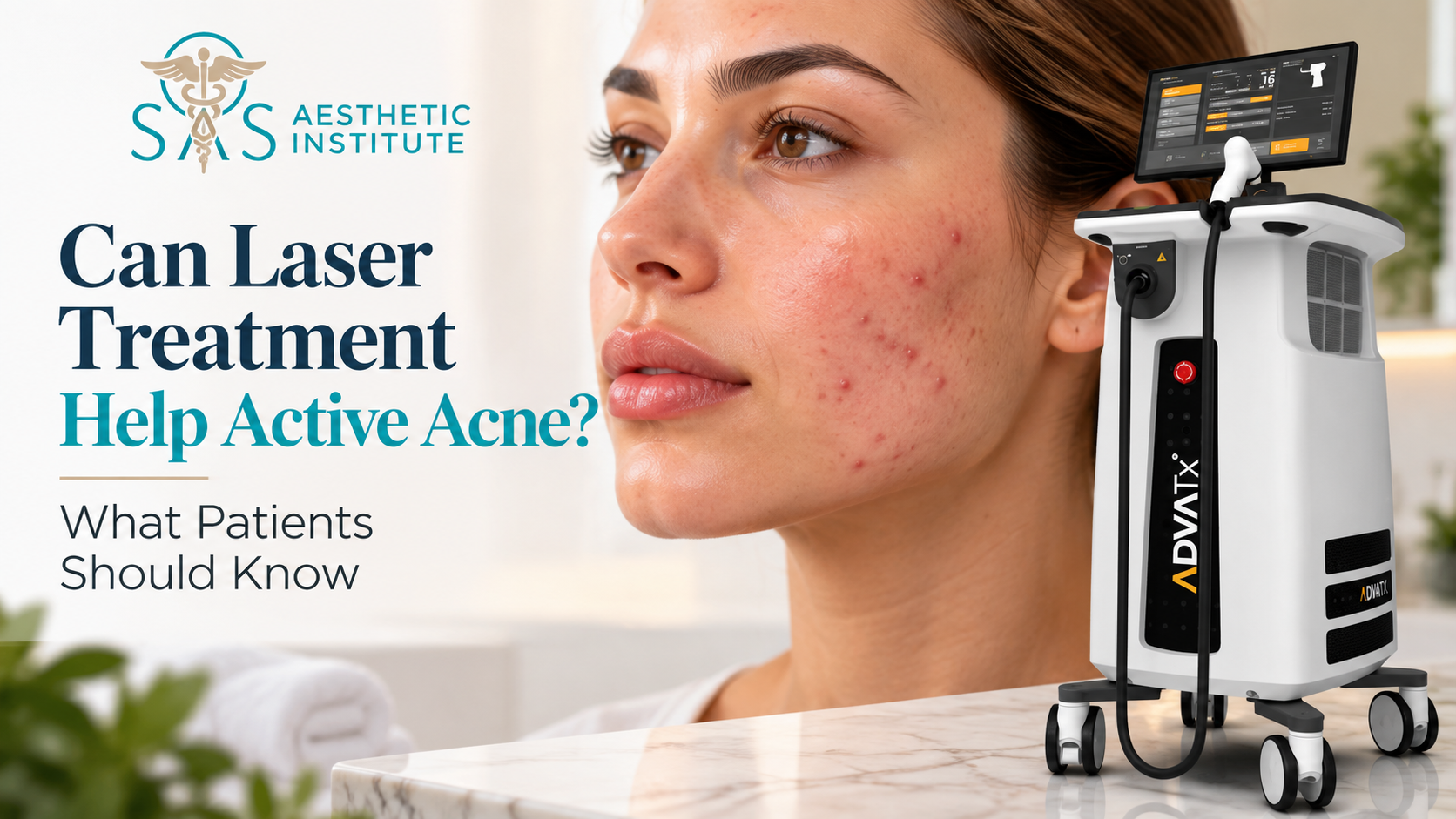
Laser treatment is often associated with acne scars, but that is not the only way laser technology may be used for acne-prone skin.
Certain laser and light-based treatments can also be considered while acne is still active.
The important distinction is that not every type of acne responds the same way, and not every device is designed to treat the same problem.
A patient with red inflammatory pimples may need a different approach from someone with blackheads, deep cystic acne, persistent redness or established acne scars.
That is why the first question should not simply be:
“Can a laser treat acne?”
A more useful question is:
“What type of acne is present, what is contributing to it, and what specifically are we trying to improve?”
At SAS Aesthetic Institute in Mokena, Dr. Michael Romberg, MD, evaluates active acne as part of the overall condition of the skin rather than treating every breakout with the same procedure.
Can Laser Treatment Be Used on Active Acne?
Yes.
Certain laser and light-based technologies may be used as part of a treatment plan for active acne.
However, laser treatment is not a universal solution for every breakout.
Different acne lesions behave differently.
For example:
- An inflamed red pimple is different from a blackhead.
- A whitehead is different from a deep nodule.
- A flat red mark left after acne heals is not the same as active acne.
- An acne scar is a structural change in the skin and requires a different treatment strategy.
This is why proper evaluation matters before choosing a laser or other device.
What Is Active Acne?
Active acne means that acne lesions are currently forming or inflamed.
These can include:
- Blackheads
- Whiteheads
- Red papules
- Pustules
- Deep nodules
- Cystic lesions
A person can also have active acne and old acne marks at the same time.
That can make the skin look like one problem when there are actually several different concerns present.
For a broader explanation of acne types, causes and treatment considerations, read our Complete Guide to Acne.
Why Does Acne Develop?
Acne develops when several processes interact inside the hair follicle.
These can include:
- Increased oil production
- Buildup of skin cells inside the follicle
- Clogged pores
- Inflammation
- Activity involving Cutibacterium acnes
- Hormonal influences
- Skin-care or cosmetic products
- Friction and repeated occlusion
This is important because laser treatment does not address every acne mechanism in exactly the same way.
A treatment plan should be based on which parts of the acne process are most relevant to the patient.
What Types of Acne May Respond to Laser or Light Treatment?
Laser or light-based treatment may be more useful for some acne concerns than others.
| Acne Concern | What It Looks Like | Possible Role of Laser or Light Treatment |
|---|---|---|
| Inflammatory papules | Red, swollen bumps | May be considered as part of a treatment plan |
| Pustules | Inflamed pimples with visible pus | May respond depending on the technology used |
| Blackheads | Open clogged pores | Usually not the main target of laser treatment |
| Whiteheads | Closed clogged pores | Often require treatment aimed at follicular plugging |
| Nodules | Deep, firm, painful lesions | Need careful medical evaluation |
| Cystic acne | Deep inflammatory lesions | Should not be treated as a simple cosmetic concern |
| Persistent redness | Flat red or pink areas after acne | Certain laser wavelengths may be useful |
| Acne scars | Indentations or raised texture | Require a scar-focused treatment plan |
The key is identifying what is actually present on the skin.
How Can Laser Treatment Help Active Acne?
Different laser and light technologies work differently.
Depending on the device and treatment settings, the goal may include reducing inflammation, addressing redness or influencing sebaceous activity.
Reducing Inflammation
Inflammation is responsible for much of the swelling, tenderness and redness associated with active acne.
Certain energy-based treatments may help calm inflammatory acne in appropriately selected patients.
The goal is not simply to make the skin look less red for a day.
The goal is to reduce one component of the acne process while the overall treatment plan addresses ongoing breakouts.
Addressing Oil-Producing Glands
Sebaceous glands produce sebum.
Sebum is a normal part of healthy skin, but excessive oil production can contribute to clogged follicles in acne-prone skin.
Some laser and energy-based technologies can affect sebaceous activity.
This may be useful for patients whose acne is accompanied by significant oiliness or inflammatory breakouts.
Addressing Acne-Related Redness
Not every red area on acne-prone skin is an active pimple.
Sometimes a lesion has already healed, but redness remains.
This is often where patients become confused.
They may say:
“My acne is still there.”
But part of what they are seeing may be post-acne redness rather than ongoing active acne.
Certain laser technologies can be useful for persistent vascular redness when that is the actual concern.
Active Acne, Acne Marks and Acne Scars Are Different
This distinction is one of the most important parts of acne treatment.
Active Acne
Active acne means there is currently a clogged or inflamed lesion.
This includes blackheads, whiteheads, papules, pustules, nodules and cystic lesions.
Post-Acne Marks
After acne heals, a flat red, pink, brown or darker area may remain.
This is not necessarily a scar.
The skin surface may still be completely smooth.
Acne Scars
A true acne scar changes the structure or contour of the skin.
Scars may appear as:
- Pits
- Depressions
- Rolling texture
- Raised areas
- Uneven skin contour
These three concerns may exist at the same time, but they are not treated exactly the same way.
Can Laser Treatment Remove Blackheads and Whiteheads?
Laser treatment is generally not the first thing to think about when the main problem is clogged pores.
Blackheads and whiteheads are primarily related to material building up within the follicle.
Treatment often focuses on improving follicular turnover and reducing plugging.
This is one reason an acne consultation should look at the actual lesion type rather than simply labeling everything “acne.”
Can Laser Treatment Help Deep or Cystic Acne?
Deep acne requires more careful evaluation.
Nodules and cystic lesions can be painful and can carry a greater risk of permanent scarring.
Laser treatment may play a role in some treatment plans, but deep inflammatory acne should not be approached as though one device will solve the entire problem.
When lesions are deep, recurrent or rapidly creating scars, the priority is controlling the active acne appropriately.
Can Laser Treatment Prevent Acne Scars?
Laser treatment cannot guarantee that acne will never scar.
However, controlling ongoing inflammation may reduce the number of new lesions that have the opportunity to leave permanent damage.
The most important step in scar prevention is controlling acne before repeated deep inflammation continues injuring the skin.
Once a true scar has formed, the treatment goal changes.
You can learn more about scar-specific treatment on our Acne Scar Treatment in Mokena page.
Can You Treat Acne Scars While Acne Is Still Active?
Sometimes both concerns can be addressed within the same overall treatment period, but active acne and acne scars should be viewed separately.
If new inflammatory lesions continue forming, focusing only on old scars can ignore the process that is creating new damage.
For many patients, controlling active acne becomes an important first priority.
Once breakouts are better controlled, scar treatment can be planned more effectively.
That does not mean every patient must have perfectly clear skin before any scar treatment is considered.
It means both problems should be identified accurately and prioritized appropriately.
Is Laser Treatment a Permanent Cure for Acne?
No acne treatment should be described as a guaranteed permanent cure.
Acne is influenced by factors that can continue changing over time.
These may include:
- Hormonal fluctuations
- Oil production
- Skin-care products
- Medications
- Friction
- Stress
- Age
- Genetics
A patient may improve significantly and still experience occasional future breakouts.
The goal is better control of acne, fewer inflammatory lesions and healthier skin over time.
How Many Laser Treatments Are Needed for Acne?
There is no universal number.
Treatment depends on:
- Type of acne
- Severity
- Technology being used
- Skin characteristics
- Response to previous treatment
- Other treatments being used
- Whether redness, active acne or scarring is the main concern
Some patients may need a series of treatments rather than one session.
Progress is evaluated over time rather than judged immediately after one procedure.
Why One Treatment Session May Not Be Enough
Acne develops over time.
A lesion that becomes visible today may have started developing beneath the surface days or weeks earlier.
That means treating visible acne once does not necessarily prevent every follicle from developing a future breakout.
A series of treatments may allow the skin to be evaluated across several acne cycles.
This also gives the treatment plan time to be adjusted based on how the skin responds.
What Is ADVATx?
At SAS Aesthetic Institute, one technology available for selected acne patients is ADVATx.
ADVATx is a dual-wavelength laser platform that uses 589 nm and 1319 nm wavelengths.
These wavelengths can be used differently depending on what needs to be treated.
For example, a patient may have:
- Active inflammatory acne
- Persistent facial redness
- Post-acne redness
- Uneven skin texture
- Acne scars
The benefit of having different wavelength options is that treatment can be selected based on the concern present rather than assuming every acne patient needs the exact same settings.
You can learn more about the platform on our ADVATx Technology page.
Does Everyone With Acne Need ADVATx?
No.
Technology should not be chosen simply because it is available.
A patient with mild blackheads may need a very different approach from someone with inflammatory acne and persistent redness.
A patient with deep cystic lesions may need a different plan again.
The treatment decision should come after the skin is evaluated.
At SAS Aesthetic Institute, ADVATx is one tool that may be incorporated into a broader acne treatment plan when appropriate.
Is Laser Treatment Better Than Acne Medication?
This is not usually the most useful way to compare them.
Laser treatment and acne medication do different things.
One is not automatically “better.”
Some patients may do well with topical treatment.
Others may need medication.
Some may benefit from device-based treatment.
Others may need a combination.
The right treatment depends on:
- Acne type
- Severity
- Location
- Scarring risk
- Skin sensitivity
- Previous treatment
- Medical history
The best plan is the one that addresses the actual acne pattern rather than forcing every patient into the same treatment.
Can Laser Treatment Help With Oily Skin?
Certain energy-based treatments may influence sebaceous activity and may be useful in patients whose acne is associated with significant oil production.
However, oily skin by itself does not automatically mean laser treatment is necessary.
Some people naturally produce more sebum without having severe acne.
The question is whether oil production is contributing to clogged and inflamed follicles.
Does Laser Treatment Help Hormonal Acne?
Laser treatment may help certain visible features of acne, such as inflammation or redness, but it does not remove hormonal influences from the body.
This is an important distinction.
If hormonal changes are contributing to acne, a laser may help the skin without addressing the entire reason breakouts are recurring.
This is why acne treatment should consider both what is visible and what may be contributing to the pattern.
Can Adult Acne Be Treated With Laser?
Yes, in appropriately selected patients.
Adult acne can involve:
- Inflammatory breakouts
- Hormonal patterns
- Oiliness
- Persistent redness
- Post-acne marks
- Older scars
The treatment plan should reflect which of those concerns are actually present.
Adults may also have more sensitive or drier skin than they did as teenagers, so treatment should not automatically be based on what worked years earlier.
For a deeper discussion, read our guide to Adult Acne.
Can Teen Acne Be Treated With Laser?
Laser or light-based treatment may be considered for selected teenagers, but it is not automatically necessary for every teen with acne.
Factors that matter include:
- Age
- Acne type
- Severity
- Scarring risk
- Skin characteristics
- Previous treatments
- Overall treatment goals
Teen acne should first be evaluated based on what is actually happening in the skin.
You can read more in our Teen Acne Guide.
What If Acne Keeps Coming Back After Treatment?
Recurring acne is common.
A breakout can return because the factors contributing to acne are still present or have changed.
For example:
- Hormones may fluctuate
- Skin-care products may change
- Oil production may increase
- Friction may worsen
- A medication may change
- Treatment may have been stopped too early
The pattern of recurrence can provide useful information.
A patient whose acne returns every month may have a different pattern from someone who suddenly breaks out after changing products.
Our guide Why Does Acne Keep Coming Back? explains this in more detail.
Can Laser Treatment Make Acne Worse?
Temporary redness, warmth or irritation can occur after laser treatment.
Acne-prone skin can also react differently depending on the technology, settings, products being used and condition of the skin barrier.
This is why patients should disclose:
- Current acne products
- Prescription medications
- Retinoid use
- Recent sun exposure
- Previous laser treatments
- Skin sensitivities
- Medical history
Treatment settings and timing should be selected with these factors in mind.
Are At-Home Light Masks the Same as Medical Laser Treatment?
No.
At-home LED masks and professional medical laser systems are not interchangeable.
Consumer devices typically use lower energy and are designed for home use.
Professional laser systems allow the provider to choose specific wavelengths, treatment parameters and settings based on the condition being treated.
An at-home mask also cannot determine whether a red bump is:
- Acne
- Rosacea
- Folliculitis
- Irritation
- Another inflammatory skin condition
The diagnosis still matters.
How Do You Know If Laser Treatment Is Right for Your Acne?
The decision should begin with the skin, not the machine.
Questions to consider include:
- Are the lesions inflammatory?
- Are blackheads and whiteheads the main problem?
- Are deep nodules developing?
- Is redness still present after acne heals?
- Are true scars forming?
- Is acne recurring in a predictable pattern?
- Has the skin become irritated from too many products?
- Is another condition possibly being mistaken for acne?
Once those questions are answered, it becomes much easier to determine whether laser treatment belongs in the plan.
When Should Active Acne Be Evaluated by a Doctor?
Consider a medical evaluation when acne is:
- Deep
- Painful
- Repeatedly inflamed
- Leaving scars
- Leaving significant discoloration
- Spreading across the face, chest or back
- Not improving with consistent care
- Suddenly becoming much worse
- Difficult to distinguish from another skin condition
You do not need to wait until acne becomes severe to have it evaluated.
The earlier the pattern is understood, the easier it may be to prevent repeated inflammation from leaving lasting changes.
Frequently Asked Questions About Laser Treatment for Acne
Can laser treatment clear active acne?
Laser treatment may help certain types of active acne, particularly when inflammation or redness is part of the problem. It is not equally effective for every acne lesion.
Does laser work on blackheads?
Laser treatment is usually not the primary treatment for blackheads. Blackheads are clogged follicles and often require treatment aimed at reducing follicular plugging.
Does laser work on cystic acne?
Deep cystic acne requires careful medical evaluation. A laser may be part of a broader treatment plan, but it should not automatically be treated as the only solution.
Can laser treatment reduce acne redness?
Certain laser wavelengths may help persistent redness associated with active or recently healed acne.
Is acne redness the same as an acne scar?
No. A flat red mark is not necessarily a scar. A scar changes the texture or contour of the skin.
Can laser prevent acne from returning?
Laser treatment cannot guarantee that acne will never return. Acne can be influenced by hormones, oil production, products, medications and other factors that change over time.
How many laser sessions are needed?
There is no fixed number. The treatment schedule depends on the acne pattern, technology used and how the skin responds.
Can teenagers have laser acne treatment?
Some teenagers may be candidates, but treatment should be individualized based on age, acne type, severity and scarring risk.
Can adults with hormonal acne use laser treatment?
Laser treatment may help visible inflammation or redness, but it does not remove hormonal influences from the body.
Can laser treat acne and acne scars at the same time?
Sometimes both concerns can be addressed during the same overall treatment period, but active acne and scars remain separate treatment problems.
Is ADVATx only for acne scars?
No. ADVATx can be used for several skin concerns depending on the treatment plan, including active acne-related concerns, redness and acne scars.
Should I get laser treatment before trying other acne treatments?
Not necessarily. The right starting point depends on what type of acne is present and how severe it is.
The Most Important Step Is Knowing What You Are Treating
Acne can look simple from a distance.
A patient sees red bumps and thinks:
“I need an acne treatment.”
But several different concerns may be present at once.
One area may be an active pimple.
Another may be a clogged pore.
Another may be residual redness.
Another may be pigmentation.
Another may be a true scar.
Treating all of those as though they are the same problem can lead to disappointing results.
Laser treatment can be useful for certain acne concerns, but the technology should follow the diagnosis.
At SAS Aesthetic Institute, Dr. Michael Romberg, MD, evaluates active acne, redness, post-acne changes and scarring to determine which treatment options make sense for the individual patient.
For a broader overview, read our Complete Guide to Acne or learn more about Acne Treatment in Mokena.
SAS Aesthetic Institute
19657 South La Grange Road, Mokena, IL 60448
(708) 476-8205

Michael S. Romberg, MD
Dr. Michael S. Romberg is a Board Certified General Surgeon with more than 32 years of experience. His medical expertise includes general and oncologic surgery, wound care, burn care, lymphedema care, and Hyperbaric Oxygen Therapy. He is also an experienced national and international speaker for healthcare professionals and patients.