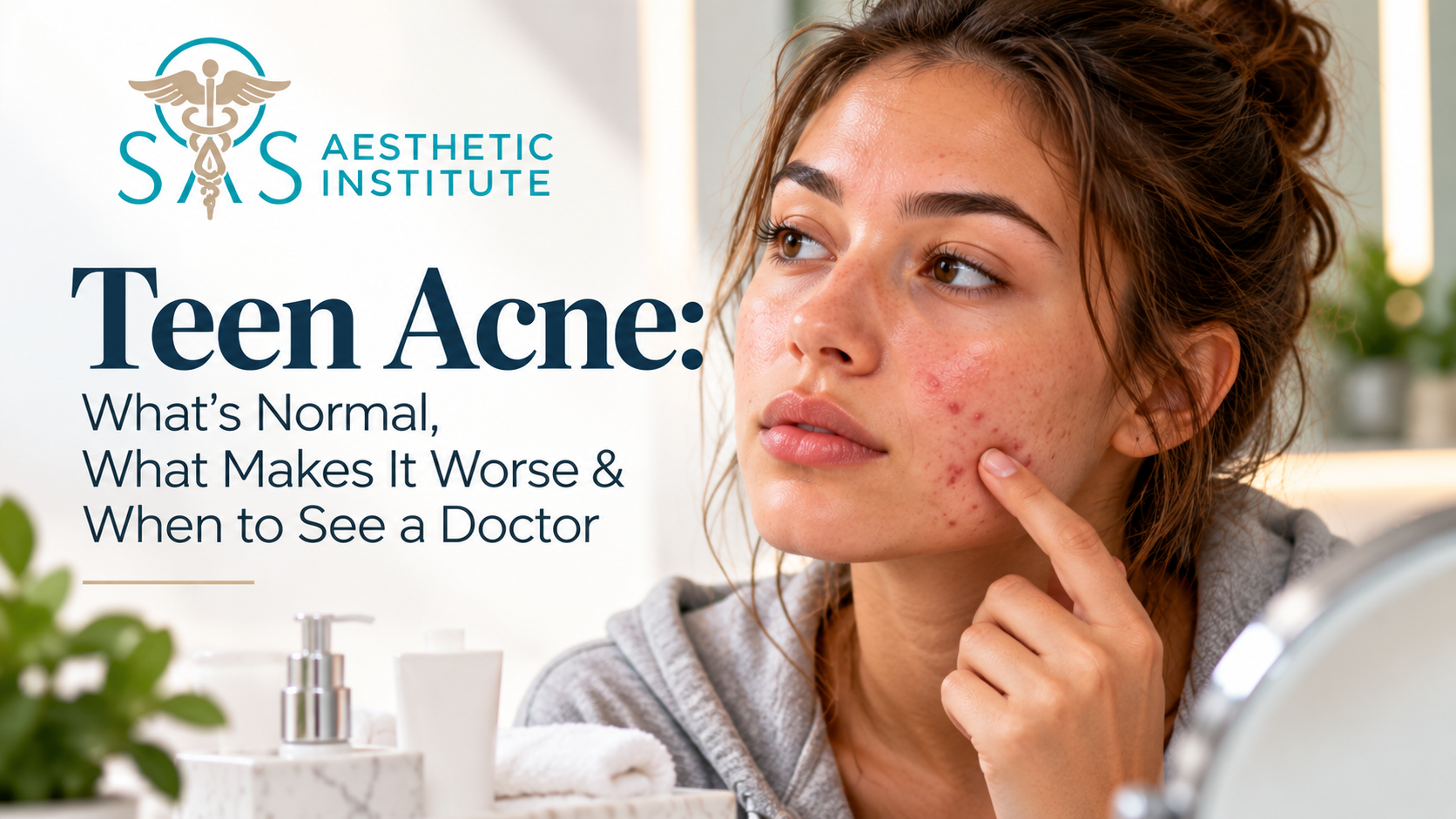
Acne is extremely common during the teenage years, but common does not mean it should always be ignored.
Some teenagers develop a few blackheads or an occasional pimple.
Others experience frequent inflammatory breakouts, painful bumps under the skin, acne across the chest and back, persistent dark marks, or scarring that continues long after individual pimples heal.
There is also a point where simply waiting for a teenager to “grow out of it” stops being a useful plan.
Acne can worsen over time, especially when deeper inflammatory lesions continue developing.
The goal is not to make teenagers worry about every blemish.
It is to recognize the difference between mild, manageable acne and acne that is becoming persistent, painful, scarring or difficult to control.
At SAS Aesthetic Institute in Mokena, teen acne is evaluated as a medical skin concern. Dr. Michael Romberg, MD, looks at the type of acne present, the pattern of breakouts, the skin-care routine, possible triggers and whether the acne is beginning to leave lasting changes in the skin.
Why Is Acne So Common During the Teen Years?
Teen acne is strongly influenced by the hormonal changes that occur during puberty.
During this period, hormones can stimulate the sebaceous glands in the skin to produce more sebum, or oil.
Sebum itself is normal and necessary.
The problem develops when increased oil combines with skin cells inside the hair follicle and contributes to clogged pores.
Several factors can then interact:
- Increased oil production
- Buildup of skin cells inside the follicle
- Clogged pores
- Inflammation
- Activity involving Cutibacterium acnes
This can create different types of acne, ranging from blackheads and whiteheads to inflamed pimples, pustules, nodules and cystic lesions.
Teen acne is therefore not simply the result of a teenager failing to wash their face properly.
For a broader explanation of how acne develops, visit our Complete Guide to Acne.
Is Teen Acne Normal?
Yes.
Acne is very common during adolescence.
But there is an important difference between saying acne is normal and saying it should never be treated.
A teenager who develops an occasional pimple may need little more than a simple skin-care routine and an appropriate acne product.
A teenager who develops painful lesions, repeated breakouts, acne across several areas of the body, or new scars may need a more structured treatment plan.
The severity of acne should not be judged only by the number of pimples visible on one particular day.
What matters is the overall pattern.
What Does Teen Acne Look Like?
Teen acne can appear in several different forms.
Blackheads
Blackheads are open clogged pores.
The dark appearance is not dirt.
The material inside the follicle becomes exposed to air and darkens.
Whiteheads
Whiteheads are closed clogged pores.
They often appear as small white or flesh-colored bumps beneath the surface of the skin.
Papules
Papules are inflamed red bumps without visible pus.
They may feel tender.
Pustules
Pustules are inflamed pimples that contain visible pus.
These are often what people picture when they hear the word “pimple.”
Nodules
Nodules develop deeper in the skin.
They may feel firm, painful and difficult to treat with basic topical products.
Cystic Lesions
Cystic acne involves deeper inflammatory lesions that can remain painful for an extended period.
These lesions can carry a higher risk of scarring and should not simply be squeezed or repeatedly picked at home.
Is Teen Acne Caused by Poor Hygiene?
No.
Acne is not caused by having a dirty face.
This is an important point for both teenagers and parents.
Acne develops inside the hair follicle.
Scrubbing the surface of the skin harder does not remove the processes that are creating clogged and inflamed follicles underneath.
In fact, excessive washing can make the skin more irritated.
A teenager may begin washing repeatedly because they think they are not doing enough.
The result can be:
- Dryness
- Peeling
- Burning
- Redness
- Tightness
- Increased sensitivity
while the underlying acne continues.
Gentle and consistent skin care is usually more useful than aggressive scrubbing.
How Often Should a Teenager Wash Their Face?
For many teenagers, washing the face about twice a day and after heavy sweating is reasonable.
The goal is to remove sweat, surface oil, sunscreen and other products without irritating the skin.
A simple cleansing routine usually means:
- Lukewarm water
- A gentle facial cleanser
- Clean fingertips
- Light pressure
Avoid rough scrubbing tools, abrasive brushes and harsh exfoliating pads.
Acne cannot be scrubbed away.
Does Sweating Cause Teen Acne?
Sweat is not the main cause of acne.
However, sweat combined with friction, oil and occlusion can aggravate acne-prone skin.
This is especially relevant for teenagers who play sports.
Equipment such as:
- Football helmets
- Chin straps
- Shoulder pads
- Baseball caps
- Tight uniforms
- Protective padding
can repeatedly rub against the skin.
A teenager may notice breakouts primarily along the forehead, jawline, shoulders, chest or back depending on where equipment or clothing makes contact.
This type of acne may be worsened by heat, friction and repeated pressure on the skin.
How Can Teen Athletes Reduce Breakouts?
The goal is not to avoid sports.
It is to reduce the conditions that may aggravate acne.
Helpful habits can include:
- Showering after heavy sweating
- Changing out of sweaty clothing
- Washing athletic clothing regularly
- Cleaning equipment that touches the face
- Avoiding unnecessary tight clothing
- Using a non-comedogenic sunscreen
- Gently cleansing after exercise
Sports equipment is often necessary for safety.
The focus should be on cleaning the skin and equipment appropriately rather than trying to eliminate all contact.
Can Touching the Face Make Acne Worse?
Repeated touching can contribute to irritation, especially when it turns into picking.
Teenagers frequently touch phones, keyboards, desks, sports equipment, backpacks and school supplies before touching their face.
The bigger problem, however, is often squeezing and picking at acne lesions.
This can make a small blemish much more inflamed.
Why Should Teenagers Avoid Popping Pimples?
Popping a pimple may feel like a quick solution, but it can create more inflammation.
Repeated squeezing can damage the surrounding skin and may contribute to:
- Longer healing time
- Persistent redness
- Dark marks
- Increased swelling
- Skin injury
- Scarring
Deep nodules and cystic lesions are especially poor candidates for home squeezing.
They often sit too deep in the skin for pressure at the surface to solve the problem.
Can Teen Acne Cause Permanent Scars?
Yes.
Deeper and more inflammatory acne can leave lasting changes in the skin.
Acne scars may appear as:
- Small pits
- Broader indentations
- Uneven texture
- Rolling depressions
- Raised areas of scar tissue
Not every mark left after acne is a true scar.
That distinction matters.
A flat red, pink, brown or dark area may represent post-inflammatory discoloration rather than permanent structural damage.
A true scar changes the texture or contour of the skin.
This is one reason repeated deep or inflamed acne should be addressed early rather than allowed to continue indefinitely.
Can Teen Acne Leave Dark Spots Without Causing Scars?
Yes.
A pimple can heal and leave a visible mark without creating a permanent scar.
These marks may be:
- Red
- Pink
- Brown
- Gray
- Darker than the surrounding skin
This is especially common after inflamed acne.
A teenager may feel like their acne is getting worse because they see many spots across the face, even though only a few of those spots represent active breakouts.
It helps to separate three different concerns:
Active acne
A current clogged or inflamed lesion.
Post-acne discoloration
A flat red, pink, brown or darker area remaining after inflammation.
Acne scarring
A lasting change in the texture or structure of the skin.
These are different problems and may require different treatment approaches.
Can Makeup Make Teen Acne Worse?
Not necessarily.
A teenager with acne does not automatically need to stop wearing makeup.
However, certain cosmetic products can contribute to clogged pores in acne-prone skin.
Products labeled:
- Non-comedogenic
- Oil-free
- Won’t clog pores
may be useful choices.
Makeup should also be removed before sleeping.
Brushes, sponges and other applicators should be cleaned regularly.
The goal is not to tell teenagers they cannot wear cosmetics.
It is to use products that are less likely to aggravate acne-prone skin.
Can Hair Products Cause Teen Acne?
Yes.
Hair products can sometimes contribute to breakouts around the forehead, temples and hairline.
Products that may come into contact with nearby skin include:
- Hair oils
- Pomades
- Styling creams
- Gels
- Leave-in conditioners
- Sprays
If acne is concentrated near the hairline, it is worth looking at what is being applied to the hair.
A teenager may continue adding facial acne products without realizing that a hair product is repeatedly contacting the same area of skin.
Can Diet Cause Teen Acne?
Diet and acne are more complicated than saying one food causes pimples.
Acne does not develop because a teenager ate one hamburger or one piece of chocolate.
Certain dietary patterns may influence acne in some individuals, but the effect can vary considerably.
It is more useful to look for a repeated pattern over time than to blame one meal.
Parents should also be cautious about creating unnecessarily restrictive diets in an attempt to clear acne.
Teenagers are still growing and need balanced nutrition.
If a teen consistently notices that certain foods seem to coincide with worsening acne, that pattern can be discussed during a medical evaluation.
Does Drinking More Water Cure Teen Acne?
No.
Hydration is important for general health, but drinking large amounts of water does not unclog pores or eliminate acne.
Water is healthy.
It just is not an acne treatment by itself.
Does Toothpaste Help Pimples?
Toothpaste should not be used as an acne treatment.
It is designed for teeth, not facial skin.
Applying toothpaste to a blemish can cause:
- Burning
- Redness
- Dryness
- Peeling
- Irritation
There are acne treatments formulated specifically for the skin that are much more appropriate.
What Over-the-Counter Ingredients May Help Teen Acne?
Several common acne ingredients are available without a prescription.
The best choice depends on the type of acne present.
Benzoyl Peroxide
Benzoyl peroxide is commonly used for inflammatory acne.
It can help reduce acne-associated bacteria and may be used as part of a broader acne routine.
One practical issue is that benzoyl peroxide can bleach towels, clothing and pillowcases.
Salicylic Acid
Salicylic acid can help unclog pores.
It may be particularly useful when blackheads and whiteheads are a major part of the acne pattern.
Adapalene
Adapalene is a topical retinoid available without a prescription.
Retinoids help regulate the buildup of cells inside follicles and can be useful for preventing clogged pores.
They may also cause dryness or irritation when first introduced.
Should Teenagers Use Several Acne Products at Once?
Usually not.
One of the most common mistakes is starting too many active products at the same time.
A teenager may suddenly begin using:
- Benzoyl peroxide
- Salicylic acid
- Retinoid
- Exfoliating toner
- Spot treatment
- Scrub
- Clay mask
all within the same week.
The result can be an irritated skin barrier rather than clearer skin.
If everything is started at once, it also becomes difficult to tell which product caused a reaction.
A simpler routine is easier to follow and easier to adjust.
How Long Does Teen Acne Treatment Take to Work?
Acne treatment takes time.
Improvement should generally be measured in weeks rather than days.
Many acne treatments need consistent use before a meaningful change becomes obvious.
It is also important to understand that a new pimple appearing today may have started developing before the current treatment was begun.
Constantly changing products every few days makes it difficult to judge whether anything is helping.
A better approach is consistency, followed by reassessment if the skin is not improving.
What Is a Simple Skin-Care Routine for a Teen With Acne?
Teenagers generally do not need a complicated routine.
A basic approach may look like this:
Morning
- Gentle cleanser
- Appropriate acne treatment if part of the plan
- Non-comedogenic moisturizer if needed
- Broad-spectrum SPF 30+ sunscreen
Evening
- Gentle cleanser
- Acne treatment
- Moisturizer if needed
The exact acne treatment should depend on what kind of acne is present.
A teenager with mainly blackheads may need a different approach from a teenager with painful nodules.
Should Teenagers With Oily Skin Use Moisturizer?
Often, yes.
Oily skin can still become irritated.
Acne treatments may make the skin dry, tight or flaky.
A lightweight non-comedogenic moisturizer can help reduce irritation and make an acne routine easier to tolerate.
Using moisturizer does not automatically make acne worse.
The formulation matters.
Does Sunscreen Make Acne Worse?
Not necessarily.
Teenagers with acne should still protect their skin from ultraviolet exposure.
The key is choosing sunscreen that is appropriate for acne-prone skin.
Look for a product that is:
- Broad-spectrum
- SPF 30 or higher
- Non-comedogenic
- Comfortable enough to use consistently
Sun protection becomes especially important when acne has already left dark or red marks.
When Is Teen Acne More Than Just a Few Pimples?
The number of pimples is only part of the picture.
More concerning signs include:
- Deep painful bumps
- Nodules
- Cystic lesions
- New scars
- Frequent inflammatory breakouts
- Acne covering large areas of the chest or back
- Persistent discoloration after breakouts
- Acne that continues worsening
- Skin that is not improving despite consistent care
A teenager does not need to wait until acne becomes severe before having it evaluated.
When Should a Parent Take a Teenager to a Doctor for Acne?
There is no single rule, but there are several situations where professional evaluation becomes especially useful.
Acne Is Starting to Scar
If acne is leaving pits, indentations or permanent texture changes, the skin is being injured deeply enough to create lasting damage.
Preventing new scars becomes an important goal.
Acne Is Deep or Painful
Nodules and cystic lesions often need more than basic skin-care products.
Acne Is Not Improving
If a teenager has followed a reasonable routine consistently and acne continues getting worse, it may be time to reassess the diagnosis and treatment plan.
Acne Is Affecting Daily Life
Skin conditions can affect much more than appearance.
A teenager may begin avoiding:
- Photographs
- Sports
- School events
- Social situations
- Dating
- Swimming
- Activities where makeup cannot easily be worn
If acne is changing how a teenager lives their life, that deserves to be taken seriously.
The emotional effect of acne does not always match how severe it looks to someone else.
How Should Parents Talk to a Teenager About Acne?
Parents often want to help, but frequent comments about the skin can have the opposite effect.
A teenager is usually already very aware of their acne.
Comments such as:
“You have another big pimple.”
“Your skin looks worse.”
“You need to wash your face more.”
can make the situation more embarrassing.
A more useful approach is to offer help without making acne a constant topic.
For example:
“If your skin is bothering you, we can have someone evaluate it and figure out what might help.”
That keeps the focus on treatment rather than blame.
Acne is a skin condition.
It is not a sign that a teenager is careless or unhygienic.
What If Teen Acne Suddenly Gets Worse?
When acne suddenly changes, it helps to look at what changed at the same time.
Ask whether there was:
- A new medication
- A new supplement
- New sports equipment
- A new skin-care routine
- A new hair product
- More picking or squeezing
- Increased friction from clothing or equipment
- A major change in stress
- A new cosmetic product
There may not always be one obvious trigger.
But building a timeline can help identify patterns.
Can Teenagers Get Acne on the Back and Chest?
Yes.
Acne frequently develops beyond the face.
Common areas include:
- Back
- Chest
- Shoulders
- Neck
- Upper arms
Body acne can be especially frustrating because it may rub against backpacks, sports equipment, bras, uniforms and tight clothing.
It can also be difficult for a teenager to see or reach these areas.
Deep chest or back acne can scar just like facial acne.
What If Teen Acne Keeps Coming Back?
Acne often improves and flares in cycles.
That does not necessarily mean the treatment failed.
Hormonal activity continues changing throughout adolescence, and new clogged follicles can begin developing even while older lesions are healing.
Some teenagers may need a maintenance plan even after the skin improves.
Stopping all treatment immediately when acne looks better can allow new breakouts to return.
Our article Why Does Acne Keep Coming Back? explains recurring breakouts in more detail.
Can ADVATx Help Teen Acne?
In selected patients, ADVATx may be considered as part of a broader acne treatment plan.
At SAS Aesthetic Institute, ADVATx is one of the technologies used for acne-related concerns, including active inflammation, persistent redness and other changes that can remain after breakouts.
ADVATx uses two wavelengths, 589 nm and 1319 nm, which can be selected differently depending on what needs to be treated.
For a teenager with acne, the goal may be different from one patient to another.
One teen may have:
- Inflamed red breakouts
- Persistent redness after acne
- Oily acne-prone skin
- Early post-acne changes
- A combination of active acne and lingering marks
This is why ADVATx is not automatically the first or only treatment for every teenager.
The decision depends on factors such as:
- Type of acne
- Severity
- Inflammation
- Scarring risk
- Previous treatment
- Skin characteristics
- Other medical considerations
The important part is matching the treatment to what is actually happening in the skin rather than simply choosing a device.
For a deeper explanation of how laser treatment may fit into acne care, read Can Laser Treatment Help Active Acne?.
You can also learn more about the ADVATx technology used at SAS Aesthetic Institute.
How Does Teen Acne Treatment at SAS Aesthetic Institute Fit Into the Bigger Picture?
Teen acne treatment is not simply about getting rid of one pimple.
A complete plan may need to address several concerns at once:
- Active breakouts
- Clogged pores
- Inflammation
- Persistent redness
- Dark marks
- Scarring risk
- Skin irritation from previous products
- Recurring acne patterns
This is why the treatment plan begins with identifying the acne pattern.
For some teenagers, a simple skin-care plan may be enough.
For others, physician-guided acne care and treatment technology such as ADVATx may be considered.
The goal is to reduce active acne while also protecting the skin from repeated inflammation and long-term changes.
Learn more about our approach on the Acne Treatment in Mokena page.
Frequently Asked Questions About Teen Acne
At what age does teen acne usually begin?
Acne commonly begins around puberty, when hormonal changes begin affecting the oil glands in the skin. The exact age varies from person to person.
Does every teenager get acne?
No, but acne is very common during adolescence. Some teenagers develop only occasional blackheads, while others experience significant inflammatory acne.
Will teen acne go away on its own?
It may improve with age, but acne can continue for years and sometimes persists into adulthood. Waiting is not always the best plan if the acne is painful, worsening or beginning to scar.
Is teen acne caused by not washing enough?
No. Acne develops inside the hair follicle and is not simply caused by dirt on the skin.
Should teenagers pop pimples?
No. Picking and squeezing can increase inflammation and make discoloration or scarring more likely.
Can sports make acne worse?
Yes. Sweat, friction, tight clothing and protective equipment can aggravate acne-prone skin.
Is back acne normal in teenagers?
Yes. Acne commonly affects the chest, back and shoulders as well as the face.
Can teen acne leave permanent scars?
Yes. Deeper and repeatedly inflamed acne can permanently change skin texture.
How quickly should acne products work?
Most acne treatments require consistent use for several weeks before a meaningful change can be judged.
Does a teenager need to stop wearing makeup?
Not necessarily. Non-comedogenic cosmetics can often be used without causing problems.
Is teen acne always caused by hormones?
Hormonal changes play an important role during puberty, but acne also involves clogged follicles, oil production and inflammation.
Can ADVATx be used for teen acne?
In selected patients, ADVATx may be considered as part of a broader acne treatment plan. The decision depends on the type of acne, level of inflammation, skin characteristics and overall treatment goals.
When should a teen see a doctor for acne?
A medical evaluation is worth considering when acne is painful, deep, scarring, worsening, affecting daily life or not improving with consistent care.
Teen Acne Is Common, but It Still Deserves Attention
Teenagers are often told:
“Everyone gets acne.”
That is true.
But it does not mean every case of acne should be treated the same way.
Some teenagers need only a basic routine.
Others develop persistent inflammatory acne that can leave discoloration or permanent scars.
The goal is not perfect skin.
The goal is to understand the type of acne present, reduce ongoing inflammation and prevent repeated breakouts from creating long-term changes.
At SAS Aesthetic Institute, Dr. Michael Romberg, MD, provides physician-led evaluation and individualized treatment planning for teens and adults dealing with acne-prone skin.
Treatment may include a combination of skin-care guidance, medical evaluation and technologies such as ADVATx when appropriate for the patient’s acne pattern.
For a broader understanding of the condition, read our Complete Guide to Acne or learn more about Acne Treatment in Mokena.
SAS Aesthetic Institute
19657 South La Grange Road, Mokena, IL 60448
(708) 476-8205

Michael S. Romberg, MD
Dr. Michael S. Romberg is a Board Certified General Surgeon with more than 32 years of experience. His medical expertise includes general and oncologic surgery, wound care, burn care, lymphedema care, and Hyperbaric Oxygen Therapy. He is also an experienced national and international speaker for healthcare professionals and patients.