
Laser hair removal for men works the same way it does for anyone, but the practical experience differs in three ways: men’s hair is typically coarser and more deeply rooted, which often means a few additional sessions; the areas treated are larger, with back, shoulders, and chest the most common; and because male hair growth is androgen-driven, new growth can appear over the years, making occasional maintenance more likely.
For men who shave regularly, the biggest benefit is often medical rather than cosmetic — laser is one of the only lasting solutions for chronic razor bumps. Men now make up a substantial and growing share of laser hair removal patients, and laser hair removal for men has moved firmly into the mainstream. Most arrive for practical reasons: they’re tired of a grooming routine that never ends, or they have a skin problem that shaving keeps causing.
Why Is Laser Hair Removal for Men Different?
The hair itself. Male body hair is generally thicker, denser, and rooted more deeply than female body hair. That cuts both ways. Coarse, dark hair holds more melanin, and melanin is exactly what the laser targets — so it responds well. But deeper follicles require energy that penetrates further, which is where wavelength and device power matter. Diode laser systems are well suited to this, since the wavelength reaches the depth where male follicles sit.
The surface area. A woman treating underarms is covering a few square inches. A man treating full back and shoulders is covering a large expanse of dense growth. That affects session length and cost, though large areas are still generally completed within a normal appointment.
The hormones. Male body hair is driven by androgens, and androgen activity continues throughout life. Many men develop new growth on the back, shoulders, and ears in their thirties and forties that simply wasn’t there before. Laser disables the follicles it treats, but it can’t prevent your body from activating new ones later.
Which Areas Does Laser Hair Removal for Men Treat Most Often?
- Back and shoulders — the single most requested. Also the most practically compelling, since it’s the one area you genuinely cannot manage yourself.
- Chest and stomach — usually full removal or thinning, depending on preference.
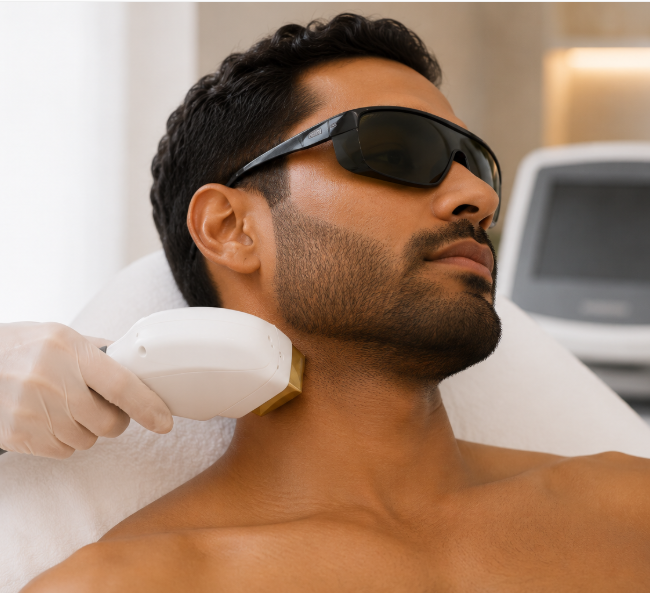
- Neck and beard line — cleaning up the area below the beard, or eliminating growth that creeps down the neck.
- Shoulders and upper arms — often treated with feathered edges so there’s no hard line where treatment stops.
- Ears and nose bridge — small areas, quick sessions, disproportionately appreciated.
Laser hair removal for men isn’t performed on or near the eyelids or brows for safety reasons. Everything else is fair game.
Can Laser Hair Removal for Men Fix Razor Bumps and Ingrown Hairs?
This is the part most men don’t know about, and it’s the strongest medical case for laser hair removal for men.
Pseudofolliculitis barbae — razor bumps — occurs when shaved hair curls back and re-enters the skin, triggering inflammation, bumps, discoloration, and sometimes scarring. It disproportionately affects men with coarse, tightly curled hair, and it affects a large share of men who shave regularly. Topical treatments manage it; they don’t resolve it. Growing a beard resolves it, which isn’t an option for everyone.
Because the condition is caused by hair re-entering the skin, permanently reducing the hair addresses the actual cause. The clinical evidence here is unusually solid: laser hair reduction has been studied extensively for pseudofolliculitis barbae, including in military populations where clean-shaven grooming standards make the condition both common and consequential. Published research reports meaningful improvement after a series of sessions, with results durable at follow-up.
Worth noting for men with deeper skin tones, who are disproportionately affected: this is precisely the population where laser settings must be calibrated carefully, and where a test patch before a full session is worth requesting. It’s a settings question, not a barrier to treatment.
If shaving has left you with persistent bumps, irritation, or dark marks along the neck and jaw, this is a medical problem with a durable treatment, not a grooming annoyance you’re stuck with.
How Many Sessions Does Laser Hair Removal for Men Take?
Laser hair removal for men generally sits at the higher end of the standard range, and sometimes beyond it. Most patients need six to eight sessions; men treating dense areas like the back or chest often need eight or more, spaced four to six weeks apart.
Coarse hair responds efficiently, but density is the limiting factor — more follicles per square inch means more to work through. Beard and neck areas can take longer still, since facial hair is hormonally reactive and grows back most persistently. Our full breakdown is in how many laser hair removal sessions you actually need, and the cost guide covers how session count and area size combine to determine your total.
Can Laser Hair Removal for Men Thin Hair Instead of Removing It?
Yes. Partial reduction is one of the more common requests in laser hair removal for men — it just rarely gets advertised.
Not everyone wants a completely bare chest. Many men want density reduced rather than eliminated: less bulk, less itch when it grows back, a cleaner line, but not a hairless look. This is achievable by adjusting the number of sessions and treatment approach, effectively stopping partway through a full reduction course.
Edges matter as much as coverage. A treated chest that ends in a hard line at the shoulders looks obviously treated. Good practice is to feather the boundaries so treated and untreated areas blend naturally. Bring this up at consultation — it’s a planning decision, not something to sort out mid-series.

Does Laser Hair Removal for Men Hurt?
Laser hair removal for men is somewhat more intense, for a straightforward reason: coarser hair absorbs more energy, which produces more heat at the follicle. Most men describe it as a quick snap against the skin, eased immediately by the device’s cooling tip.
Area matters more than gender. Bony, thin-skinned regions — the sternum, ribs, along the jaw — register more than fleshy areas like the shoulders or upper back. Sessions are short, no anesthesia is required, and there’s no recovery period.
Does Hair Grow Back After Laser Hair Removal for Men?
Follicles disabled during treatment don’t regenerate. But androgens continue activating new follicles throughout adult life, particularly on the back, shoulders, and ears — which is why men are somewhat more likely than women to want a maintenance session once or twice a year.
That’s new growth, not treatment failure, and the distinction matters when you’re evaluating results.
Is Laser Hair Removal for Men Right for Everyone?
Hair color is the main limiting factor in laser hair removal for men. Very light blonde, red, gray, and white hair lack the pigment the laser targets, and won’t respond meaningfully regardless of how many sessions you buy. Given that men often start considering treatment around the age when hair begins greying, this is worth checking honestly before committing.
A few situations call for medical clearance or postponement: a history of skin cancer in the treatment area, recent radiation therapy, active cold sores if the face is being treated, certain photosensitizing medications, and recent tanning. Mention all of it at consultation.
Booking Laser Hair Removal for Men in Mokena, IL

At SAS Aesthetic Institute in Mokena, treatments are performed under the direction of Michael S. Romberg, MD, FACS, using FDA-cleared Diode laser technology, with settings matched to your skin type and hair characteristics rather than pulled from a preset. If your goal is reduction rather than removal, or if razor bumps are the reason you’re considering treatment, say so at consultation — both change the plan.
See treatment details on our laser hair removal page or call (708) 476-8205. We see patients from Mokena, Frankfort, Orland Park, New Lenox, and Tinley Park.
People Also Ask

Michael S. Romberg, MD
Dr. Michael S. Romberg is a Board Certified General Surgeon with more than 32 years of experience. His medical expertise includes general and oncologic surgery, wound care, burn care, lymphedema care, and Hyperbaric Oxygen Therapy. He is also an experienced national and international speaker for healthcare professionals and patients.