
Most people need six to eight laser hair removal sessions to reach their goal, spaced roughly four to six weeks apart, though the American Academy of Dermatology notes some patients see results in as few as two to six treatments. How many laser hair removal sessions depends on the treatment area, your hair color and thickness, and hormonal factors. A full course typically runs six to twelve months from first session to last, with occasional maintenance afterward.
That’s the range. What determines where you fall within it is worth understanding before you book, because it changes both your timeline and your total cost.
Why Do You Need More Than One Laser Hair Removal Session?

This is the part most people find frustrating, and it comes down to biology rather than any limitation of the technology.
Your hair doesn’t grow on a single schedule. Each follicle cycles independently through an active growth phase, a transitional phase, and a resting phase — and the laser can only meaningfully disable a follicle during the active phase, when the hair is still connected to the structures feeding it. At any given moment, only a portion of the hair in any area is in that phase. Clinical estimates commonly put it at roughly 15 to 20 percent.
So your first session treats the follicles that happen to be active that day and leaves the rest untouched, not because it failed but because there was nothing there to target. Those dormant follicles cycle into their growth phase over the following weeks — which is precisely when your next appointment is scheduled. The full mechanism is covered in our complete guide to laser hair removal.
A series isn’t a sales structure. It’s the only way to catch every follicle at the one moment it’s vulnerable.
When Will You See Results From Laser Hair Removal?
Results are progressive rather than sudden, and knowing the pattern in advance prevents the most common mistake — quitting early because the first session underwhelmed.
Dermatology practices generally report reduction accumulating along these lines: somewhere around 10 to 25 percent after the first session, roughly 50 percent by the third, and 70 to 90 percent in the treated area after six. These are clinical ranges rather than guarantees, and individual response varies, but the shape of the curve is consistent.
There’s also a quirk in the first two to three weeks after each session that catches people off guard. Treated hairs appear to grow out, then shed on their own. That looks like regrowth and isn’t — it’s the disabled hair working its way out of the follicle, and it’s the sign the session did what it was supposed to.
How Many Laser Hair Removal Sessions Do You Need for Each Body Area?
Denser, coarser hair and larger areas generally require more sessions.
- Upper lip, chin, and face — typically six to eight. Facial hair is often finer, which makes it more stubborn, and the face is hormonally sensitive.
- Underarms — often at the lower end, around six. Coarse dark hair in a small area responds efficiently.
- Bikini and Brazilian — usually six to eight, varying with hair density.
- Arms — commonly six to eight.
- Legs — frequently eight or more, given the surface area and hair density.
- Chest and back — often eight or more, and among the slowest-cycling areas.
These are starting estimates, not a quote. Your actual plan comes out of a consultation where your hair and skin are assessed directly.
How Far Apart Should Laser Hair Removal Sessions Be?
Spacing exists to match your hair’s growth cycle, and different areas cycle at different speeds.
Four to six weeks is the standard interval for most areas. Faster-cycling regions like the face and underarms sit at the shorter end. Slower-cycling areas like the back and legs are often spaced six to eight weeks or longer, because returning before new follicles have entered their growth phase means treating skin where there’s nothing to target.
Going too soon wastes a session. Going much too late isn’t harmful, but it can stretch your timeline unnecessarily. Following the interval your provider sets is one of the few variables entirely within your control — and one of the most common reasons a course underperforms.
End to end, most people complete a full series in six to twelve months.
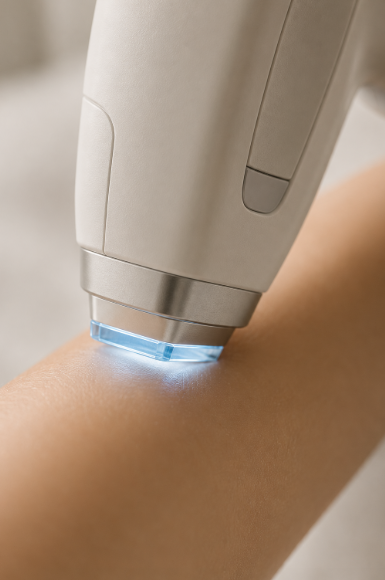
What Affects How Many Laser Hair Removal Sessions You Need?
Hair color and thickness. Dark, coarse hair contains the most pigment and absorbs laser energy most efficiently, so it tends to respond in fewer sessions. Fine, light hair holds less pigment and responds more slowly — and very light blonde, white, or gray hair may not respond at all.
Hair density. More follicles per square inch means more to work through.
The treatment area. Larger surfaces and hormonally sensitive regions generally need more sessions than small, non-hormonal ones.
Hormonal factors. This is the variable most often overlooked. Conditions like PCOS, thyroid disorders, and hormonal shifts from pregnancy or menopause can continue stimulating new follicle activity during and after your series. Patients with PCOS frequently need additional sessions and more regular maintenance — not because the treatment isn’t working, but because new growth keeps arriving. If this applies to you, say so at consultation; it changes the plan meaningfully and it’s better addressed upfront than discovered at session seven.
Your consistency. Missing appointments, drifting off the interval, or waxing between sessions all extend the timeline.
Can You Wax or Shave Between Laser Hair Removal Sessions?
Shaving is the only hair removal method permitted during a laser course. That’s not a preference — it’s structural. Waxing, plucking, threading, and epilating all pull the follicle out by the root, which removes the exact target the laser needs at your next appointment. Do that in the weeks before a session and you’ve effectively wasted it.
Sun exposure and self-tanner matter for the same reason in reverse: both change your skin’s pigment, which changes how it responds to the laser and can force your provider to reduce settings or postpone. Sunscreen on treated areas between sessions is worth the habit.
This is also the practical reason people switch away from waxing before starting: you can’t run both.
Do You Need Maintenance Sessions After Laser Hair Removal?
Follicles successfully disabled during treatment don’t regenerate. What can happen over subsequent years is that previously dormant follicles activate — usually triggered by hormonal change — and produce hair that wasn’t present during your original course.
That’s new growth, not treatment failure. Many people need nothing further. Others benefit from a single maintenance session once or twice a year to stay on top of it, particularly those with hormonal factors in play. It’s worth budgeting for the possibility rather than being surprised by it.
What Happens If You Stop Laser Hair Removal Early?
Stopping partway is the most expensive mistake in laser hair removal.
Each session builds on the last by catching a new cohort of follicles. Stop at three and you’ve paid for three sessions and captured roughly half the available reduction, with the untreated follicles continuing exactly as before. The money is spent either way; the result is only durable if you finish.
This is also why packages usually make more sense than paying visit to visit — they align the purchase with the way the treatment actually works. We break the numbers down in how much does laser hair removal cost.
At SAS Aesthetic Institute in Mokena, treatments are performed under the direction of Michael S. Romberg, MD, FACS, using FDA-cleared Diode laser technology. Every plan starts with an assessment of your skin type, hair color and density, and any hormonal factors, so the session count you’re given reflects your hair rather than a default package. See treatment details on our laser hair removal page or call (708) 476-8205 to schedule a consultation.

People Also Ask

Michael S. Romberg, MD
Dr. Michael S. Romberg is a Board Certified General Surgeon with more than 32 years of experience. His medical expertise includes general and oncologic surgery, wound care, burn care, lymphedema care, and Hyperbaric Oxygen Therapy. He is also an experienced national and international speaker for healthcare professionals and patients.