Yes — laser hair removal for PCOS is one of the most effective treatments available for hormonal hair growth, but it works differently than it does for other patients. Because PCOS continuously stimulates new follicles, most women need more sessions than average, commonly eight to twelve rather than six to eight, followed by ongoing maintenance once or twice a year. Realistic outcomes are substantial reduction and far easier management, not permanent elimination. Results tend to last longest when laser is combined with medical treatment of the underlying hormonal imbalance.
That’s the honest version. A lot of clinics won’t give it to you, because “significant reduction plus lifelong maintenance” sells less well than “permanent removal.” But if you have PCOS, knowing the real shape of the treatment is what makes it work — the women who do best are the ones who went in with accurate expectations.
Why Does PCOS Cause Excess Hair Growth?
Polycystic ovary syndrome raises androgen levels, and androgens change hair at a structural level. Fine, pale vellus hair — the barely-visible hair covering most of the body — converts into coarse, dark terminal hair. That conversion process is what produces hirsutism, and it typically shows up in androgen-sensitive areas: the chin, jawline, upper lip, neck, chest, and abdomen.
This is why PCOS hair feels impossible to manage with shaving and waxing. It’s not just more hair; it’s thicker, darker, faster-growing hair, and the hormonal signal driving it doesn’t stop. You’re not failing to keep up. The condition is actively resupplying.
There’s one genuinely useful piece of news buried in that biology. Coarse, dark terminal hair contains a high concentration of melanin — and melanin is exactly what a laser targets. The hair that’s hardest to manage with a razor is the hair lasers respond to best.
Does Laser Hair Removal for PCOS Actually Work?
It does, and the clinical literature is reasonably consistent on it. Studies and practice data on PCOS patients generally report reduction somewhere in the range of 50 to 80 percent after a completed series, with the higher end more achievable when laser is paired with medical management of androgen levels. Several observational studies have also documented measurable improvements in quality of life and psychological wellbeing following treatment — which, for a symptom this visible, is not a trivial outcome.
What laser will not do is stop your body from producing androgens. It disables the follicles it treats; it doesn’t change the hormonal environment recruiting new ones. That distinction is the entire reason PCOS treatment plans look different, and it’s the thing to hold onto when comparing clinics.
The underlying mechanism is the same as for any patient — we cover it in the complete guide to laser hair removal. What changes with PCOS is the arithmetic.
How Many Sessions Does Laser Hair Removal for PCOS Take?
More than average. Where most patients complete a series in six to eight sessions, women with PCOS commonly need eight to twelve, spaced four to six weeks apart. Facial areas — the most frequently treated and the most hormonally reactive — often sit at the upper end.
The reason isn’t that the laser works less well on PCOS hair. It’s that you’re treating a moving target. A standard series works through a fixed population of follicles; with PCOS, androgens keep converting additional vellus follicles into terminal ones during the months your series is running. Some of what appears at session eight simply wasn’t there at session one.
Plan for the longer course from the beginning rather than discovering it midway. Our breakdown of how many sessions you actually need covers the general timeline, and the cost guide is worth reading alongside it — a longer series changes the budget, and package pricing usually makes more sense here than paying visit to visit.
Why Is Maintenance Necessary With PCOS?

For most patients, maintenance sessions are optional. With PCOS, they’re generally part of the plan.
Follicles successfully disabled during your series don’t come back. But the hormonal driver persists, which means new follicles continue to be recruited over time. Most women with PCOS do well with a touch-up once or twice a year to stay ahead of it. Some need slightly more, some less, depending on how well their hormones are managed.
It’s worth reframing this rather than resenting it. The goal isn’t a single permanent fix — it’s converting a daily, exhausting problem into a twice-yearly appointment. Patients who make that mental shift early report far higher satisfaction than those expecting to be finished forever.
Should You Treat PCOS Medically as Well?
Yes, and this is the part most cosmetic clinics skip.
Laser addresses the hair. It does not address the condition producing it — and PCOS carries implications well beyond hirsutism, including effects on fertility, insulin resistance, and long-term metabolic health. If you have not been formally evaluated, that evaluation matters more than any cosmetic treatment. Work with your primary care physician, gynecologist, or an endocrinologist.
There’s also a practical benefit to treating both. Medical management that lowers androgen activity — approaches your physician might discuss include anti-androgen medications, hormonal contraceptives, or addressing insulin resistance — reduces the rate at which new follicles are recruited. Fewer new follicles means your laser results hold longer between maintenance visits. The two treatments compound rather than compete.
We’re not prescribing here; that’s your physician’s role. But any clinic treating PCOS hirsutism without asking whether your PCOS is being medically managed is giving you half a plan.
Can Laser Hair Removal Make Hair Growth Worse?
Rarely, but it’s a documented phenomenon and you deserve to know about it.
Paradoxical hypertrichosis is an uncommon reaction in which treated areas develop increased hair growth rather than reduction. It’s most often reported on the face and neck, in patients with darker skin tones, and in those with underlying hormonal conditions — a combination that describes a meaningful subset of women with PCOS.
It remains uncommon, and it’s manageable when caught early, typically by adjusting settings or changing approach. The practical safeguards are straightforward: choose a provider who screens for hormonal conditions before treating, request a test patch on facial areas, and have baseline photographs taken so progress is measured objectively rather than from memory. A provider who monitors your response session by session will identify an atypical reaction quickly.
If a clinic has never mentioned this to you, that’s information about the clinic.
Is Laser Hair Removal for PCOS Safe on Darker Skin Tones?
This matters here specifically, because PCOS is common among women of South Asian, Middle Eastern, Hispanic, and Mediterranean heritage, many of whom have olive to deeply pigmented skin.
Modern laser platforms can be used safely across a wide range of skin tones when settings are properly calibrated to the individual. The risk in treating pigmented skin comes from energy intended for one skin type being applied to another, which can cause burns or pigment changes — a settings problem, not an inherent barrier.
That calibration is precisely what physician-led treatment is for. It’s also why a test patch is worth requesting on facial areas or richly pigmented skin before committing to a full session, and why walk-in chains running default presets are the wrong choice for this particular combination of factors.
What to Expect at Your Laser Hair Removal Consultation
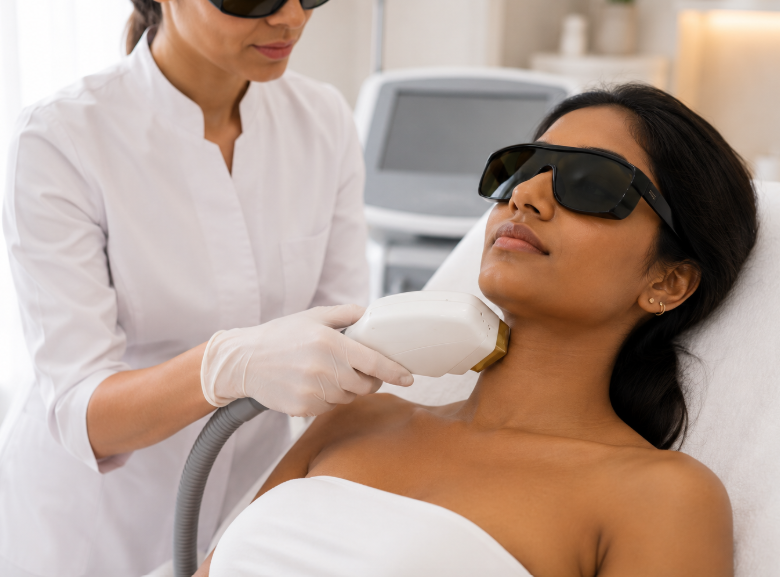
A consultation for PCOS-related hair growth should be more thorough than a standard one. Expect a review of your diagnosis and current medications, an assessment of skin type and hair characteristics, baseline photography, and a realistic session estimate that accounts for the hormonal factor rather than quoting you a standard package.
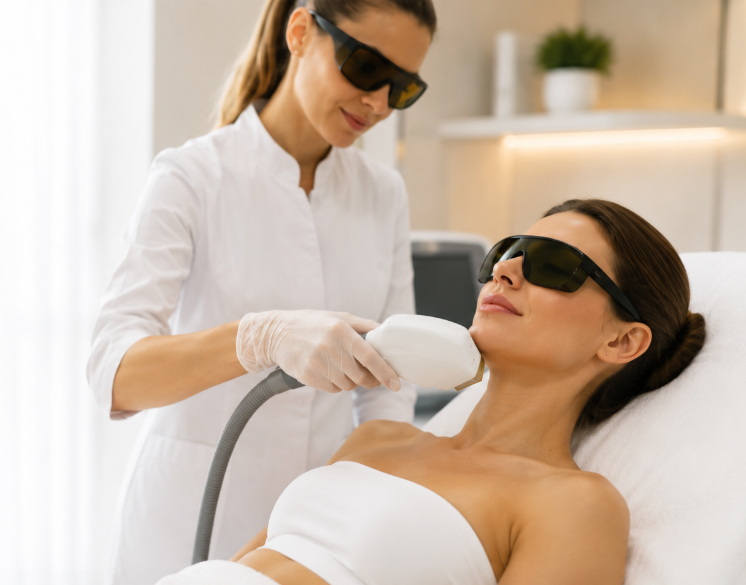
At SAS Aesthetic Institute in Mokena, treatments are performed under the direction of Michael S. Romberg, MD, FACS, using FDA-cleared Diode laser technology, with settings matched to each patient individually. If you have PCOS or suspect you might, say so at consultation — it changes the plan, and it’s far better addressed at the start than discovered at session eight.
See treatment details on our laser hair removal page, or call (708) 476-8205 to schedule. We see patients from Mokena, Frankfort, Orland Park, New Lenox, and Tinley Park.
People Also Ask

Michael S. Romberg, MD
Dr. Michael S. Romberg is a Board Certified General Surgeon with more than 32 years of experience. His medical expertise includes general and oncologic surgery, wound care, burn care, lymphedema care, and Hyperbaric Oxygen Therapy. He is also an experienced national and international speaker for healthcare professionals and patients.