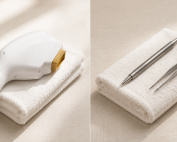
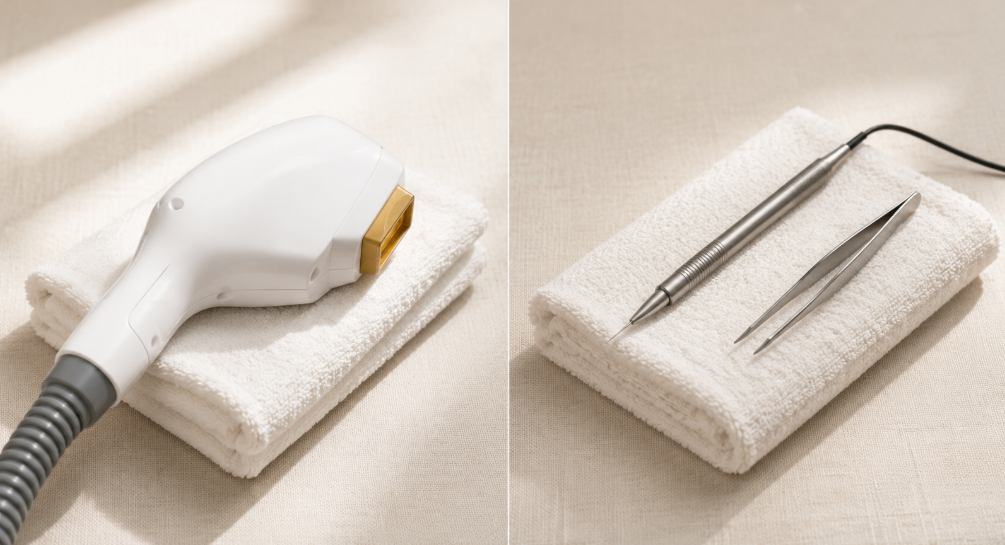
The core difference in laser hair removal vs electrolysis comes down to permanence versus speed. Electrolysis is the only method the FDA recognizes as permanent hair removal, and it works on any hair color including white, grey, blonde, and red — but it treats one follicle at a time, making it slow and impractical for large areas.
Laser is cleared for permanent hair reduction, treats many follicles per pulse, and clears large areas like legs or a back in a single session — but it requires pigment, so it doesn’t work on light-colored hair. For most people with dark hair, laser is the practical choice. For light hair or small stubborn patches, electrolysis is the answer.
Laser Hair Removal vs Electrolysis: What’s the Actual Difference?
Laser targets pigment. A pulse of light passes into the skin, melanin in the hair follicle absorbs it, and the resulting heat damages the follicle’s ability to produce hair. Because each pulse covers an area rather than a point, a laser can treat many follicles simultaneously.
Electrolysis targets the follicle directly. A fine probe is inserted into each individual follicle and an electrical current destroys the growth cells at its base. There’s no pigment involved, which is why hair color is irrelevant — but every follicle must be treated one at a time, by hand.
That single mechanical difference explains nearly every other distinction in laser hair removal vs electrolysis.
Is Electrolysis Really the Only Permanent Hair Removal?
Yes, and this is a legal distinction rather than a marketing one — which is precisely why so many clinics blur it.
The FDA permits electrolysis to be described as permanent hair removal. Laser devices are cleared for permanent hair reduction. Those are different claims, and the difference is meaningful: reduction means a large, lasting decrease in the number of hairs, with regrowth typically finer and lighter, sometimes requiring occasional maintenance. Removal means the treated follicle is destroyed and will not produce hair again.
Any clinic advertising laser as “permanent hair removal” is overstating what the technology is cleared to do. We use the accurate language throughout our complete guide to laser hair removal, and it’s worth knowing the distinction before you compare offers — the clinics most willing to overstate this are rarely the most careful about anything else.
In practice, most laser patients find that “permanent reduction” is functionally close enough to permanence that they stop thinking about the area. But you should choose with accurate information.
Which One Works on Blonde, Grey, White, or Red Hair?
Electrolysis — and it’s not close.
Laser needs melanin to function. White, grey, and very light blonde hair contain little to none, so the laser has essentially nothing to absorb its energy and disable the follicle. Red hair contains a pigment that responds poorly for the same reason. No number of laser sessions overcomes this; it’s a limitation of physics rather than technique or device quality.
Electrolysis destroys the follicle directly with an electrical current, so pigment is irrelevant. It works on every hair color and every skin tone.
If you have light-colored hair, this single factor decides your answer. It’s also the most common reason we tell someone at consultation that laser isn’t right for them.
Which Is Faster? Laser or Electrolysis

Laser, by a wide margin.
A laser pulse treats an area; an electrolysis probe treats one hair. Underarms take minutes with laser. Full legs are completed within a normal appointment. Electrolysis on a small area like the upper lip or chin typically runs 15 to 30 minutes per session, while large areas can require one to two hours per visit.
Total commitment differs just as sharply. Most laser patients complete a series in six to eight sessions over six to twelve months. Electrolysis frequently requires many more appointments — one published comparison put laser at roughly eight sessions against about twenty-four for electrolysis — often with weekly or biweekly visits early on, and courses commonly running twelve to eighteen months or longer for full clearance.
For a back, a chest, or a pair of legs, electrolysis is simply impractical. That’s not a criticism of the method; it’s the tradeoff for treating each follicle individually.
Laser or Electrolysis? Which Costs More?
Electrolysis usually costs less per session and more in total, particularly for larger areas. Sessions are often billed hourly, and the number of hours needed for a large surface adds up well beyond a laser package.
Laser costs more per session and typically less overall for anything larger than a small patch, because far fewer sessions are needed. Our cost guide breaks down laser pricing and how the long-term math compares.
Neither is covered by insurance in ordinary circumstances — both are classified as cosmetic.
Laser Hurts More or Electrolysis?
Most people find electrolysis more uncomfortable, though sessions on small areas are short. The sensation is typically described as a distinct sting or heat at each follicle, repeated hair by hair.
A laser is usually described as a quick snap against the skin, immediately eased by the device’s cooling tip. It’s brief, and it covers many hairs at once rather than one at a time. Comfort varies more by treatment area than by method — bony, thin-skinned regions register more with either approach.
Can You Use Both?
Yes, and combining them is often the smartest approach for people with mixed hair.
The common sequence is laser first to clear the bulk of pigmented hair efficiently, then electrolysis afterward to finish off resistant or light-colored hairs the laser can’t address. This is particularly useful on the face, where a handful of stubborn white or blonde hairs often remain after an otherwise successful laser course.
If you’re planning to do both, tell each provider. Sequencing and timing matter, and coordinating avoids treating the same follicles twice or working at cross purposes.
Laser Hair Removal vs Electrolysis: Which Should You Choose?
Choose laser if your hair is dark, you’re treating a medium or large area, you want results in months rather than years, or you’re addressing something like back, chest, legs, or bikini where treating follicles individually would be unrealistic.
Choose electrolysis if your hair is white, grey, blonde, or red, you’re treating a small precise area like a few chin hairs or an eyebrow line, you want genuinely permanent removal rather than reduction, or laser has left behind a small number of resistant hairs.
Consider both if you have a mix of dark and light hair in the same area — laser for the bulk, electrolysis to finish.
Getting an Honest Assessment For Your Hair Removal Treatment
At SAS Aesthetic Institute in Mokena, we perform laser hair removal under the direction of Michael S. Romberg, MD, FACS, using FDA-cleared Diode laser technology. We don’t offer electrolysis — which is exactly why we’ll tell you plainly if it’s the better option for your hair.
A consultation covers your hair color and density, skin type, and treatment area, and produces a realistic assessment rather than a sales pitch. If your hair won’t respond to laser, you’ll hear that, along with a recommendation to see a licensed electrologist. Paying for sessions that can’t work isn’t a good outcome for anyone.
See treatment details on our laser hair removal page or call (708) 476-8205. We see patients from Mokena, Frankfort, Orland Park, New Lenox, and Tinley Park.


Michael S. Romberg, MD
Dr. Michael S. Romberg is a Board Certified General Surgeon with more than 32 years of experience. His medical expertise includes general and oncologic surgery, wound care, burn care, lymphedema care, and Hyperbaric Oxygen Therapy. He is also an experienced national and international speaker for healthcare professionals and patients.