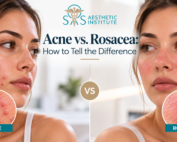
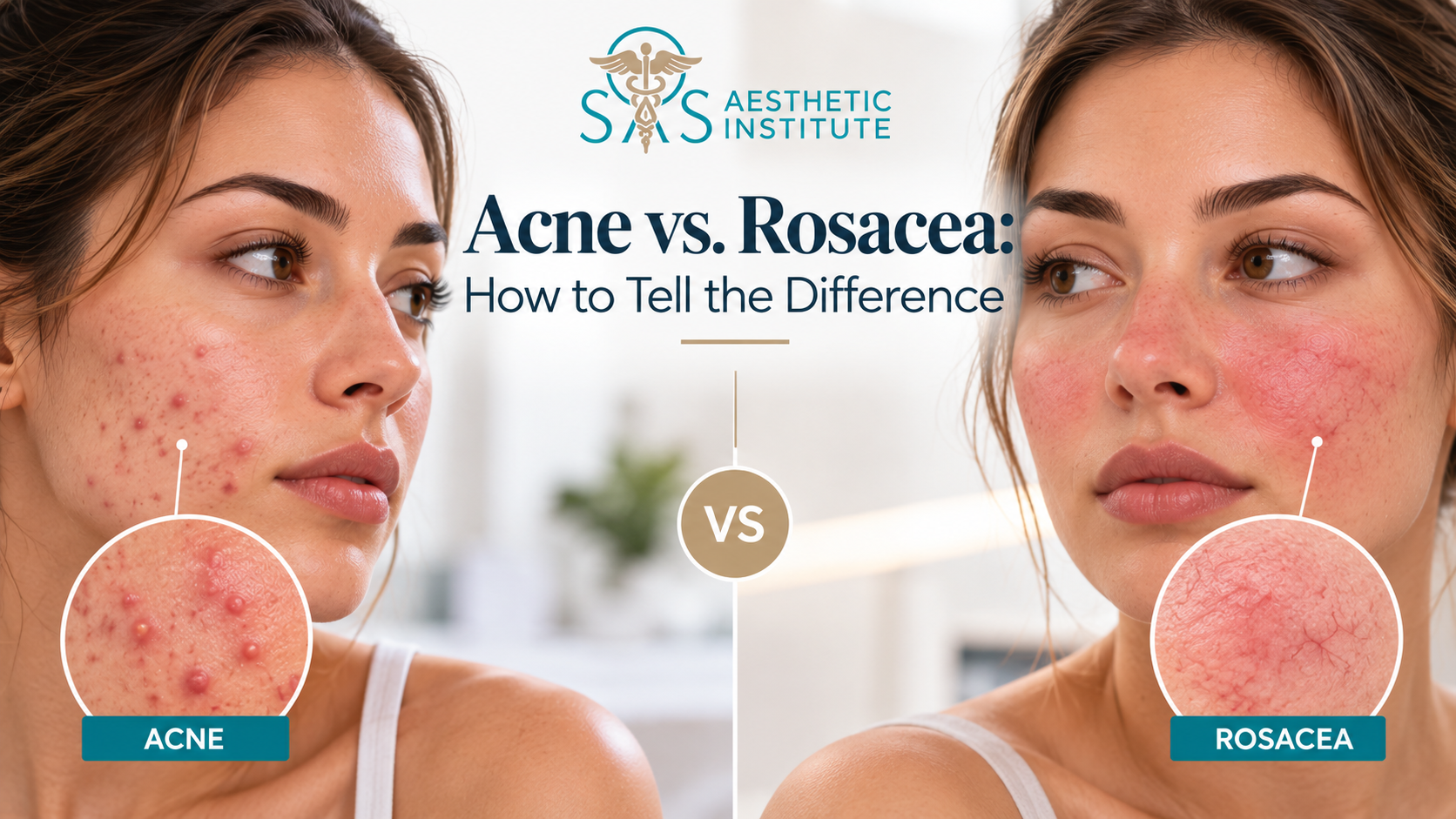
A red, bumpy face does not automatically mean acne.
Rosacea can also cause facial redness, inflamed bumps and pustules that look surprisingly similar to breakouts.
That overlap is one reason some patients spend months treating what they believe is acne without seeing meaningful improvement.
They may add stronger cleansers, exfoliating acids, drying spot treatments and acne products while the underlying problem is actually rosacea—or a combination of rosacea and acne.
The reverse can happen too.
Persistent acne may be mistaken for sensitive or redness-prone skin when clogged pores and inflammation are actually driving the problem.
The distinction matters because acne and rosacea are different conditions.
They can share certain visible features, but they tend to follow different patterns and do not always respond to the same treatment.
At SAS Aesthetic Institute in Mokena, Dr. Michael Romberg, MD, evaluates the full pattern of the skin rather than identifying a condition from one red bump.
What Is the Main Difference Between Acne and Rosacea?
Acne primarily involves clogged hair follicles, oil production and inflammation, while rosacea is a chronic inflammatory facial condition commonly associated with persistent redness, flushing, visible blood vessels and sometimes acne-like bumps.
The appearance can overlap.
A person with acne may have red inflammatory pimples.
A person with rosacea may also have red inflammatory bumps or pustules.
That is why one lesion by itself may not tell the entire story.
Other clues matter, including:
- Whether blackheads or whiteheads are present
- Whether the face flushes easily
- Whether redness remains between breakouts
- Whether small visible blood vessels are present
- Where the bumps appear
- Whether certain triggers repeatedly cause flares
- Whether the eyes are irritated
- Whether the skin burns or stings easily
The pattern is often more useful than one individual symptom.
Acne vs. Rosacea at a Glance
| Feature | Acne | Rosacea |
|---|---|---|
| Blackheads | Common | Typically not a defining feature |
| Whiteheads | Common | Typically not a defining feature |
| Red bumps | Common | Common |
| Pustules | Can occur | Can occur |
| Persistent facial redness | May occur around inflamed lesions | Common feature |
| Facial flushing | Not typical of acne itself | Common |
| Visible small blood vessels | Not a typical acne feature | May occur |
| Deep nodules or cysts | Can occur | Not typical |
| Oily skin | Common in many patients | Skin may be oily, dry or sensitive |
| Burning or stinging | Usually related to irritation rather than acne itself | Can occur |
| Eye irritation | Not a usual acne feature | Can occur |
| Common locations | Face, chest, back, shoulders | Primarily central face |
| Scarring | Possible, especially with deep acne | Does not usually behave like acne scarring |
| Triggered flushing | Not a typical acne pattern | Can be an important clue |
This table can help identify patterns, but skin conditions should not be diagnosed from a checklist alone.
Some patients can have more than one condition at the same time.
What Does Acne Usually Look Like?
Acne can take several forms.
Blackheads
Blackheads are open clogged pores.
They often appear as small dark dots, particularly around the nose, forehead and chin.
The dark material is not dirt.
Whiteheads
Whiteheads are closed clogged follicles.
They may look like small flesh-colored or white bumps beneath the skin.
Papules
Papules are inflamed red bumps that do not contain visible pus.
Pustules
Pustules are inflamed lesions with visible pus.
Nodules
Nodules develop deeper beneath the skin and may be painful.
Cystic Lesions
Deep cystic acne can remain inflamed for an extended period and carries a greater risk of permanent scarring.
The presence of blackheads and whiteheads is especially useful when distinguishing acne from rosacea.
Rosacea can create acne-like bumps, but clogged pores are much more characteristic of acne.
For a broader understanding of acne types and causes, read our Complete Guide to Acne.
What Does Rosacea Usually Look Like?
Rosacea often centers around facial redness.
A patient may notice that the cheeks, nose, chin or central forehead become red more easily than they used to.
Over time, redness may become more persistent.
Other features can include:
- Flushing
- Red or pink facial skin
- Small visible blood vessels
- Red bumps
- Pustules
- Skin sensitivity
- Burning
- Stinging
- Swelling
- Dry or rough-feeling skin
- Eye irritation in some patients
Not everyone with rosacea experiences all of these symptoms.
One patient may primarily have redness and visible vessels.
Another may have acne-like bumps.
Another may experience frequent flushing with very sensitive skin.
Can Rosacea Look Like Acne?
Yes.
This is one of the main reasons the two conditions become confused.
Rosacea can cause inflamed bumps and pustules that resemble acne.
A patient may look in the mirror and think:
“I am breaking out.”
But there may be important differences.
For example, someone with rosacea may have:
- Red inflammatory bumps
- Persistent background redness
- Easy flushing
- Visible facial vessels
- Sensitive or burning skin
without having the blackheads and whiteheads commonly seen in acne.
The surrounding skin often provides important clues.
Does Rosacea Cause Blackheads?
Blackheads are not a typical feature of rosacea.
If numerous blackheads or whiteheads are present, acne becomes more likely.
This is one of the simplest distinctions patients can look for.
However, it is possible for someone to have both acne and rosacea.
In that situation, clogged pores may be present because of acne while persistent redness and flushing come from rosacea.
Can You Have Acne and Rosacea at the Same Time?
Yes.
Skin conditions do not always occur one at a time.
A patient may have:
- Blackheads and whiteheads from acne
- Inflammatory pimples
- Persistent facial redness
- Visible vessels
- Flushing
all at once.
This can make treatment more complicated because a very aggressive acne routine may irritate rosacea-prone skin.
A treatment plan should therefore identify which features belong to which condition.
Where Does Acne Usually Appear?
Acne can affect areas of the body with active sebaceous glands.
Common locations include:
- Forehead
- Nose
- Chin
- Jawline
- Cheeks
- Neck
- Chest
- Shoulders
- Upper back
Body involvement can be an important clue.
Rosacea primarily affects the face.
A patient with inflammatory bumps across the face, chest and back is much more likely to be dealing with acne than rosacea alone.
Where Does Rosacea Usually Appear?
Rosacea typically affects the central part of the face.
Common areas include:
- Cheeks
- Nose
- Chin
- Central forehead
Redness may initially come and go.
Over time, it can become more persistent.
The skin may also become more reactive to heat, skin-care products or environmental changes.
Is Facial Redness Always Rosacea?
No.
Facial redness has many possible causes.
Redness may occur because of:
- Active acne inflammation
- Rosacea
- Skin irritation
- Over-exfoliation
- Sun exposure
- Allergic or irritant reactions
- Recent procedures
- Heat
- Exercise
- Other inflammatory skin conditions
The pattern helps differentiate them.
Redness directly surrounding an inflamed acne lesion is different from broad, persistent redness across both cheeks.
How Is Acne Redness Different From Rosacea Redness?
Acne-related redness is often concentrated around individual inflamed lesions.
For example, a pimple may have a red halo around it.
After the pimple heals, a flat red or pink mark can sometimes remain.
Rosacea redness tends to be more diffuse.
Instead of appearing only around individual bumps, redness may involve broader areas of the central face.
A person may also notice episodes of flushing where the entire area becomes noticeably red.
What Does Facial Flushing Tell You?
Frequent flushing can be an important rosacea clue.
A person may suddenly become red after exposure to something that increases facial blood flow or triggers skin reactivity.
Examples may include:
- Heat
- Hot showers
- Exercise
- Spicy foods
- Alcohol
- Emotional stress
- Rapid temperature changes
- Sun exposure
Not everyone reacts to the same triggers.
The important clue is repetition.
If the face repeatedly becomes very red after the same situations, that pattern is worth paying attention to.
Acne itself does not usually cause repeated whole-face flushing.
Does Heat Make Rosacea Worse?
It can.
Heat is a common trigger for facial flushing in rosacea-prone skin.
Patients may notice increased redness after:
- Hot weather
- Hot showers
- Saunas
- Intense exercise
- Sitting near a heat source
A person may initially think their skin is simply “sensitive to heat.”
Repeated flushing may provide a clue that rosacea is involved.
Can Stress Affect Acne and Rosacea?
Yes, but in different ways.
Stress can aggravate inflammatory skin conditions.
For acne-prone patients, stress may coincide with increased breakouts.
For rosacea-prone patients, emotional stress may contribute to flushing or a flare in redness.
Stress is not usually the only cause of either condition.
It is better thought of as one possible aggravating factor.
Does Rosacea Cause Oily Skin?
Rosacea does not have one universal skin type.
Some patients have oily skin.
Others have dry or sensitive skin.
Some have a combination.
Acne is more commonly associated with excess sebum and clogged follicles, although acne can occur in people who do not feel especially oily.
Skin type alone cannot distinguish the two conditions.
Why Does Rosacea Skin Sometimes Burn or Sting?
Rosacea-prone skin may be unusually reactive.
Products that once felt comfortable may begin causing:
- Burning
- Stinging
- Tightness
- Redness
- Sensitivity
This can become worse when a patient thinks they have acne and begins aggressively treating the skin.
For example, repeatedly combining exfoliating acids, scrubs and drying spot treatments may further irritate already reactive skin.
That is one reason getting the diagnosis right matters.
Can Acne Products Make Rosacea Worse?
They can.
This does not mean every acne ingredient is automatically inappropriate for every patient with rosacea.
The issue is irritation.
Strong or frequently layered acne products can aggravate redness, dryness and sensitivity.
A person who mistakes rosacea for acne may gradually increase the strength of their routine because the “breakouts” are not disappearing.
The skin then becomes more inflamed, which may make the original condition harder to recognize.
Can Scrubbing Help Acne or Rosacea?
No.
Neither condition is caused by failing to scrub hard enough.
Aggressive exfoliation can irritate the skin barrier.
For acne, scrubbing does not remove clogged follicles from beneath the skin.
For rosacea, excessive friction may make already sensitive skin more reactive.
Gentle cleansing is generally a better starting point.
Does Rosacea Cause Pimples?
Rosacea can cause acne-like inflammatory bumps.
These may include red papules and pustules.
However, rosacea is not simply another form of acne.
The conditions behave differently and should not be treated as though they are interchangeable.
Acne Bumps vs. Rosacea Bumps
The appearance of individual bumps can overlap.
A better comparison is to look at everything surrounding them.
Acne Is More Likely When You See:
- Blackheads
- Whiteheads
- Oily or clogged pores
- Deep nodules
- Cystic lesions
- Breakouts on the chest or back
- Acne scars
Rosacea Is More Likely When You See:
- Persistent central facial redness
- Easy flushing
- Visible facial vessels
- Burning or stinging
- Facial sensitivity
- Acne-like bumps without many clogged pores
- Eye irritation
- Flares associated with heat or other triggers
Both conditions can still occur together.
Can Rosacea Affect the Eyes?
Yes.
Some patients with rosacea develop eye-related symptoms.
These may include:
- Dryness
- Burning
- Grittiness
- Red eyes
- Irritated eyelids
- Watery eyes
Eye symptoms are not a typical feature of ordinary acne.
If facial redness and acne-like bumps occur along with persistent eye irritation, that information should be mentioned during an evaluation.
Can Rosacea Change the Nose?
In more advanced cases, rosacea can sometimes cause thickening of the skin, particularly around the nose.
This is very different from acne.
Skin thickening does not happen to everyone with rosacea, and early facial redness does not mean that this change will automatically develop.
Still, persistent rosacea should be treated as a real skin condition rather than simply cosmetic redness.
Does Acne Cause Visible Blood Vessels?
Acne itself does not typically create the fine visible facial vessels commonly associated with rosacea.
Redness around acne can certainly occur.
However, small persistent vessels across the cheeks or around the nose can point more toward vascular redness or rosacea.
This is especially relevant when the skin also flushes easily.
What Is Post-Acne Redness?
After an acne lesion heals, a flat red or pink mark may remain.
This can be mistaken for rosacea.
The difference is that post-acne redness often follows the exact location of a previous pimple.
Rosacea redness is usually broader and follows a facial pattern rather than appearing only where a blemish recently healed.
A patient can also have both.
Can Rosacea Leave Acne Scars?
Rosacea bumps do not typically produce the same type of depressed scars associated with deep nodular or cystic acne.
If there are multiple pitted or indented scars, a history of acne becomes more likely.
However, persistent redness and visible vessels can remain with rosacea, creating a different type of long-term skin concern.
Does Hormonal Acne Look Like Rosacea?
Sometimes the two can be confused, but hormonal acne generally still behaves like acne.
A patient may notice inflammatory lesions along the lower face, chin or jawline.
There may also be:
- Whiteheads
- Clogged pores
- Recurring lesions
- Breakouts following a predictable hormonal pattern
Rosacea more commonly centers around redness, flushing and vascular changes.
Location alone is not enough to identify either one.
For more information on adult breakout patterns, see our guide to Adult Acne.
Can Teenagers Get Rosacea?
Rosacea is more commonly recognized in adults, while acne is extremely common during adolescence.
That means a teenager with blackheads, whiteheads and inflammatory pimples is more likely to have acne.
However, age by itself does not diagnose a skin condition.
Persistent unusual redness, sensitivity or symptoms that do not fit a typical acne pattern still deserve evaluation.
Our Teen Acne Guide explains teenage breakout patterns in more detail.
Why Does Correct Diagnosis Matter So Much?
Because treatment depends on what is actually causing the problem.
Imagine someone has persistent facial redness and rosacea-like bumps.
They assume they have acne.
They begin:
- Scrubbing harder
- Using stronger exfoliants
- Applying more drying products
- Picking at bumps
- Frequently switching treatments
The redness gets worse.
They conclude that they have “very stubborn acne.”
But the problem may be that they are aggressively treating the wrong condition.
The reverse can happen when true acne is dismissed as simple sensitivity.
Accurate identification changes the treatment strategy.
What If You Cannot Tell Which One You Have?
That is common.
You do not need to diagnose yourself perfectly before having the skin evaluated.
It can help to pay attention to:
Clogged Pores
Do you have visible blackheads or whiteheads?
Flushing
Does your entire face suddenly become red?
Location
Is the problem only on the central face, or do you also have chest and back breakouts?
Triggers
Does redness consistently appear after heat, exercise, spicy food or other situations?
Sensitivity
Does the skin frequently burn or sting?
Deep Lesions
Are you getting painful nodules or cysts beneath the skin?
Eye Symptoms
Do you also experience persistent eye irritation?
Those observations can make the pattern easier to identify.
How Is Acne Treated?
Acne treatment depends on lesion type and severity.
The plan may focus on:
- Reducing follicular plugging
- Managing oil production
- Controlling inflammation
- Reducing new breakouts
- Preventing scarring
- Treating persistent redness or discoloration
Some patients may need only a basic topical routine.
Others may need physician-guided care or technology-based treatment.
At SAS Aesthetic Institute, the goal is to identify which acne concerns are active and then choose treatment based on the pattern rather than applying the same approach to every patient.
Learn more about our full approach on the Acne Treatment in Mokena page.
How Is Rosacea Treated?
Rosacea treatment depends on which features are most prominent.
One patient may be most concerned about persistent redness.
Another may have visible facial vessels.
Another may have inflammatory bumps.
Treatment planning can include:
- Identifying personal triggers
- Using gentle skin care
- Protecting the skin from excessive sun exposure
- Reducing irritation
- Addressing persistent redness
- Treating visible vessels
- Managing inflammatory bumps
There is no single rosacea treatment that is appropriate for every patient.
How Does ADVATx Fit Into Acne and Rosacea Treatment?
At SAS Aesthetic Institute, ADVATx is one of the technologies used for selected acne and redness-related concerns.
The platform uses 589 nm and 1319 nm wavelengths, which can be selected differently depending on what is actually being treated.
That matters because acne and rosacea can both create redness, but the reason for the redness may be different.
For example, a patient may have:
- Active inflammatory acne
- Persistent post-acne redness
- Rosacea-related facial redness
- Visible facial vessels
- Acne together with rosacea
- Lingering redness after breakouts
These concerns should not automatically receive the same treatment settings.
ADVATx gives the treatment plan flexibility to address different components of the skin concern when appropriate.
The technology should still follow the diagnosis.
The goal is not to choose ADVATx simply because redness is visible.
The goal is to identify why the skin is red and then determine whether ADVATx belongs in the treatment plan.
Learn more about the ADVATx technology used at SAS Aesthetic Institute.
Can ADVATx Help Active Acne?
In selected patients, ADVATx may be incorporated into a broader acne treatment plan.
The treatment goal may involve active inflammatory acne, persistent redness or other acne-related changes.
A patient whose primary concern is clogged pores may need a different strategy from someone whose acne is predominantly red and inflammatory.
That is why ADVATx is not presented as a universal acne cure.
It is one treatment tool that can be selected based on the acne pattern.
For a deeper explanation, read Can Laser Treatment Help Active Acne?.
Can ADVATx Help Rosacea Redness?
ADVATx may also be considered for selected patients with rosacea-related redness and visible vascular changes.
The treatment approach depends on factors such as:
- The pattern of redness
- Visible vessels
- Skin sensitivity
- How easily the patient flushes
- Other symptoms
- Previous treatment
- Whether acne is also present
This overlap is one reason distinguishing acne from rosacea is so important.
The same patient may have both acne inflammation and vascular redness, but those concerns still need to be identified individually.
Can Laser Treatment Help Acne Redness?
Yes, in selected patients.
The important first step is determining what the redness represents.
It may be:
- Active inflammatory acne
- A recently healed acne lesion
- Persistent post-acne redness
- Rosacea
- Visible vessels
- Another inflammatory skin concern
Treatment should be based on the source of the redness rather than the color alone.
What Should You Avoid If You Think You Have Rosacea?
Until you understand what is causing the redness, avoid making the routine unnecessarily aggressive.
Be cautious about:
- Harsh scrubs
- Excessive exfoliation
- Frequent product changes
- Very hot water
- Picking at bumps
- Layering several irritating active ingredients
- Treating every red spot like a clogged pore
Keeping the routine simple can make it easier to see the natural pattern of the skin.
What Should You Avoid If You Have Acne?
Acne also benefits from avoiding unnecessary irritation.
Common mistakes include:
- Picking
- Squeezing
- Scrubbing aggressively
- Starting many new products at once
- Changing treatments every few days
- Using pore-clogging products
- Ignoring deep or scarring acne for too long
Acne-prone skin does not need to feel painfully dry for treatment to be working.
When Should Facial Redness or Acne-Like Bumps Be Evaluated?
Consider having the skin evaluated when:
- Redness does not go away
- Flushing is becoming more frequent
- Visible facial blood vessels are appearing
- The skin burns or stings
- Acne-like bumps continue returning
- Blackheads or whiteheads are also present
- Acne treatment is making the skin more irritated
- Deep or painful lesions are developing
- Scarring is beginning
- Eye irritation accompanies facial redness
- You simply cannot tell whether the problem is acne, rosacea or both
A proper evaluation can prevent months of treating the wrong condition.
Frequently Asked Questions About Acne vs. Rosacea
How can I tell acne from rosacea?
Blackheads, whiteheads, deep pimples and body breakouts point more toward acne. Persistent central facial redness, flushing and visible blood vessels point more toward rosacea.
Can rosacea cause pimples?
Rosacea can cause red bumps and pustules that look similar to pimples, but rosacea is not the same condition as acne.
Does rosacea have blackheads?
Blackheads are much more characteristic of acne and are not a defining feature of rosacea.
Can acne cause facial redness?
Yes. Active pimples can become red and inflamed, and flat red marks may remain after acne heals.
Does rosacea cause clogged pores?
Clogged pores are much more characteristic of acne.
Can I have acne and rosacea together?
Yes. A person can have clogged pores and acne lesions while also experiencing rosacea-related redness and flushing.
Does jawline acne mean rosacea?
Usually not. Jawline breakouts more commonly fit an acne pattern, although location alone cannot determine the diagnosis.
Does rosacea only affect the cheeks?
No. Rosacea commonly affects the cheeks and nose but can also involve the chin, forehead and eyes.
Can rosacea occur on the back?
Rosacea primarily affects the face. Breakouts on the face, chest and back together are much more typical of acne.
Can acne products worsen rosacea?
Aggressive or irritating acne products can aggravate rosacea-prone skin, particularly when several strong ingredients are combined.
Can ADVATx help both acne and rosacea?
In selected patients, ADVATx may be used for acne-related inflammation, persistent redness, rosacea-related redness or visible vessels. The treatment goal depends on what is actually present in the skin.
Is facial flushing a sign of acne?
Frequent flushing of broad areas of the face is not a typical acne symptom and may point more toward rosacea or another cause of facial redness.
Are acne scars and rosacea redness the same thing?
No. Acne scars are structural changes in the skin. Rosacea-related redness is a vascular and inflammatory concern.
Should I treat redness with acne products?
Not automatically. The cause of the redness should be identified first.
Do Not Treat Every Red Bump Like Acne
Acne and rosacea are a good example of why skin treatment should begin with understanding the problem rather than choosing a product or procedure first.
Both conditions can create red bumps.
Both can affect the face.
Both can become inflamed.
But the surrounding pattern can be very different.
Blackheads, whiteheads, deep lesions and body breakouts support an acne pattern.
Persistent redness, flushing, visible vessels and facial sensitivity support a rosacea pattern.
And some patients have features of both.
At SAS Aesthetic Institute, Dr. Michael Romberg, MD, evaluates the full pattern of the skin before recommending treatment.
For patients dealing primarily with breakouts, read our Complete Guide to Acne and learn more about Acne Treatment in Mokena.
For patients with active acne, persistent redness, rosacea or visible facial vessels, ADVATx may be one of the technologies considered as part of an individualized treatment plan.
SAS Aesthetic Institute
19657 South La Grange Road, Mokena, IL 60448
(708) 476-8205

Michael S. Romberg, MD
Dr. Michael S. Romberg is a Board Certified General Surgeon with more than 32 years of experience. His medical expertise includes general and oncologic surgery, wound care, burn care, lymphedema care, and Hyperbaric Oxygen Therapy. He is also an experienced national and international speaker for healthcare professionals and patients.