Hormonal acne is one of the most commonly used terms in conversations about breakouts.
A pimple appears on the chin and someone says:
“It must be hormonal.”
Breakouts return before a menstrual period and the conclusion becomes:
“My hormones are out of balance.”
Sometimes hormones really are an important part of the acne pattern.
But hormonal acne is more complicated than the location of one breakout.
Acne develops through several interacting processes involving oil production, clogged follicles and inflammation. Hormones—particularly androgens—can influence those processes by stimulating the sebaceous glands and changing how much oil the skin produces.
That means hormones can contribute to acne without necessarily meaning that someone has abnormal hormone levels or an underlying hormonal disorder.
The pattern matters.
At SAS Aesthetic Institute in Mokena, Dr. Michael Romberg, MD, evaluates recurring acne by looking at the patient’s age, breakout pattern, timing, lesion type, medical history, products, medications and other symptoms rather than assuming every chin or jawline breakout is hormonal.
What Is Hormonal Acne?
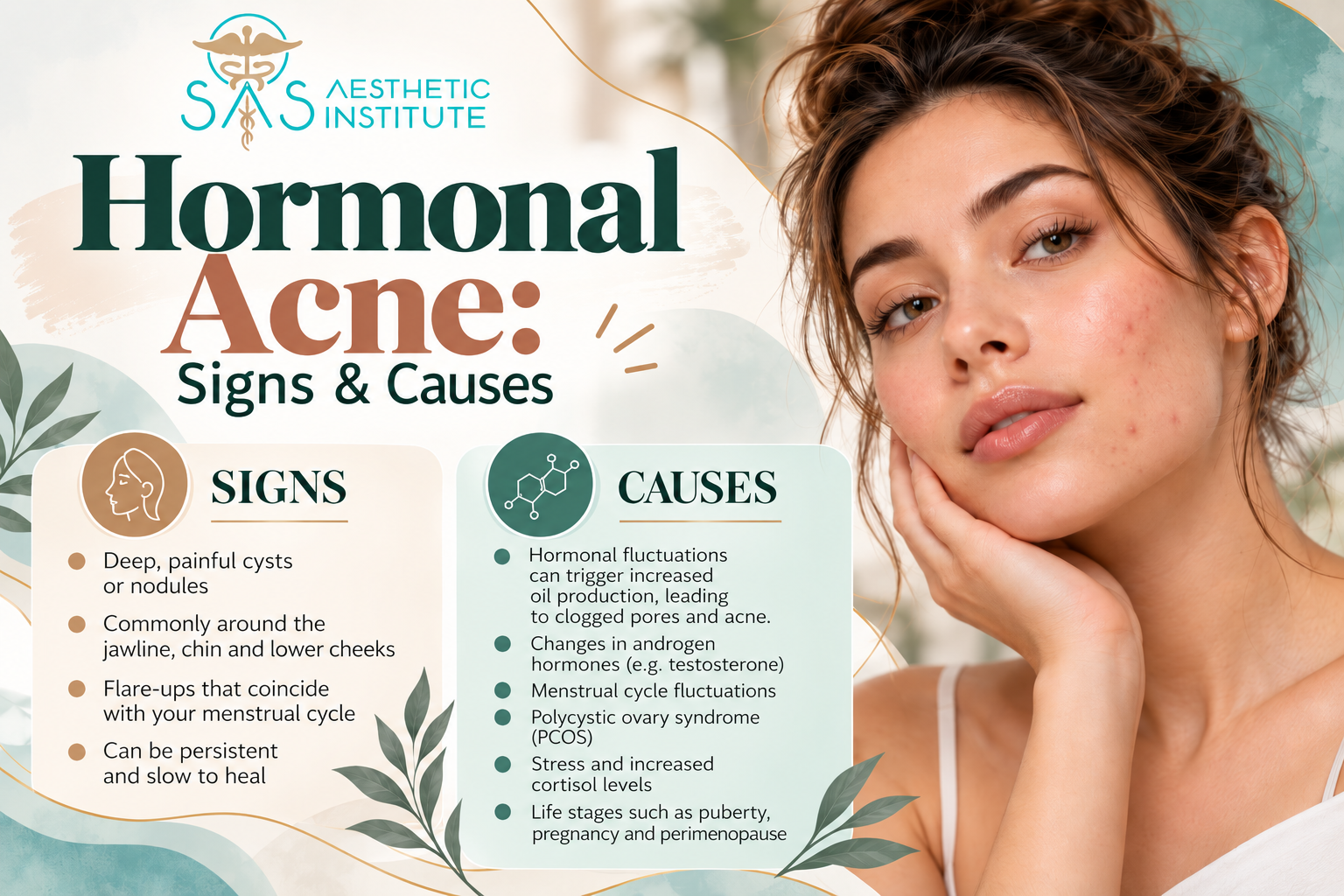
Hormonal acne is acne in which hormonal activity appears to play an important role in the pattern or recurrence of breakouts.
Hormones influence the sebaceous glands that produce oil in the skin.
Androgens can increase sebum production and affect activity within the follicle.
When excess oil combines with accumulated skin cells, the follicle can become clogged.
Inflammation can then develop, creating acne lesions such as:
- Blackheads
- Whiteheads
- Papules
- Pustules
- Nodules
- Cystic lesions
Hormones are therefore one possible driver within the larger acne process.
They are not the only factor involved.
For a broader explanation of how acne develops, read our Complete Guide to Acne.
Does Hormonal Acne Mean Your Hormones Are Abnormal?
Not necessarily.
This is an important distinction.
A person can experience hormonally influenced acne even when circulating hormone levels are within expected ranges.
The skin itself can respond strongly to normal hormonal fluctuations.
Sebaceous glands may be particularly sensitive to androgen activity, which can influence oil production and follicular behavior.
That means recurring acne around certain hormonal changes does not automatically prove that someone has a hormonal disorder.
At the same time, acne can occasionally appear along with other symptoms that make additional medical evaluation appropriate.
The entire clinical picture matters more than acne alone.
What Does Hormonal Acne Usually Look Like?
There is no single appearance that proves acne is hormonal.
However, certain patterns can raise the possibility of hormonal influence.
These may include:
- Breakouts that repeatedly follow a menstrual pattern
- Acne concentrated along the lower face
- Chin or jawline breakouts
- Deeper inflammatory lesions
- Tender nodules
- Acne that repeatedly returns in similar locations
- Adult acne that persists beyond adolescence
- Acne that begins or changes after stopping hormonal contraception
- Breakouts associated with pregnancy or postpartum hormonal changes
- Acne that changes during perimenopause
The key word is pattern.
One pimple on the chin does not provide enough information by itself.
Does Jawline Acne Automatically Mean Hormonal Acne?
No.
Jawline and chin acne are frequently associated with hormonal patterns, particularly in adult women.
But location alone is not enough to determine the cause.
Breakouts in the same area may also be influenced by:
- Cosmetics
- Skin-care products
- Hair products
- Friction
- Touching the face
- Hair removal
- Occlusive products
- Picking
- Other acne mechanisms
A lower-face distribution can be a clue.
It is not a hormone test.
Why Do Hormones Affect Acne?
Hormones can influence several processes related to acne.
One important effect involves the sebaceous glands.
These glands produce sebum, the oily substance that helps protect the skin.
Sebum is not inherently unhealthy.
The problem occurs when increased oil production combines with abnormal buildup inside the follicle.
The follicle can become clogged, creating an environment where inflammation develops more easily.
Androgen activity can therefore contribute to:
- Increased sebaceous gland activity
- Increased sebum production
- Clogged follicles
- Inflammatory acne
Hormones are one piece of the acne process rather than the entire explanation.
What Are Androgens?
Androgens are a group of hormones present in both men and women.
They include hormones such as testosterone and related compounds.
During puberty, androgen activity increases significantly.
That is one reason acne becomes so common during adolescence.
The sebaceous glands respond by becoming more active and producing more oil.
But androgen influence does not disappear after the teenage years.
Hormonal changes continue throughout adulthood.
This helps explain why some adults continue experiencing acne or develop new acne later in life.
Why Does Acne Get Worse Before a Period?
Some women notice a very predictable pattern:
Skin looks relatively calm for part of the month, then breakouts appear during the days leading up to menstruation.
Hormone levels naturally fluctuate throughout the menstrual cycle.
Those changes can influence sebaceous activity and inflammation in acne-prone skin.
The result may be recurring breakouts at approximately the same time each month.
A useful clue is consistency.
If acne repeatedly worsens during the same portion of the cycle, that pattern is more meaningful than one random breakout.
Should You Track Your Acne With Your Menstrual Cycle?
It can be useful.
You do not need an elaborate system.
For several months, note:
- When new acne appears
- Where it appears
- Whether lesions are superficial or deep
- When the menstrual period begins
- When the skin improves
- Whether other symptoms change at the same time
Photographs taken under similar lighting can also be helpful.
Patterns that are difficult to notice from day to day often become obvious when viewed across several months.
Can Hormonal Acne Start in Your 20s or 30s?
Yes.
Acne does not always end after adolescence.
Some adults continue experiencing acne that began during the teenage years.
Others have acne that improves and later returns.
And some develop acne for the first time as adults.
Hormonal changes throughout adulthood can influence these patterns.
For more information about adult breakouts, read Adult Acne: Why Breakouts Can Start or Continue After Your Teen Years.
Can Hormonal Acne Begin in Your 40s?
It can.
Hormonal activity continues changing throughout adult life.
Women entering perimenopause may experience changes in the balance of reproductive hormones.
Some begin developing breakouts despite having had relatively clear skin for years.
This can be especially frustrating because the surrounding skin may simultaneously become:
- Drier
- More sensitive
- Less tolerant of harsh acne products
An aggressive teenage acne routine may therefore be poorly suited for someone developing breakouts at age 42.
Treatment should reflect both the acne and the current condition of the skin.
Can Menopause Cause Acne?
Hormonal changes during the years surrounding menopause can contribute to breakouts in some women.
The acne pattern may be different from adolescent acne.
For example, a patient may experience:
- Fewer overall lesions
- Deeper individual breakouts
- Lower-face acne
- Increased sensitivity
- Drier surrounding skin
Sudden or unusually severe acne later in life should be evaluated rather than automatically attributed to menopause.
Can Pregnancy Affect Acne?
Yes.
Pregnancy causes significant hormonal changes, and the skin can respond in different ways.
Some patients notice improvement.
Others develop new or worsening acne.
Treatment during pregnancy requires additional consideration because not every acne medication or ingredient is appropriate during pregnancy.
If someone is pregnant, planning pregnancy or breastfeeding, that information should be part of treatment planning from the beginning.
Can Acne Change After Stopping Birth Control?
It can.
Hormonal contraception can influence hormone activity and acne patterns.
When hormonal contraception is stopped, the skin may respond to the change.
Some patients who had relatively clear skin while using hormonal contraception notice breakouts returning afterward.
This does not necessarily mean the contraception permanently “fixed” or “caused” acne.
It may simply have been influencing one of the hormonal factors affecting the skin.
Can Starting Birth Control Change Acne?
Yes.
Depending on the formulation and the individual patient, hormonal contraception can change acne activity.
Some patients may notice improvement.
Others may notice a change in breakouts after beginning or changing contraception.
If acne changes shortly after a medication or hormonal treatment change, the timing is worth mentioning during a medical evaluation.
Do not stop a prescribed medication solely because of acne without discussing it with the clinician managing that medication.
Is Hormonal Acne Always Cystic?
No.
Hormonal influences can contribute to different acne lesions.
A patient may experience:
- Whiteheads
- Inflamed papules
- Pustules
- Nodules
- Deeper cystic lesions
However, many patients who describe their acne as hormonal are particularly bothered by deeper, tender lesions along the lower face.
These lesions may last longer than superficial pimples and can carry a greater risk of persistent marks or scarring.
Why Does Hormonal Acne Keep Coming Back in the Same Spot?
Acne can recur in similar areas for several reasons.
The follicles in that area may remain particularly acne-prone.
Hormonal activity may repeatedly stimulate oil production.
Inflammation may also develop in neighboring follicles, making it appear as though the exact same pimple returned.
Picking can make recurrence appear worse because the area remains inflamed for longer.
The more useful question is not:
“Why does this exact pimple keep coming back?”
but:
“Why does this area repeatedly develop inflammatory acne?”
Our article Why Does Acne Keep Coming Back? looks at recurring breakouts in greater detail.
Can Hormonal Acne Appear on the Cheeks?
Yes.
Hormonal acne is not restricted to the chin and jawline.
The location of acne may provide clues, but acne can affect:
- Forehead
- Cheeks
- Nose
- Chin
- Jawline
- Neck
- Chest
- Back
- Shoulders
That is another reason location should never be used as the only evidence that acne is hormonal.
Is Back Acne Hormonal?
Hormones can contribute to acne on the body just as they can contribute to facial acne.
The back contains many sebaceous glands and is a common acne location.
But body acne can also be aggravated by:
- Sweating
- Tight clothing
- Sports equipment
- Friction
- Occlusive products
Hormonal influence may be part of the picture without being the only explanation.
Can Stress Cause Hormonal Acne?
Stress and hormones are connected, but the phrase “stress causes hormonal acne” oversimplifies the relationship.
Periods of significant stress can influence hormonal and inflammatory pathways in the body.
Some acne-prone patients notice more breakouts during stressful periods.
Stress can also indirectly affect acne by changing:
- Sleep
- Skin-care habits
- Eating patterns
- Picking behavior
- Exercise
- Daily routines
Stress should therefore be considered one possible aggravating factor rather than the sole explanation for every breakout.
Is Hormonal Acne Related to PCOS?
Acne can occur in patients with polycystic ovary syndrome, commonly called PCOS.
But having acne does not mean a patient has PCOS.
Acne becomes more important as part of the overall picture when it appears alongside other possible signs of androgen excess or hormonal irregularity.
Examples may include:
- Irregular menstrual cycles
- Increased coarse facial or body hair
- Noticeable scalp hair thinning
- Other menstrual or reproductive changes
- Difficult-to-control acne
These symptoms do not diagnose PCOS by themselves.
They simply mean the acne may deserve evaluation in a broader medical context rather than being treated as an isolated skin complaint.
When Can Hormonal Acne Be a Sign That Something Else Should Be Evaluated?
Most acne does not mean something serious is wrong.
However, certain patterns deserve additional attention.
Consider discussing the broader picture with a physician when acne:
- Begins suddenly and severely
- Changes dramatically after years of stable skin
- Appears with irregular menstrual cycles
- Occurs with new coarse facial or body hair
- Occurs with significant scalp hair changes
- Becomes unusually severe later in adulthood
- Does not respond as expected to an appropriate treatment plan
The purpose is not to assume every patient needs extensive hormone testing.
It is to recognize when acne may be one part of a larger pattern.
Does Everyone With Hormonal Acne Need Hormone Testing?
No.
Acne alone does not automatically mean laboratory hormone testing is necessary.
The decision depends on the medical history and whether other signs suggest a hormonal abnormality.
A physician may consider factors such as:
- Age
- Menstrual history
- Sudden vs. gradual onset
- Hair changes
- Other symptoms
- Medications
- Pregnancy status
- Previous treatment response
Testing should answer a clinical question rather than simply being ordered because a breakout appeared on the jawline.
Can Skin-Care Products Still Cause Breakouts If the Acne Is Hormonal?
Absolutely.
Acne can have more than one contributor at the same time.
A patient may have hormonally influenced acne while also using a product that contributes to clogged pores.
For example:
- A menstrual pattern may influence lower-face breakouts
- A heavy cosmetic may contribute additional clogged pores
- Picking may worsen inflammation
- An irritating routine may prolong redness
Calling acne “hormonal” should not prevent us from evaluating other factors.
Is Hormonal Acne Different From Adult Acne?
They overlap, but the terms are not interchangeable.
Adult acne describes acne occurring in adulthood.
Hormonal acne describes acne in which hormonal activity appears to play an important role.
An adult can have acne that is strongly influenced by hormones.
But adult acne may also be influenced by:
- Products
- Medications
- Genetics
- Stress
- Friction
- Other factors
Likewise, hormonal influences are important during teen acne as well.
The terms describe different aspects of the condition.
Can Teen Acne Be Hormonal?
Yes.
Hormones are a major reason acne becomes so common during puberty.
Increased androgen activity stimulates sebaceous glands and oil production.
That does not mean every teenager needs hormone testing.
Puberty itself involves major normal hormonal changes.
Teen acne should still be evaluated based on lesion type, severity, scarring risk and how the skin is responding.
Read our Teen Acne Guide for more information.
How Is Hormonal Acne Treated?
Treatment depends on the individual patient.
The goal is not simply to label the acne hormonal and then apply one standard treatment.
A complete plan may need to address:
- Clogged follicles
- Oil production
- Inflammation
- Recurring lesions
- Hormonal contribution
- Persistent redness
- Dark marks
- Scarring risk
Depending on the patient, treatment may involve topical care, prescription treatment, hormonal treatment when medically appropriate, technology-based options or a combination.
What makes sense for a teenager may differ from what makes sense for a 35-year-old patient with cyclical inflammatory acne.
Should Hormonal Acne Only Be Treated With Hormonal Medication?
No.
Hormonal influence does not mean hormonal medication is automatically the only treatment option.
The acne itself still involves processes occurring in the skin.
Even when hormones contribute to the pattern, the treatment plan may also need to address:
- Follicular plugging
- Inflammation
- Active lesions
- Oiliness
- Redness
- Scarring
This is where acne treatment often becomes a combination strategy rather than a single-product solution.
Can ADVATx Help Hormonal Acne?
ADVATx may be useful for selected skin concerns associated with hormonally influenced acne, but it does not change the body’s hormone levels.
That distinction is important.
If hormones are contributing to recurrent breakouts, laser treatment does not remove that hormonal influence.
What ADVATx can do is address appropriate acne-related concerns occurring in the skin.
At SAS Aesthetic Institute, ADVATx may be considered for selected patients dealing with concerns such as:
- Active inflammatory acne
- Acne-related redness
- Persistent post-acne redness
- Other acne-related skin changes
This means the treatment can be useful even when hormones are one of the underlying contributors—but it should not be described as a treatment that “balances hormones.”
How Does ADVATx Fit Into an Acne Treatment Plan?
ADVATx is a dual-wavelength laser platform using 589 nm and 1319 nm wavelengths.
Those wavelengths can be used differently depending on what needs to be addressed.
A patient with hormonally influenced acne may have several concerns at the same time:
- New inflammatory breakouts
- Redness around active lesions
- Red marks from older breakouts
- Uneven skin texture
- Early scarring
- Older acne scars
The treatment plan should identify each concern rather than grouping them together.
ADVATx is one tool that can be selected based on what is actually happening in the skin.
Learn more about the ADVATx technology available at SAS Aesthetic Institute.
Will ADVATx Stop Hormonal Acne From Ever Coming Back?
No treatment should promise that.
If hormonal fluctuations continue influencing the sebaceous glands, future acne can still develop.
That does not mean treatment has no value.
The goal may be to:
- Reduce active inflammation
- Improve acne-related redness
- Support control of current breakouts
- Address some of the changes previous acne has left behind
A long-term plan may still be needed when the underlying acne pattern is recurrent.
Can Laser Treatment Replace Medical Evaluation of Hormonal Acne?
No.
Technology should not replace understanding the acne.
A patient whose breakouts follow a predictable monthly pattern but who otherwise feels well may have a very different situation from someone who suddenly develops severe acne along with irregular menstrual cycles and new facial hair growth.
The skin treatment may overlap.
The medical evaluation may not.
This is why physician-led acne care is important.
Can ADVATx Help With the Red Marks Left by Hormonal Acne?
In selected patients, yes.
A deep inflammatory breakout may resolve but leave a persistent flat red mark.
When this happens repeatedly, the patient may have:
- Current acne
- Healing acne
- Persistent redness
all visible at the same time.
ADVATx may be considered when persistent redness is part of the treatment concern.
The first step is determining whether the red area represents:
- Active inflammation
- Post-acne redness
- Rosacea
- Another cause of facial redness
Read our guide to Acne vs. Rosacea if redness is a major concern.
What About Acne Scars From Hormonal Breakouts?
Deep recurring acne can create permanent scars regardless of whether hormones contributed to the breakout pattern.
This is particularly important for patients who develop repeated painful lesions along the jawline.
Every deep inflammatory lesion creates another opportunity for:
- Persistent redness
- Pigmentation
- Indentation
- Structural scarring
If texture has already changed, read our guide to Acne Scars vs. Post-Acne Marks.
Patients with permanent texture changes can also learn more about Acne Scar Treatment in Mokena.
Why Treating Only Individual Pimples Often Does Not Work
Hormonal acne frequently behaves like a recurring pattern rather than an isolated pimple problem.
Spot treatment may help one visible lesion.
But another breakout can appear several days later.
Then another appears the following month.
A better strategy looks at:
- How often acne returns
- Whether there is a predictable cycle
- Which areas are affected
- How deep the lesions become
- Whether scars are developing
- Whether products are contributing
- Whether other symptoms are present
- What maintenance may be needed
The goal is to manage the acne pattern, not simply chase each new pimple.
Can Hormonal Acne Be Prevented?
Not every breakout can be prevented.
However, identifying a predictable pattern may make acne easier to manage.
That can include:
- Following a consistent acne routine
- Avoiding unnecessary product changes
- Using non-comedogenic products
- Not picking deep lesions
- Tracking recurring patterns
- Addressing acne before scarring progresses
- Following an individualized maintenance plan when needed
Consistency is particularly important with recurring acne.
Stopping every treatment as soon as the skin clears can allow the cycle to begin again.
What Should You Avoid With Hormonal Acne?
Common mistakes include:
- Squeezing deep jawline lesions
- Constantly changing skin-care products
- Using several harsh active ingredients at once
- Assuming every chin breakout proves a hormone disorder
- Ignoring sudden acne accompanied by other new symptoms
- Treating only individual pimples without considering recurrence
- Waiting until permanent scars develop before seeking help
The most effective plan starts with understanding the pattern.
When Should Hormonal Acne Be Evaluated?
Consider an evaluation when acne is:
- Deep
- Painful
- Recurrent
- Leaving scars
- Leaving persistent red or dark marks
- Returning in a strong monthly pattern
- Continuing well into adulthood
- Beginning suddenly later in life
- Not improving with consistent care
- Occurring with other hormonal symptoms
- Affecting confidence or daily life
An evaluation does not automatically mean extensive testing or prescription medication.
It means stepping back and determining what type of acne is actually occurring and what may be contributing to it.
Frequently Asked Questions About Hormonal Acne
How can I tell if my acne is hormonal?
A recurring pattern can provide clues. Breakouts that repeatedly occur around the menstrual cycle or lower-face inflammatory acne may suggest hormonal influence, but location or timing alone cannot prove the cause.
Is chin acne always hormonal?
No. Chin acne may be hormonally influenced, but products, friction, hair removal, touching and other acne mechanisms can also contribute.
Is jawline acne hormonal?
It can be, particularly when it is recurrent or follows a menstrual pattern. Jawline location alone does not confirm hormonal acne.
Does hormonal acne mean my hormone levels are abnormal?
Not necessarily. Skin can respond strongly to normal hormonal fluctuations.
Can hormonal acne begin in adulthood?
Yes. Acne may persist from adolescence, return after years of clear skin or begin for the first time in adulthood.
Can hormonal acne happen during perimenopause?
Yes. Hormonal changes during perimenopause may contribute to new or changing acne patterns.
Can PCOS cause acne?
Acne can occur as part of PCOS, particularly when other signs of androgen activity are present. Acne by itself does not diagnose PCOS.
Do I need hormone testing if I have jawline acne?
Not automatically. Testing depends on the overall history and whether other symptoms suggest a hormonal abnormality.
Can hormonal acne cause scars?
Yes. Deep inflammatory acne can scar regardless of what is driving the breakout pattern.
Can ADVATx treat hormonal acne?
ADVATx may help selected acne-related skin concerns such as active inflammation and persistent redness, but it does not alter hormone levels.
Does ADVATx balance hormones?
No. ADVATx acts on the skin. It should not be presented as a treatment for changing the body’s hormonal balance.
Can ADVATx help red marks after hormonal acne?
It may be considered for selected patients with persistent acne-related redness, depending on what is causing the visible color change.
Will hormonal acne come back?
It can. Hormonal activity changes over time, so some patients experience recurring acne and may need ongoing management.
Can hormonal acne be treated without hormonal medication?
Depending on the individual patient, yes. Hormonal influence is only one part of the acne process, and treatment may also target clogged follicles, inflammation, redness and other acne-related concerns.
Should I treat hormonal acne or acne scars first?
If active deep acne continues forming, controlling new breakouts becomes important because new lesions can create additional scars. Treatment planning can also address existing marks and scars when appropriate.
Hormonal Acne Is About the Pattern, Not Just the Location
The phrase “hormonal acne” is useful only when it helps us understand what the skin is doing.
It should not become a shortcut for diagnosing every chin or jawline breakout.
Hormones can influence oil production and acne activity at many stages of life.
But acne remains a multifactorial condition.
A patient may simultaneously have:
- Hormonal influences
- Clogged pores
- Inflammatory acne
- Product-related breakouts
- Persistent redness
- Acne scars
That is why treatment begins with identifying the pattern.
At SAS Aesthetic Institute, Dr. Michael Romberg, MD, provides physician-led evaluation for patients dealing with persistent and recurring acne.
For a complete overview of acne, read our Complete Guide to Acne and learn more about Acne Treatment in Mokena.
For selected patients with inflammatory acne, persistent acne-related redness or other appropriate concerns, ADVATx may be incorporated into an individualized acne treatment plan.
SAS Aesthetic Institute
19657 South La Grange Road, Mokena, IL 60448
(708) 476-8205

Michael S. Romberg, MD
Dr. Michael S. Romberg is a Board Certified General Surgeon with more than 32 years of experience. His medical expertise includes general and oncologic surgery, wound care, burn care, lymphedema care, and Hyperbaric Oxygen Therapy. He is also an experienced national and international speaker for healthcare professionals and patients.