Sometimes the pimple is gone, but the redness stays.
That can be confusing because the skin may still look inflamed even though the active breakout has healed.
A patient may look in the mirror and think:
“Why is my acne still there?”
But what remains may not be active acne at all.
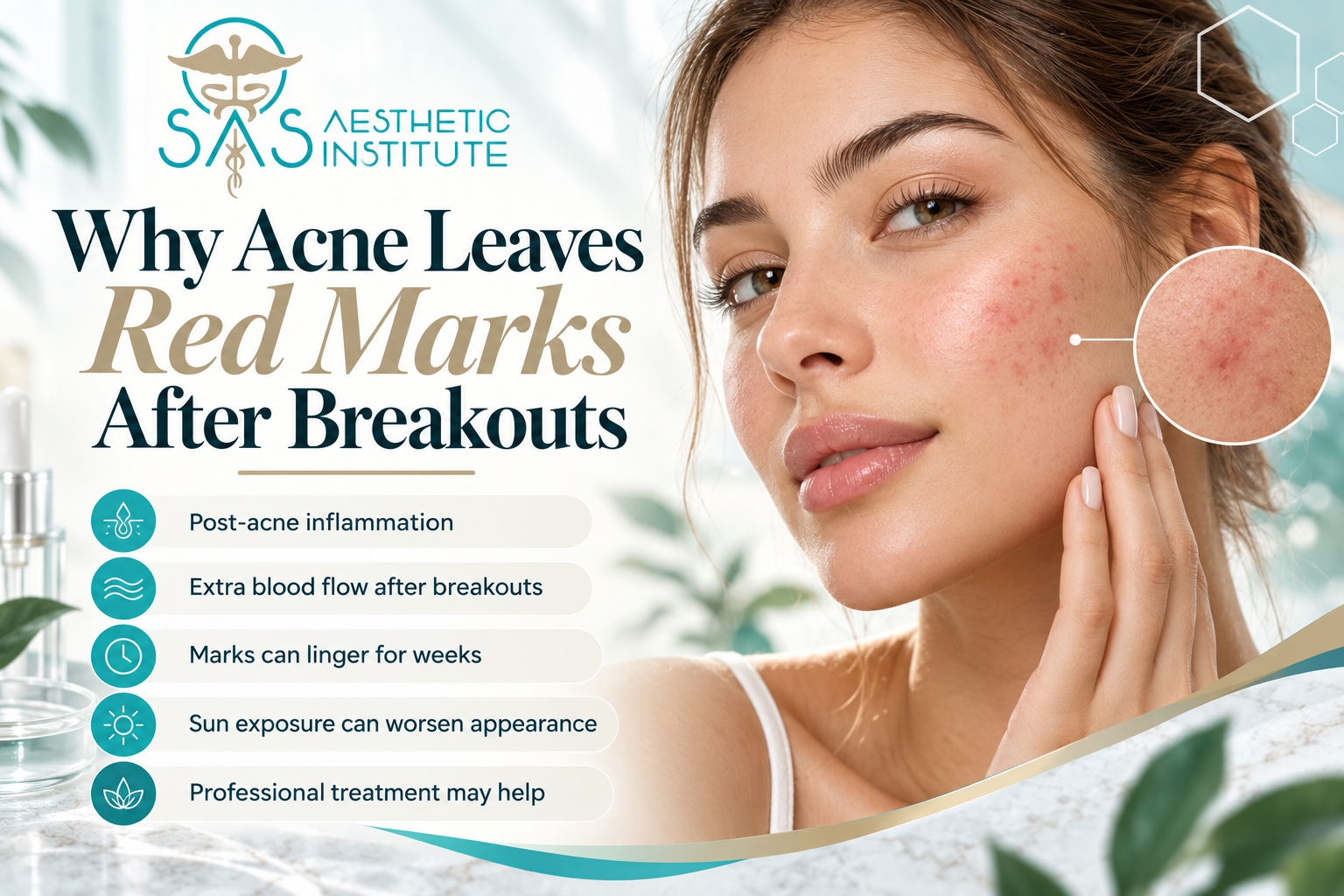
It may be post-acne redness—a flat red or pink mark left behind after inflammation has settled.
This is an important distinction because active acne, post-acne redness, dark marks and true acne scars are different concerns.
At SAS Aesthetic Institute in Mokena, Dr. Michael Romberg, MD, evaluates whether a visible mark represents ongoing acne, persistent redness, pigmentation or structural scarring before deciding what treatment makes sense.
Why Does Acne Leave Red Marks?
Acne can leave red or pink marks because inflammation affects the small blood vessels and surrounding tissue in the skin, and those changes can remain visible after the active lesion heals.
When an acne lesion becomes inflamed, the body increases blood flow to the area as part of the healing response.
That is why an active pimple often looks red.
After the pimple itself resolves, the vascular and inflammatory changes may take longer to settle.
The result can be a flat red or pink area that stays visible even though there is no longer an active bump.
Is a Red Acne Mark the Same as a Scar?
No.
This is one of the most important differences to understand.
A red acne mark primarily changes the color of the skin.
A true acne scar changes the texture or structure of the skin.
If the area is flat but red or pink, it may be post-acne redness.
If the area is indented, pitted, raised or uneven, structural scarring is more likely.
For a deeper comparison, read Acne Scars vs. Post-Acne Marks.
What Does Post-Acne Redness Look Like?
Post-acne redness usually appears as:
- Flat red areas
- Pink marks
- Reddish-purple marks
- Redness in the exact location of a previous pimple
- Groups of marks where repeated acne occurred
The skin may look uneven in color even when the surface feels smooth.
This is one reason someone may think they still have more active acne than they actually do.
Why Do Some Acne Marks Stay Red for So Long?
Healing speed varies from person to person.
Several factors can influence how long redness remains visible.
These may include:
- How inflamed the original breakout was
- How deep the lesion was
- Whether the area was picked or squeezed
- Skin sensitivity
- Repeated breakouts in the same location
- Sun exposure
- Ongoing irritation
- Whether new acne continues forming nearby
A small superficial pimple may leave very little redness.
A deeper inflammatory lesion may leave a mark that remains noticeable for much longer.
Why Does Picking Make Red Marks Worse?
Picking adds additional trauma to already inflamed skin.
Squeezing or scratching a lesion can:
- Increase inflammation
- Damage nearby tissue
- Prolong redness
- Delay healing
- Increase pigmentation
- Increase the risk of scarring
This is especially true when patients repeatedly manipulate the same area.
Sometimes the original acne lesion would have healed relatively quickly, but repeated picking keeps the area inflamed.
Can Red Marks Remain Even After Acne Improves?
Yes.
This is very common.
A patient may have fewer active pimples but still see many red marks across the face.
That can create the impression that treatment is not working.
A closer look may show:
- Only a few active lesions
- Many flat red marks from older acne
- Some brown marks
- A few areas of actual scarring
The treatment plan should distinguish between what is active and what is healing.
Can You Have Active Acne and Red Marks at the Same Time?
Absolutely.
Many patients have several stages of acne visible at once.
For example:
Active acne
New inflamed pimples, blackheads, whiteheads or deeper lesions.
Healing acne
Recently resolved lesions that may still look pink or red.
Post-acne redness
Flat red or pink marks after the lesion has healed.
Acne scars
Indentations or structural changes in the skin.
This overlap is one reason acne can appear more severe than it actually is at a single moment.
What Is the Difference Between Red Marks and Dark Spots?
Red marks and dark spots are not the same thing.
Red or Pink Marks
These are more closely related to vascular and inflammatory changes.
The area may appear:
- Red
- Pink
- Reddish-purple
Brown or Dark Marks
These are more consistent with post-inflammatory pigmentation.
The area may appear:
- Brown
- Gray
- Tan
- Darker than the surrounding skin
One patient can have both.
The distinction matters because the treatment approach may differ depending on whether the concern is vascular redness, pigment or both.
Can Red Acne Marks Turn Into Scars?
A red mark itself is not a scar.
However, the original inflammatory acne that caused the redness may also have damaged the structure of the skin.
That means a single breakout can leave:
- Redness
- Pigmentation
- A structural scar
in the same location.
As the redness fades, an underlying indentation may become easier to see.
This is why some patients say:
“I thought it was just a red mark, but later I noticed a scar underneath.”
Why Do Red Marks Look Worse After Exercise or Heat?
Heat and exercise increase blood flow to the skin.
That can make existing vascular redness appear temporarily more noticeable.
A mark that looks faint while the skin is cool may become much redder after:
- Exercise
- Hot showers
- Warm weather
- Saunas
- Stress
- Rapid temperature changes
That does not necessarily mean the acne itself became worse.
The increased blood flow can simply make existing redness more visible.
Why Do Red Marks Look Worse in Certain Lighting?
Lighting can change how color and texture appear.
Bright overhead light, side lighting or high-contrast bathroom lighting can make redness look more intense.
Phone cameras may also exaggerate red tones depending on:
- White balance
- Exposure
- Flash
- Contrast
- Skin tone
A mark can therefore look much worse in one mirror or photograph than another.
Does Sun Exposure Make Red Acne Marks Worse?
Sun exposure can make post-acne changes more noticeable and can also complicate healing.
Acne-prone skin should still be protected from ultraviolet exposure.
A broad-spectrum sunscreen can be useful, especially when the skin is dealing with:
- Persistent redness
- Dark marks
- Active acne
- Recent procedures
For acne-prone skin, a non-comedogenic formulation is generally a better choice.
Do Red Acne Marks Fade on Their Own?
Some do.
Post-acne redness can gradually become less noticeable as the skin recovers.
The timeline varies.
Some marks fade relatively quickly.
Others can remain visible for months.
The process may take longer when:
- The original acne was deeply inflamed
- New acne keeps forming
- The area is repeatedly irritated
- Picking continues
- The skin is frequently exposed to heat or sun
The important point is that flat redness is not automatically permanent.
Why Do Some People Get More Red Marks Than Others?
Individual healing responses differ.
Some skin is more prone to visible vascular redness after inflammation.
Other patients are more prone to brown pigmentation.
Some experience both.
The way skin reacts after acne can be influenced by:
- Skin tone
- Depth of inflammation
- Severity of acne
- Picking
- Healing response
- Sun exposure
- Skin sensitivity
That is why two people with similar acne may be left with very different marks.
Can Teen Acne Leave Red Marks?
Yes.
Teen acne can leave persistent redness just like adult acne.
Inflamed papules, pustules, nodules and picked lesions can all leave red areas after healing.
This can be especially frustrating for teenagers because the marks may remain visible even after the number of active breakouts decreases.
Read our Teen Acne Guide for more information about adolescent acne patterns.
Can Adult or Hormonal Acne Leave Red Marks?
Yes.
Adult acne and hormonally influenced acne can create persistent redness, particularly when lesions are inflammatory or deep.
A patient with recurring jawline acne may develop:
- New inflamed lesions
- Healing pimples
- Red marks from older breakouts
- Dark spots
- Early scarring
all at the same time.
For more information, read our guide to Hormonal Acne.
Why Do Jawline Breakouts Often Leave Marks?
Jawline acne can be deeper and more inflammatory in some patients.
Deeper inflammation often takes longer to resolve and may leave more noticeable post-acne changes.
Repeated breakouts in the same area can also create layers of visible redness.
One lesion heals.
Another appears nearby.
Then another follows.
The result can make the jawline look continuously inflamed even when only a few active lesions remain.
Can Red Acne Marks Be Prevented?
Not every mark can be prevented.
However, several habits may reduce unnecessary inflammation and skin injury.
These include:
- Avoiding picking and squeezing
- Treating inflammatory acne before it becomes more severe
- Using a consistent skin-care routine
- Avoiding excessive scrubbing
- Using non-comedogenic products
- Protecting the skin from sun exposure
- Addressing recurring acne before repeated inflammation continues
The most important step is controlling the acne that keeps creating new marks.
Why Treating Only the Red Marks Can Be Frustrating
Imagine treating the marks from last month’s acne while new inflammatory breakouts continue forming today.
The skin may never look clear because new redness keeps replacing the old redness.
A complete treatment plan should answer two questions:
What is creating new acne?
and
What has previous acne already left behind?
Both matter.
That is why post-acne redness should not be treated separately from active acne when breakouts are still occurring.
Learn more about ongoing breakout treatment on our Acne Treatment in Mokena page.
Can Skin Care Help Red Acne Marks?
Skin care can support healing, but the goal should be to avoid creating more irritation.
A simple routine may include:
- Gentle cleansing
- Appropriate acne treatment
- Moisturizer when needed
- Broad-spectrum SPF 30+ sunscreen
What should generally be avoided is repeatedly layering harsh products in an attempt to “burn off” the redness.
Excessive irritation can make the skin look even redder.
What Ingredients Should Be Used Carefully When Skin Is Already Red?
Strong or frequently layered active products can irritate already inflamed skin.
This may include combinations of:
- Retinoids
- Exfoliating acids
- Benzoyl peroxide
- Strong scrubs
- Alcohol-heavy toners
- Multiple spot treatments
This does not mean these ingredients are always inappropriate.
It means the routine should make sense for the condition of the skin.
More irritation does not equal faster healing.
Can ADVATx Help Post-Acne Redness?
In selected patients, ADVATx may be considered for persistent acne-related redness.
This is one of the reasons ADVATx is relevant within the acne treatment cluster at SAS Aesthetic Institute.
ADVATx uses 589 nm and 1319 nm wavelengths, allowing treatment to be selected based on what is actually happening in the skin.
For a patient with acne-related concerns, that may include:
- Active inflammatory acne
- Persistent red marks
- Redness around healing lesions
- Uneven skin texture
- Acne scars
- A combination of active and healed acne
The important step is identifying whether the visible redness is truly post-acne redness or something else.
Learn more about the ADVATx technology available at SAS Aesthetic Institute.
How Does ADVATx Fit Into an Acne Treatment Plan?
ADVATx should not be thought of as a stand-alone answer to every red mark.
It is one treatment tool that may be used when the skin concern matches the technology.
For example, a patient may have:
- Active inflammatory acne
- Persistent vascular redness
- Red marks after breakouts
- Early scarring
The treatment plan may need to address several of these concerns.
This is why acne treatment at SAS Aesthetic Institute begins with identifying what is still active and what is left behind from previous inflammation.
Can ADVATx Treat Active Acne and Red Marks Together?
In selected patients, the overall treatment plan may address both active acne and persistent redness.
However, the treatment goal should still be clear.
Active acne and post-acne redness are different concerns.
The technology and treatment settings should reflect what is actually being targeted.
For more information about active acne treatment, read Can Laser Treatment Help Active Acne?.
Is Every Red Mark a Good Candidate for Laser Treatment?
No.
Redness can have several possible causes.
It may represent:
- Active acne inflammation
- Post-acne redness
- Rosacea
- Visible blood vessels
- Skin irritation
- Recent sun exposure
- Another inflammatory skin condition
The diagnosis matters.
Treating every red area with the same technology would ignore the reason the skin is red.
If you are unsure whether redness is from acne or rosacea, read Acne vs. Rosacea: How to Tell the Difference.
How Is Post-Acne Redness Different From Rosacea?
Post-acne redness usually follows the exact location of a previous inflammatory lesion.
Rosacea tends to involve broader facial redness, often across the central face.
Other rosacea clues may include:
- Flushing
- Visible vessels
- Burning or stinging
- Facial sensitivity
- Eye irritation
- Redness triggered by heat
A patient can have both conditions.
That is why persistent redness should be evaluated based on its pattern.
How Is Post-Acne Redness Different From Active Acne?
Active acne usually has a physical lesion.
The area may be:
- Raised
- Tender
- Inflamed
- Pustular
- Clogged
- Deep beneath the skin
Post-acne redness is usually flat.
If the bump has disappeared but the red color remains, the concern may have shifted from active acne to healing redness.
How Is Post-Acne Redness Different From a Scar?
A scar changes texture.
Post-acne redness changes color.
Try looking at the skin from the side.
If the surface appears smooth but red, that suggests a color change.
If the skin is indented or raised, structural scarring is more likely.
Patients dealing with permanent texture changes can learn more about Acne Scar Treatment in Mokena.
When Should Red Acne Marks Be Evaluated?
Consider an evaluation when:
- Redness remains for a long time
- New acne continues creating new marks
- The skin stays persistently inflamed
- You cannot tell whether marks are scars
- Redness is accompanied by flushing
- Visible facial vessels are present
- Acne is becoming deeper or more painful
- Picking has caused visible damage
- Previous treatments have not helped
- You are interested in treatment but do not know whether acne or redness should be addressed first
The first step is identifying what is actually present.
Frequently Asked Questions About Red Marks After Acne
Why does a pimple stay red after it goes away?
Inflammation can leave vascular changes behind after the active lesion heals. The bump may disappear while the redness remains.
Are red acne marks scars?
Not necessarily. If the skin is flat and only the color has changed, the concern may be post-acne redness rather than structural scarring.
How long do red acne marks last?
The timeline varies. Some fade relatively quickly, while others can remain visible for months.
Why do my red acne marks look worse after a shower?
Hot water can increase blood flow to the skin, temporarily making vascular redness more noticeable.
Why do acne marks get red after exercise?
Exercise increases circulation and skin temperature, which can make existing red marks appear brighter temporarily.
Can picking cause red marks?
Yes. Picking increases inflammation and can prolong redness.
Why do my acne marks stay red even though I have fewer pimples?
Post-acne redness can remain after the active acne has improved, so the skin may still look inflamed even when fewer new lesions are forming.
Can red acne marks become permanent?
Many red marks improve over time, but the timeline varies. Persistent redness may also benefit from treatment in selected patients.
Can ADVATx help red acne marks?
ADVATx may be considered for selected patients with persistent acne-related redness, depending on what is causing the visible redness.
Can ADVATx also help active acne?
In selected patients, ADVATx may be incorporated into a broader acne treatment plan for active inflammatory acne and related redness.
Are dark acne marks the same as red marks?
No. Red marks are more vascular and inflammatory, while brown or dark marks involve pigment.
Can I have red marks and acne scars in the same place?
Yes. A breakout can leave both redness and structural scarring.
Should I treat the redness or the acne first?
If active acne continues creating new inflammation, controlling new breakouts is important. The overall plan may also address persistent redness when appropriate.
Does sunscreen help with red acne marks?
Sun protection helps protect healing skin and may prevent post-acne changes from becoming more noticeable.
The Pimple May Be Gone, but the Skin Is Still Healing
One of the biggest misconceptions about acne is that the problem ends when the bump disappears.
The skin may still be recovering.
A healed breakout can leave:
- Redness
- Pigmentation
- Sensitivity
- Texture changes
- Scarring
The important step is understanding which of those concerns is actually present.
At SAS Aesthetic Institute, Dr. Michael Romberg, MD, evaluates both active acne and the changes acne leaves behind.
If new breakouts are still forming, learn more about Acne Treatment in Mokena and read our Complete Guide to Acne.
For selected patients with persistent acne-related redness, active inflammatory acne or other appropriate concerns, ADVATx may be incorporated into an individualized treatment plan.
SAS Aesthetic Institute
19657 South La Grange Road, Mokena, IL 60448
(708) 476-8205

Michael S. Romberg, MD
Dr. Michael S. Romberg is a Board Certified General Surgeon with more than 32 years of experience. His medical expertise includes general and oncologic surgery, wound care, burn care, lymphedema care, and Hyperbaric Oxygen Therapy. He is also an experienced national and international speaker for healthcare professionals and patients.