Sometimes a pimple heals, but the skin does not return to its original color right away.
Instead, a brown, gray or darker spot remains exactly where the breakout used to be.
Patients often call these areas acne scars.
But many of them are not scars at all.
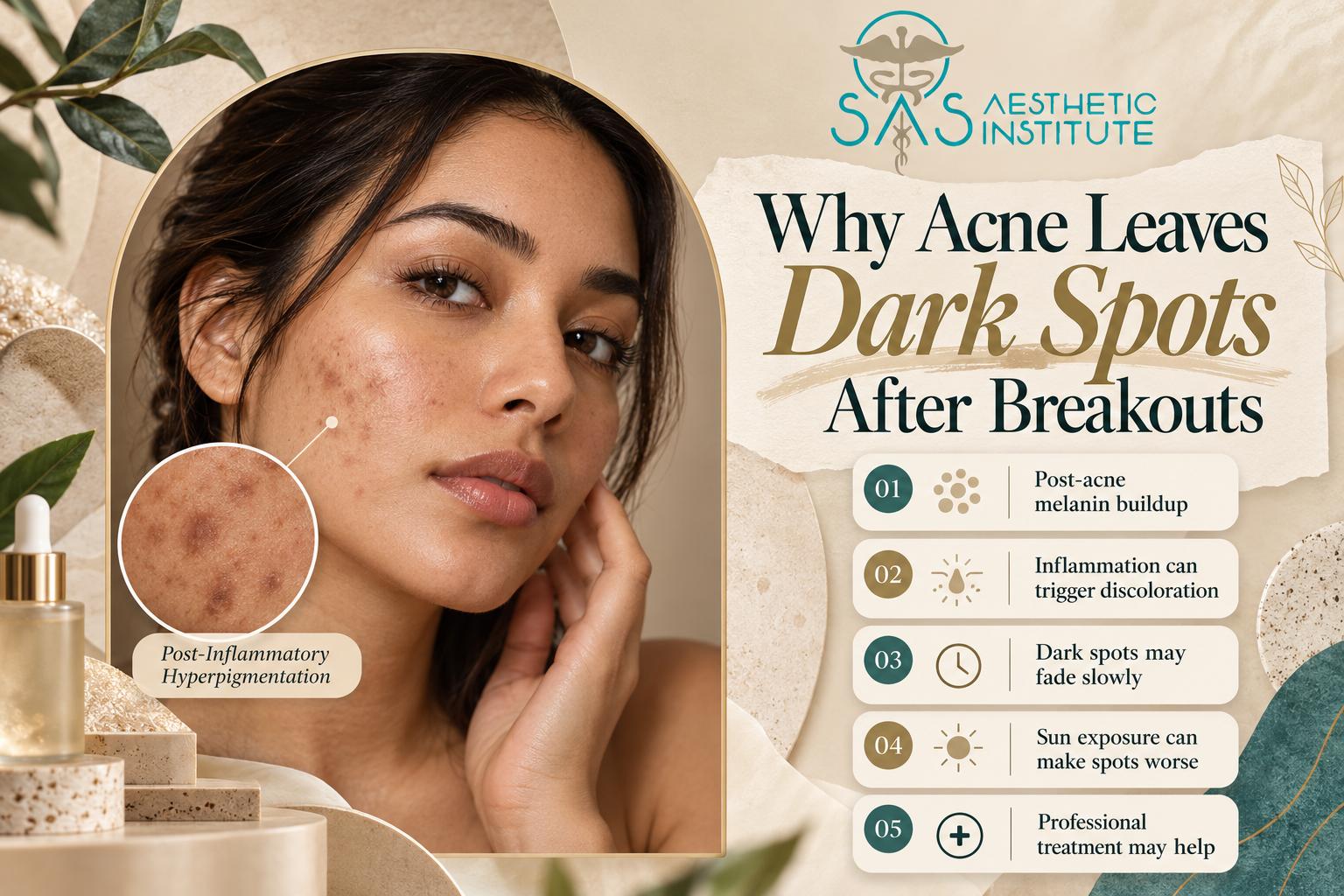
They may represent post-inflammatory hyperpigmentation, which is a change in skin color left behind after inflammation.
That distinction matters because a dark mark and a true acne scar are different problems.
One changes pigment.
The other changes the structure or texture of the skin.
At SAS Aesthetic Institute in Mokena, Dr. Michael Romberg, MD, evaluates whether a post-acne concern is active acne, redness, pigmentation, structural scarring—or a combination of several changes.
Why Does Acne Leave Dark Spots?
Acne can leave dark spots because inflammation can stimulate the skin to produce extra pigment during the healing process.
When a pimple becomes inflamed, the surrounding skin reacts.
As the area heals, pigment-producing cells may create more melanin in that location.
The result can be a flat area that looks:
- Brown
- Tan
- Gray
- Purple-brown
- Darker than the surrounding skin
The active pimple may be gone, but the color change remains.
What Is Post-Inflammatory Hyperpigmentation?
Post-inflammatory hyperpigmentation, often shortened to PIH, is a darkening of the skin that develops after inflammation or injury.
Acne is a very common cause.
The skin may look completely flat and smooth, but the color is different.
That means PIH is not the same thing as a structural acne scar.
The discoloration may gradually fade, although the timeline can vary significantly from one patient to another.
Is a Dark Acne Spot the Same as an Acne Scar?
No.
A dark spot primarily changes the color of the skin.
A scar changes the texture or structure of the skin.
A simple way to think about it is:
| Concern | Main Change | Usually Flat? |
|---|---|---|
| Dark post-acne mark | Pigment | Yes |
| Red post-acne mark | Redness | Yes |
| Depressed acne scar | Texture | No |
| Raised acne scar | Texture | No |
If you run your finger over a dark area and the surface feels smooth, you may be dealing primarily with pigmentation rather than a true scar.
For a deeper comparison, read Acne Scars vs. Post-Acne Marks.
Why Are Some Acne Marks Brown While Others Are Red?
Redness and pigmentation involve different processes.
A red or pink mark is more closely related to persistent vascular and inflammatory changes.
A brown or darker mark is more related to increased pigment production after inflammation.
One patient may develop mostly red marks.
Another may develop mostly brown spots.
Some patients develop both.
That difference can change the treatment approach.
Who Is More Likely to Develop Dark Spots After Acne?
Post-inflammatory pigmentation can occur in many skin tones, but it can be more noticeable and persistent in skin that produces pigment more readily.
Other factors can also increase the likelihood of a dark mark developing, including:
- Deeper inflammation
- Larger breakouts
- Picking
- Squeezing
- Repeated inflammation
- Sun exposure
- Irritation from aggressive products
- Acne that keeps recurring in the same area
The more inflammation and trauma the skin experiences, the more opportunity there is for pigment to remain afterward.
Why Does Picking Acne Make Dark Spots Worse?
Picking increases inflammation.
It can also damage the surrounding skin.
That additional trauma can trigger more pigment production during healing.
A small pimple that might have healed with minimal discoloration can become a much darker, longer-lasting mark after repeated squeezing.
Picking can also increase the risk of:
- Prolonged redness
- Hyperpigmentation
- Skin injury
- Infection
- Permanent scarring
This is one of the reasons avoiding manipulation is so important when trying to reduce post-acne marks.
Can One Pimple Leave Both a Dark Spot and a Scar?
Yes.
The same inflammatory lesion can create more than one lasting change.
For example, a deep breakout may leave:
- Brown pigmentation
- Persistent redness
- An indentation
- Uneven texture
all in the same location.
As the color improves, the underlying texture may become easier to see.
This is why a mark that initially looks like “just discoloration” may later reveal that structural scarring is also present.
Do Dark Acne Spots Fade on Their Own?
Some do.
Post-inflammatory pigmentation can gradually lighten as the skin recovers.
The timeline varies.
Some marks improve relatively quickly.
Others can remain noticeable for months.
Several factors can affect how long they last, including:
- Depth of the original inflammation
- Skin tone
- Sun exposure
- Picking
- Repeated breakouts
- New irritation
- Whether acne is still active
The more new acne continues forming, the harder it can be to appreciate progress because fresh marks keep replacing older ones.
Why Do Dark Acne Spots Sometimes Last for Months?
Pigment does not disappear immediately when inflammation ends.
Once additional melanin has been deposited in the skin, the body needs time to gradually process and clear that pigment.
Deeper inflammation can also lead to pigment sitting deeper in the skin, which may take longer to improve.
This is why patients may notice:
The pimple lasted one week.
The mark lasted three months.
The visible aftermath can last much longer than the active breakout.
Does Sun Exposure Make Dark Acne Spots Worse?
It can.
Ultraviolet exposure can stimulate pigment production and make post-acne discoloration appear darker or more persistent.
That means sun protection is an important part of managing post-acne pigmentation.
For acne-prone skin, look for sunscreen that is:
- Broad-spectrum
- SPF 30 or higher
- Non-comedogenic
- Comfortable enough to use consistently
A sunscreen that is too heavy or uncomfortable may not be used regularly, which defeats the purpose.
Can Dark Acne Spots Get Darker After They Have Already Formed?
Yes.
Existing pigmentation can become more noticeable after:
- Sun exposure
- Continued inflammation
- Picking
- Irritation
- Repeated breakouts in the same location
This is why protecting the skin while it heals matters.
The goal is not only to fade existing pigment.
It is also to avoid creating additional inflammation that keeps darkening the same areas.
Why Do I Have More Dark Spots Than Active Pimples?
This is very common.
A person may only have a few active breakouts but dozens of old marks.
That can make the skin look like the acne is much more severe than it actually is.
Look closely.
Are the areas:
- Raised?
- Tender?
- Inflamed?
- Flat?
- Brown?
- Gray?
If most of them are flat, the main visible concern may now be pigmentation rather than active acne.
The treatment plan should recognize that difference.
Can You Have Active Acne and Dark Spots at the Same Time?
Yes.
A patient may have:
Active acne
New inflammatory or clogged lesions.
Healing acne
Recently resolved lesions.
Dark post-acne spots
Flat areas of pigmentation.
Red marks
Persistent vascular redness.
Acne scars
Permanent texture changes.
Several stages can be visible at once.
This is why a single acne treatment does not always address every concern the patient sees.
Why Is It Important to Control Active Acne First?
Because every new inflammatory breakout can create another dark mark.
Treating pigmentation while new acne continues forming can become a frustrating cycle.
One spot begins fading.
A new breakout appears.
That breakout leaves another dark mark.
Then another lesion follows.
The goal should be to reduce the process creating new marks while also addressing what previous acne has left behind.
Learn more about controlling active breakouts on our Acne Treatment in Mokena page.
Can Hormonal Acne Leave Dark Spots?
Yes.
Hormonally influenced acne can leave pigmentation just like any other inflammatory acne.
This is particularly relevant when breakouts are:
- Deep
- Recurrent
- Painful
- Concentrated along the jawline
- Frequently picked
Repeated acne in the same area can create overlapping dark marks.
For more information about recurring hormonal patterns, read our guide to Hormonal Acne.
Can Teen Acne Leave Dark Spots?
Yes.
Teenagers can develop significant post-inflammatory pigmentation, particularly after deeper or picked acne.
This can be frustrating because even when the acne starts improving, the marks can remain visible.
The teenager may feel as though nothing has changed.
But there may actually be far fewer active breakouts.
Read our Teen Acne Guide for more information.
Does Back Acne Leave Dark Spots Too?
Yes.
Post-inflammatory pigmentation can occur anywhere acne develops.
That includes:
- Face
- Neck
- Chest
- Shoulders
- Back
Body acne can leave widespread discoloration, especially when lesions repeatedly develop in the same areas.
Friction from clothing, sports equipment or backpacks may also contribute to ongoing irritation.
Can Dark Marks Develop Without Severe Acne?
Yes.
Even relatively small inflammatory breakouts can leave pigment in patients whose skin is prone to post-inflammatory color changes.
Severity does not always predict how noticeable the mark will be.
One patient may have a relatively small pimple that leaves a dark area for months.
Another may heal from a more significant breakout with very little discoloration.
Individual skin response matters.
Why Do Dark Spots Look Different on Different Skin Tones?
The skin’s pigment response varies from person to person.
Post-inflammatory hyperpigmentation may appear:
- Light brown
- Deep brown
- Gray-brown
- Purple-brown
- Nearly black in some areas
The contrast between the mark and surrounding skin can also change how noticeable it appears.
This is why treatment planning should consider the patient’s natural skin tone and pigment response.
Can Scrubbing Remove Dark Acne Spots?
No.
Dark marks are not dirt sitting on the surface.
Scrubbing harder will not remove pigment deposited in the skin.
In fact, aggressive scrubbing can create more irritation and potentially make pigmentation worse.
That includes:
- Rough exfoliating brushes
- Abrasive scrubs
- Frequent peels
- Overuse of acids
- Repeated rubbing
Gentle skin care is usually a better foundation.
Can Exfoliation Help Dark Acne Marks?
Exfoliating ingredients may play a role in some skin-care plans, but more is not always better.
Too much exfoliation can:
- Irritate the skin
- Increase redness
- Damage the skin barrier
- Trigger more inflammation
- Potentially worsen pigmentation
The goal should be controlled improvement, not repeatedly irritating the skin until it peels.
Can Skin Care Help Post-Acne Dark Spots?
Yes, depending on the type and depth of pigmentation.
A skin-care plan may focus on:
- Preventing new acne
- Supporting healthy skin turnover
- Reducing additional inflammation
- Protecting against ultraviolet exposure
- Gradually improving uneven tone
The exact products depend on the patient’s skin and other treatments being used.
The most important rule is not to create new inflammation while trying to remove old pigment.
Which Skin-Care Mistakes Can Make Dark Marks Worse?
Common mistakes include:
- Picking acne
- Using too many active ingredients
- Scrubbing aggressively
- Skipping sunscreen
- Frequently changing products
- Using irritating spot treatments
- Treating every mark like an active pimple
- Ignoring ongoing acne
A dark spot should not automatically be treated the same way as a current breakout.
Are Dark Acne Spots More Noticeable in Summer?
They can be.
More ultraviolet exposure can make existing pigmentation appear darker.
Increased sun exposure may also make the contrast between normal skin and pigmented areas more noticeable.
This makes consistent sun protection particularly important during months when outdoor exposure increases.
Can Makeup Cover Dark Acne Spots Safely?
Yes, in many patients.
Makeup can be used to camouflage pigmentation while the skin is healing.
For acne-prone skin, it is generally useful to choose products labeled:
- Non-comedogenic
- Oil-free
- Won’t clog pores
Makeup should also be removed before sleeping.
Covering a dark spot is not harmful by itself.
The concern is whether the product contributes to new clogged pores or irritation.
When Is a Dark Spot Actually a Scar?
Color alone does not make something a scar.
Look at the surface of the skin.
If the area is:
- Flat and brown → pigmentation is more likely
- Flat and red → vascular redness is more likely
- Indented → structural scarring is more likely
- Raised → a raised scar may be present
Some lesions have both pigment and texture.
For a more detailed explanation, read Acne Scars vs. Post-Acne Marks.
Can ADVATx Help With Dark Acne Spots?
ADVATx may be incorporated into an acne treatment plan when multiple acne-related concerns are present, but dark pigmentation should first be distinguished from redness, active acne and structural scarring.
At SAS Aesthetic Institute, ADVATx is particularly relevant when the treatment plan also involves concerns such as:
- Active inflammatory acne
- Persistent redness
- Post-acne vascular changes
- Acne-related texture
- Acne scars
The visible dark color itself needs to be evaluated based on its pigment characteristics and depth.
The important point is that not every mark should automatically receive the same treatment.
How Does ADVATx Support the Overall Acne Treatment Plan?
ADVATx is a dual-wavelength laser platform using 589 nm and 1319 nm wavelengths.
The two wavelengths can be used differently depending on what needs to be addressed.
A patient with post-acne dark spots may also have:
- Active inflammatory acne
- Persistent red marks
- Uneven texture
- Early scars
- Ongoing breakouts
ADVATx can be incorporated when appropriate for those acne-related concerns while the overall treatment plan addresses pigment and recurrence as well.
Learn more about the ADVATx technology used at SAS Aesthetic Institute.
Can ADVATx Help If I Still Have Active Acne?
In selected patients, yes.
If inflammatory acne is still active, treating the ongoing breakout pattern is important because each new lesion can create another mark.
ADVATx may be incorporated into a broader plan for appropriate inflammatory acne and redness-related concerns.
For a deeper explanation, read Can Laser Treatment Help Active Acne?.
Are Red Marks Better Candidates for ADVATx Than Dark Marks?
They are different concerns.
Persistent redness often has a stronger vascular component, which can make laser treatment particularly relevant depending on the patient.
Dark marks are more pigment-based.
That is why identifying whether a mark is red, brown, or both matters before treatment begins.
Read our guide to Why Acne Leaves Red Marks After Breakouts for more information about persistent redness.
Can Dark Acne Spots Be Treated at the Same Time as Acne Scars?
Sometimes several concerns can be addressed during the same overall treatment period.
However, pigment and structural scars remain different problems.
A patient may need a plan that separately considers:
- Active acne
- Redness
- Pigmentation
- Depressed scars
- Raised scars
The order and combination depend on which concerns are most significant and whether acne is still active.
Patients with permanent texture changes can learn more about Acne Scar Treatment in Mokena.
Why Do New Dark Marks Keep Appearing?
Usually because new inflammatory acne continues forming.
This is one of the most important concepts in post-acne pigmentation.
If the acne itself is not controlled, new dark marks can continue appearing faster than older ones fade.
That is why treating post-acne pigmentation without addressing recurrent acne can feel like constantly starting over.
Our guide Why Does Acne Keep Coming Back? explains recurring acne patterns in more detail.
When Should Dark Acne Spots Be Evaluated?
Consider having the skin evaluated when:
- Marks remain for months
- New acne keeps creating new spots
- You cannot tell whether the concern is pigmentation or scarring
- The color is becoming darker
- Several different types of post-acne marks are present
- Acne is still deep or painful
- You are developing texture changes
- Previous products have caused irritation
- Picking has created visible damage
- You are unsure which concern should be treated first
A good treatment plan starts by identifying exactly what is present.
Frequently Asked Questions About Dark Spots After Acne
Why does acne leave brown spots?
Inflammation can stimulate excess pigment production during healing, leaving a flat brown or darker mark after the pimple resolves.
Are dark acne spots permanent?
Not always. Many gradually fade, although the timeline can vary significantly.
Are dark spots acne scars?
Not necessarily. A flat dark area is usually a pigment concern rather than structural scarring.
Why do dark acne marks last longer than the pimples?
Inflammation may resolve quickly, while deposited pigment takes longer for the skin to gradually clear.
Can picking make dark spots worse?
Yes. Picking increases inflammation and skin injury, which can lead to more noticeable pigmentation.
Does sunlight make acne spots darker?
It can. Ultraviolet exposure can increase pigment production and make existing marks more noticeable.
Can dark spots and red marks happen together?
Yes. A single acne lesion can leave both vascular redness and pigmentation.
Why do I still look like I have acne when the pimples are gone?
You may be seeing post-acne marks rather than active lesions. Flat brown or red areas can remain long after the bump has healed.
Can hormonal acne leave dark spots?
Yes. Any inflammatory acne can leave pigmentation, including recurrent hormonal-pattern breakouts.
Can teen acne leave dark spots?
Yes. Teen acne can leave significant discoloration, especially when breakouts are inflammatory or picked.
Can ADVATx help dark acne spots?
The treatment approach depends on whether the concern is pigment, redness, active acne or scarring. ADVATx may be incorporated when appropriate for accompanying acne-related inflammation, redness or texture concerns.
Can ADVATx help prevent new marks?
ADVATx may be used as part of an acne treatment plan for selected inflammatory acne concerns. Reducing ongoing inflammation can help reduce the number of new breakouts that have the opportunity to leave marks.
Do I need to treat active acne before dark spots?
If new acne continues forming, controlling the breakouts is an important part of the plan because every new inflammatory lesion can create another mark.
Is a dark mark easier to treat than an acne scar?
They are different concerns. A flat pigment mark does not involve the same structural damage as an indented scar.
The Dark Spot Is Often the Aftermath, Not the Active Acne
Post-acne pigmentation can make acne feel as though it never truly goes away.
The active breakout may last days.
The mark it leaves may remain for months.
That is why acne treatment should look beyond the individual pimple.
The goal is to understand:
What is active now?
What is healing?
What has previous inflammation left behind?
What is creating new breakouts?
At SAS Aesthetic Institute, Dr. Michael Romberg, MD, evaluates active acne, persistent redness, pigmentation and acne scarring as separate but related concerns.
If breakouts are still occurring, learn more about Acne Treatment in Mokena and read our Complete Guide to Acne.
For selected patients with active inflammatory acne, persistent redness or other appropriate acne-related concerns, ADVATx may be incorporated into an individualized treatment plan.
SAS Aesthetic Institute
19657 South La Grange Road, Mokena, IL 60448
(708) 476-8205

Michael S. Romberg, MD
Dr. Michael S. Romberg is a Board Certified General Surgeon with more than 32 years of experience. His medical expertise includes general and oncologic surgery, wound care, burn care, lymphedema care, and Hyperbaric Oxygen Therapy. He is also an experienced national and international speaker for healthcare professionals and patients.